

5 Genesis Songs That Prove 1973 Was The Best Year Of Their Career
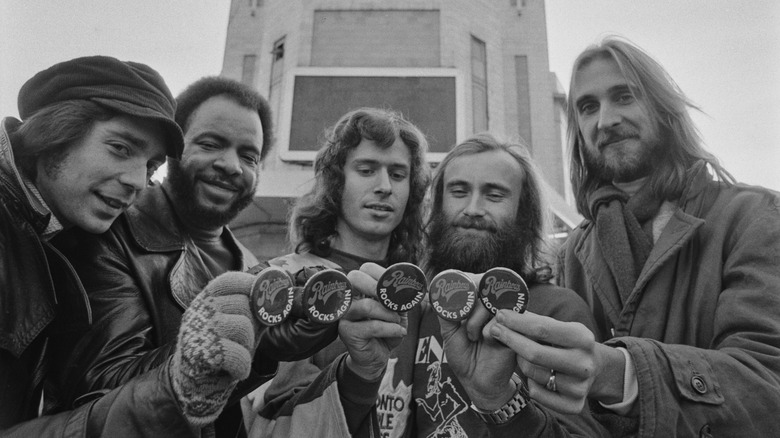
Genesis is basically two wildly different bands in one: The artsy Peter Gabriel-led version (1967 to 1975) and the pop-rock Phil Collins-led version that began in 1976 and ran until he eventually quit in 1996. And while both versions of the group have their merits, the fanciful beauty, complexity, and craftsmanship of older Genesis trump the head-bopping hooks of later Genesis every time — except maybe at parties or bars. But out of Genesis' entire discography, it's "Selling England by the Pound" and five of its songs that prove 1973 was the band's best year.
In general, Genesis' top tracks are spread out over their albums. There's 1971's "Nursery Cryme" and its superlative "The Musical Box" (a song from that year that's so underrated), while 1972's "Foxtrot" has "Supper's Ready," a 23-minute-long musical suite that rivals other contemporary, ultra-prog outings like Yes' "Close to the Edge." But "Selling England by the Pound" is the band's most consistent work, maintaining quality across the entire album while striking a balance between their more languorous older material and later, head-bopping tracks like "Invisible Touch." And since the album has eight tracks, we're going to drop the worst three and keep the rest.
At this point, savvy Genesis fans might be able to predict our choices, because they've been debating this point for years: "Firth of Fifth," "The Battle of Epping Forest," "The Cinema Show," "I Know What I Like (In Your Wardrobe)," and "Dancing with the Moonlit Knight." Together, these five songs act like neo-folk tales scouring the weird and mystical depths of the English countryside.
Dancing with the Moonlit Knight
Starting very much like a folk standard waiting for a fife and drum corps, "Dancing with the Moonlit Knight" kicks off "Selling England by the Pound" and sets the stage for the album's whimsical English woodland-and-country motifs. Like the rest of the record's best songs, "Dancing with the Moonlit Knight" is written in movements like a classical composition. There's galloping drums and riffy guitar sections, swooshing synths, dreamy interludes, and immense theatricality that builds and builds into an intertwined, masterfully composed piece of art.
"Dancing with the Moonlit Knight" also sets the stage for listener expectations throughout "Selling England by the Pound" by teaching them how to take in the album. If you're impatient and expect a big, key-jangling, Kiss-like chorus to capture your waning attention within the song's first five seconds, you're out of luck ("That's All" from Genesis' 1983 self-titled album might suffice). But if you really must: "Dancing with the Moonlit Knight" does have this little, catchy guitar loop in the beginning that sounds uncannily suited to a hip-hop sample. And wouldn't you know it? Outkast sampled it on 1998's "SpottieOttieDopaliscious" (amongst other artists).
As Peter Gabriel said before performing "Dancing with the Moonlit Knight" at a concert in Shepparton Studios after the release of "Selling England by the Pound": "I am in the English Channel. It is cold, exceedingly wet. I am the voice of Britain, before the Daily Express. My name is Britannia. This is my song." That little introduction, much like the song's musical merits, encapsulates the kind of artistic sincerity and thoughtfulness that makes 1973 Genesis' best year.
I Know What I Like (In Your Wardrobe)
"I Know What I Like (In Your Wardrobe)" is easily the most accessible and radio-friendly of our 1973 Genesis songs and proves that the band was capable of making Phil Collins-era grooves and hooks even in its earlier days. When it ends at a mere four minutes and 10 seconds — when other songs from "Selling England by the Pound" are just getting started — you'll be wondering, "What? That's it?" even as you start it over. "I Know What I Like (In Your Wardrobe)" has got a funky, cool, proto-disco bassline (don't say that too loudly), but it still retains enough outré elements like flute lines, ringing sitars, clanging percussion, and an overall psychedelic soundscape to make it clear you're listening to early '70s Genesis. Also, and shockingly, it was actually released as a single and reached No. 21 on the U.K. Singles Chart — a feat far weirder than the song itself.
Peter Gabriel wrote the lyrics to "I Know What I Like (In Your Wardrobe)" as an assemblage of little stories about common English folk like Mr. Farmer, Mister Lewis, Ethel, Jacob, and Miss Mort. The lyrics contain quotes, like Gabriel is switching characters in a fireside folk tale, relating a story that can be summarized by the lyrics: "Listen, son, you're wasting time / There's a future for you in the fire escape trade / Come up to town." Hence the name of the song, which isn't about literal clothes but about something we can all understand: The desire for another life. Yet that life might not be what you really want. Such a pitch-perfect blend of nuance, subtext, and comprehensibility in subject matter and music might be Genesis at its finest.
Firth of Fifth
"Firth of Fifth" is a true musical odyssey. It has the explosive crescendos of Pink Floyd's "Shine On You Crazy Diamonds," the drama and bravado of Queen, the singing, emotional guitar bends of a song like "Starless" from King Crimson, and massive guitar chords and delicate piano work topped off with some flutes and synths. Now, bundle it into something that sounds like a traveling cosmic carnival, and you'll start to see why "Firth of Fifth" is such an amazing track. Like most of the songs in this list, you won't be able to grok them until they're over, or at least approaching the end. And then, like the way the books or movies can't be understood until the final words or frames, you'll get it.
Lyrically, "Firth of Fifth" touches on the same themes that wind throughout "Selling England by the Pound": journeys, paths, gods, nature, magic, more gods, more nature, and more magic (with a definitive Greek myth color). Beyond that, the music does the talking. It takes listeners on the same journey that the song describes, much like how Genesis keyboardist Tony Banks describes writing the song's flute solo, which would eventually become the song's guitar solo (played by Steve Hackett). The music guided its own writing, so long as the band was present and everyone was involved in the process.
That guitar solo might not be as universally known as, let's say, Jimmy Page's guitar solo from "Stairway to Heaven." But it is a masterwork, nonetheless, and possibly the best from Genesis and Hackett. It landed on Rolling Stone's list of top 100 guitar solos of all time, too. Sometimes it's nice to get recognition from the normies.
The Battle of Epping Forest
"The Battle of Epping Forest" is a bananas collage of musical ideas and narrative vignettes, odd chord changes, keyboard-centered progressions, affected accents from Peter Gabriel, dirty jokes, and loads of wordplay. The song sounds through-composed (sequential and non-repeating), but it actually does loop around to its chorus, though both choruses have different lyrics. In other words, it's as ambitious as it is awesome. Another band might break under the weight of such a composition, but Genesis makes it look easy even as the tune helped make 1973 the group's best year.
"The Battle of Epping Forest" gets a lot of attention for its lyrics, and rightfully so. It's absolutely stuffed to the gills with bizarre little characters like Harold Demure, the Barking Slugs, Mick the Prick, Bob the Nob, and Liquid Len. The first chorus goes, "Amidst the battle roar / Accountants keep the score 10-4 / They've never been alone / After getting a radiophone / The bluebells are ringing for Sweetmeal Sam / Real ham, handing out bread and jam / Just like any picnic, picnic / Picnic, picnic." Uh ... what? It's all utterly ambiguous while being vaguely anti-war and flows like a dream state where nothing makes sense unless you relent to the flow.
Lots of analyses exist for "The Battle of Epping Forest." But as The Genesis Archive writes, Gabriel drafted the song as an exaggerated, absurdist version of an actual news story about a gang fight in Epping Forest outside of London. Gabriel knew he went over the top, saying, "I was quite reluctant to edit as severely as I should have done. It did end up too wordy." Indeed, sir, but that's why we love it.
The Cinema Show
"The Cinema Show" rounds out our choices much like it rounds out 1973's "Selling England by the Pound" (aside from the album's brief addendum and closer, "Aisle of Plenty"). This is a song to truly get lost in, from the opening, chime-like mesh of dual, 12-string acoustic guitars to the final fade-out. It's kind of a scaled-back version of the same lyrical themes from 1972's epic "Supper's Ready": the cycle of sexual attraction, love, perspective taking, possessiveness, destruction, etc.
"The Cinema Show's" lyrics stop at about three minutes in, after which an extended musical interlude evolves through a webwork of guitar plucks and melodic flute lines. This whole section is exquisitely beautiful, like crystal, contains no lyrics beyond "Na, na, na, na-na, na," and eventually reconnects to the chorus over 90 seconds later. Then, about a minute after that, the lyrics drop out entirely, and the final five minutes of the song are just instrumentation. That instrumentation segues into an uptempo, rhythmically different section, and though it veers toward minor modes and dissonance, it ultimately emerges victorious — perhaps like the tale of male/female harmony described in the song. Also, the blind prophet from Homer's "The Odyssey," Tiresias, makes an appearance. You know, in case things weren't grand enough already.
All this is to say: The attention to detail and musical wherewithal is off the charts here, much like our other selections for this article. "The Cinema Show" adds more than enough weight, virtuosity, and grandeur to the case for 1973 being Genesis' best year.