

5 Peter Gabriel Songs That Prove 1986 Was The Best Year Of His Career
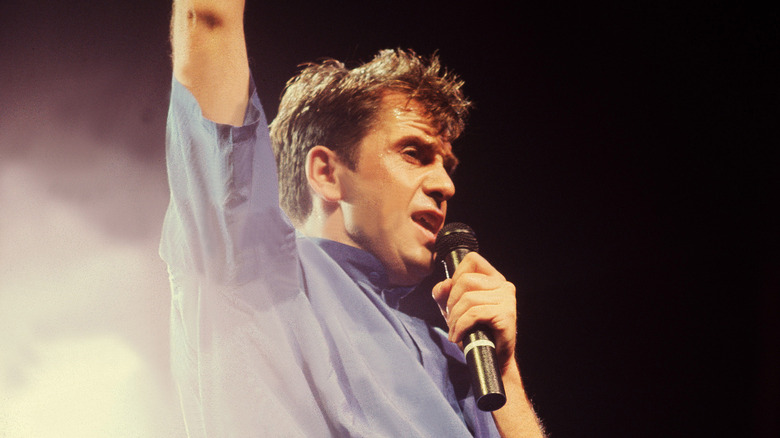
By 1986, Peter Gabriel was looking to do something new and a bit less experimental than his earlier work. The early 1980s were a hard time for the ex-Genesis lead singer. His third and fourth albums, "Peter Gabriel III," often called "Melt," from 1980, and "Peter Gabriel IV," also known as "Security," two years later, were brilliant but far from mainstream. With his next album, "So," Gabriel managed to stay true to his art-rock roots while crafting songs that were also radio friendly.
"It was a very conscious decision on his part to come up with material that would make a very good and accessible record," Gabriel's longtime guitarist David Rhodes recalled (via Guitar World). "So there was a lot that went into it, which paid off, thank goodness." The payoff was an album full of incredible songs, from massive hits such as "Sledgehammer" to critically acclaimed tunes like "Red Rain," that demonstrated the scope of Gabriel's skills and prove 1986 was the best year of his career.
Don't Give Up
The Depression-era work of American photographer Dorothea Lange and the 1980s recession in the U.K. inspired Peter Gabriel's song "Don't Give Up," about a man struggling during hard economic times. The narrator, at the end of his rope, is forced to move from place to place in hopes of finding work that never materializes. The counterbalance to Gabriel's narration of struggle and desperation is the soothing voice, one can surmise of a wife, who tells him, "Don't give up" during the chorus, hauntingly sung by Kate Bush.
The interplay between their two voices and narratives make this one of Gabriel's most powerful ballads, and it gets us choked up with every single listen. While the song is centered around economic struggle, it goes beyond this with hallucinatory imagery ("As daylight broke, I saw the earth / The trees had burned down to the ground") that lends "Don't Give Up" a mysterious edge. It also opens up the song to wider interpretation. "Don't Give Up" has been covered by numerous artists over the years, with an especially brilliant rendition by Willie Nelson and Sinéad O'Connor from Nelson's 1993 album "Across the Borderline." It proves just how universal this song truly is.
Mercy Street
With the album "So," Peter Gabriel majestically blended world music, R&B, and art pop into a unique sound, as can be seen with "Mercy Street." Its sinuous guitar, Brazilian rhythms by percussionist Djalma Corrêa, atmospheric synthesizers, and Gabriel's doubled voice make for a song that shimmers and floats, underpinned by a sense of darkness. The music perfectly matches the song's subject.
Lyrically, "Mercy Street" is about the famed American poet Anne Sexton (1928-1974), known for her confessional poems. The song is centered around her poem "45 Mercy Street," which explores dream, memory, complex family dynamics, and womanhood. Gabriel uses this as a jumping-off point to delve into the poet's work and history, which included time spent in psychiatric hospitals, with an equally poetic approach. It's a song that has connections to his earlier work with its dark feel, but the lyrics are less cryptic. It's another track from 1986 that proves he was at the top of his game. "Mercy Street" has also seen multiple covers in assorted genres, which indicates just how much it has resonated with other artists.
In Your Eyes
"In Your Eyes" has become one of the most beloved songs from Peter Gabriel's extensive discography. The song, which may have been written for Rosanna Arquette, whom Gabriel dated for a few years, is both musically and culturally impactful. This was another track from "So" that seamlessly incorporated world music into its DNA while fully remaining a Gabriel song. It helped introduce the Senegalese artist Youssou N'Dour, who sang backup and toured with Gabriel, to an international audience.
It would be impossible to write about this song without mentioning its pop-culture importance due to the 1989 romantic comedy "Say Anything," with its iconic scene in which John Cusack stands outside the window of his love interest holding a boombox above his head blasting "In Your Eyes." It's a scene that likely launched a million (perhaps misguided) romantics to try something similar. And while "In Your Eyes" has all the earmarks of a classic love song, it wouldn't be a Gabriel tune without a deeper meaning. When writing the song, he employed an African tradition of writing about love in a way that blurs the line between the spiritual and the romantic, giving it a depth that most love songs lack.
Red Rain
"Red Rain" opens "So" and starts with the complex hi-hat work of drummer Stewart Copeland of Police fame. If anything signaled a change in direction for Peter Gabriel on this album, it might be this moment. He'd previously avoided the use of cymbals in his earlier music. (Listen to "Peter Gabriel III" and "IV," and you'll notice their absence.) Copeland's intricate cymbal playing soon gives way to atmospheric synth, mimicking the patter of rain turning into a deluge that bursts forth when Gabriel sings, "Red rain is coming down / Red rain / Red rain is pouring down / Pouring down all over me." It's anthemic, driving, and the perfect song to open the album.
Lyrically, the song has a visceral central image of blood-red rain pouring down. The song's meaning has been interpreted as relating to the two huge events then unfolding: the AIDS crisis, and the arms race and the potential for nuclear war during the Cold War. Gabriel apparently had a more Jungian analysis for his words. The song was based on a recurring dream that he believed referred to bottling up emotions. Whatever the true meaning, "Red Rain" is a stormy, emotional ride with startling imagery.
Sledgehammer
There's no denying that "Sledgehammer" is the biggest hit from "So." In 1986, there was no avoiding this tune on the radio or MTV, with its groundbreaking video featuring claymation that incredibly took less than a week to film. "Sledgehammer" was on MTV on repeat day and night, becoming the channel's most-played video ever. The song showcased Peter Gabriel's voice in a very different way from his past work and drew heavily on classic soul music for a sound that's full of punchy horns and female backup singers.
The song's lyrics are full of not-so-hidden sexual imagery in the blues vein made famous by artists such as Bessie Smith ("I Need a Little Sugar in My Bowl"). From "sledgehammer" to "steam train" to "fruit cage," it's one innuendo after another carried along by the song's fierce and funky sound. The song knocked his former band Genesis' "Invisible Touch" from the No. 1 spot on Billboard's Hot 100 and became Gabriel's biggest worldwide hit. The video also won nine awards from MTV in 1987, including video of the year, making it the most-awarded video ever on the channel. All that adds up to 1986 being the best year of Gabriel's career.