

5 Hits From The Monkees That Take Boomers Back To Their First Crush
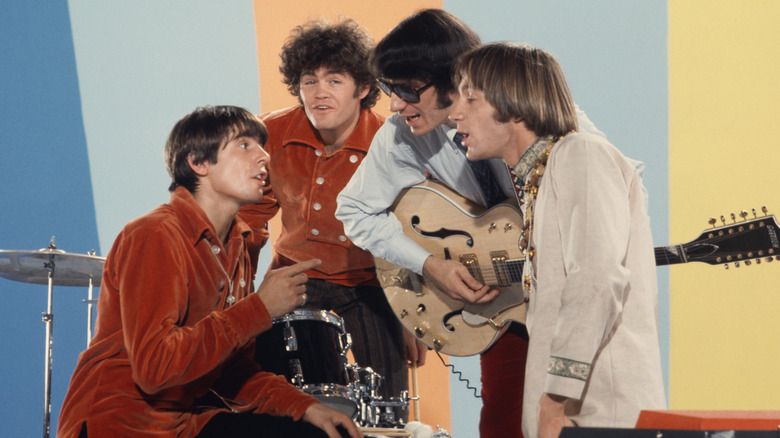
During the decade of "Peace and Love," four mop-topped musicians delivered the rock soundtrack to every flowerchild's first crush — and we don't mean the lads from Liverpool. The Monkees (Davy Jones, Mike Nesmith, Peter Tork, and Micky Dolenz) released chart-topping albums and hit singles throughout the '60s. And what the band's music did best was capture that wonderful, almost indescribable sensation of falling in love for the first time.
Whereas other bands of the day were waist-deep in the sensations of lust and desire, the Monkees leaned into the bittersweet fun of love. From the gushing "I'm a Believer" to the heartbreak of "Words" and the forlorn yet sweet "Last Train to Clarksville," there was a Monkees song for those love-struck moments. The naivety of youth may have long been replaced by wisdom, but the following hits are sure to take any baby boomer back to when they first believed in love.
Last Train to Clarksville
The Monkees burst upon the scene with its debut single, 1966's "Last Train to Clarksville," a Beatles-inspired tune from the songwriting duo of Tommy Boyce and Bobby Hart. After Hart misheard the fadeout on the Beatles' "Paperback Writer," he constructed a song about a desperate plea from one lover to another.
"'Cause I'm leaving in the morning / And I must see you again," sings Micky Dolenz at the start of the second verse, before adding, "We'll have one more night together / 'Til the morning brings my train and I must go." For those in love during those turbulent times, it captured both the excitement of youth and the wild, rash bounds one does for those first crushes. The song clearly struck a nerve with the kids of the day, too, as it went to No. 1 in November '66, just two months after the TV show "The Monkees" debuted.
"Last Train to Clarksville" may also resonate with boomers who fell in love during the Vietnam War. The line "And I don't know if I'm ever coming home" led some to suspect that the song's narrator is a soldier being deployed (plus, there's a U.S. Army base in Clarksville, Tennessee, though Hart was inspired by Clarksdale, Arizona, before changing the name). Dolenz stands by the song's hidden meaning, saying on Instagram in 2024 that the song was a "subtle commentary on the Vietnam War."
Words
Let's face it: the first crush usually doesn't end well. Perhaps you were infatuated with someone who, looking back, was never your type. Or worse, maybe you fell for someone who didn't take your love seriously and played romance like a game. And while many of the Monkees' hits harken to the joy and fun of first love, there are some songs, like 1967's "Words," that resonate with those whose first crushes turned into their first heartbreaks. "Words," written by the songwriting duo Tommy Boyce and Bobby Hart, is a psychedelic dive into the confusion of love when someone says something they don't really mean.
Micky Dolenz and Peter Tork trade lines on the opening verse that sets the stage for this confrontation: "Girl, don't you know everytime I see you smilin' / Hurts so bad 'cause when I see you, I start trying / I've tried everything to stop, but there's no denying / Falling in love with you girl is just like dying." Ah, the melodrama of young love. Dolenz then cranks up the emotion on the chorus, decrying, "Words with lies inside / But small enough to hide / 'Til your playin' was through."
The Monkees included "Words" as the B-side to its single, "Pleasant Valley Sunday," which went to No. 3 on the Billboard Hot 100. But since Monkeemania was in full swing, "Words" also charted, reaching No. 11 in September 1967.
Daydream Believer
If there is one Monkees song that really captures that wistful longing, that sweet pining that comes with your first crush, it's "Daydream Believer." Starting with twinkling piano keys courtesy of Peter Tork, Davy Jones spins a tale of the titular daydreamer crushing on a "homecoming queen." Though Jones sings, "Oh, and our good time starts and ends / Without dollar one to spend," he seems content with living just with love. "But how much, baby, do we really need?"
There's also an element of nostalgia to "Daydream Believer." Jones sings, "You one thought of me / As a white knight on steed," with the song's narrator seemingly referring to days long gone by. For boomers, hearing "Daydream Believer" might transport them back to when love was fresh and unfamiliar.
The purity and innocence of "Daydream Believer" helped it become a massive No. 1 hit. The song reached the top of the Billboard Hot 100 in December 1967, closing out the year with a four-week run at No. 1. It would be the Monkees' final chart-topper, and the band owed it to John Stewart, formerly of the folk-pop group, the Kingston Trio. Inspired by a day he spent daydreaming, Stewart didn't think much about the song when he wrote it. "Within three months," Stewart told American Songwriter, "it was number one around the world."
Valleri
If you were named Valleri, Valerie, or Val in 1968, this might have been the song that your crush played for you to win your love. Hopefully it worked, as the song is unbridled love wrapped up in psychedelic garage rock (with a healthy dash of flamenco guitar). "There's a girl I know who makes me feel so good," sings Davy Jones, adding, "And I wouldn't live without her, even if I could."
Written under a deadline after "The Monkees" music director Don Kirshner requested a song based on a girl's name, the original version first aired in February 1967. Kirshner was fired before he could have the rough version cleaned up for the Monkees' second album, so "Valleri" didn't get an official release until TV bootlegs started showing up on radio shows. So, the Monkees' label re-recorded the song and put it out as a single.
With surging brass, a very "Please Please Me"-esque "C'mon" from Jones, and an impressive guitar solo from Wrecking Crew member Louie Shelton, "Valleri" became a hit, going to No. 3 on the Billboard Hot 100 in March 1968. It would be the group's last Top 10 hit ever.
I'm a Believer
"Then I saw her face, now I'm a believer." If there isn't a more perfect Monkees song to take someone back to the '60s, to when they first felt those fireworks of passion, then what is? "I'm a Believer," released in late 1966 as one of the group's early singles, established the Monkees as more than a television show band. It reached No. 1 on Billboard Hot 100 in the last week of '66, and remained in the top spot for seven weeks.
It is truly a song about discovering love. Micky Dolenz presents it plain and simple in the first lines. "I thought love was only true in fairy tales / Meant for someone else, but not for me," he sings. The song details his trials and tribulations, yet the moment he saw her face, his doubts and troubles shed away, much like any boomer when they felt those feelings for the first time, too.
"I'm a Believer" also made Neil Diamond, who wrote the song for the Monkees, a credible force in the music industry. "I was a songwriter, first and foremost. I kind of reluctantly became a recording artist, you know?" Diamond told Guitar Player. "So, having the Monkees get the number one was as good as if I had recorded it, honestly."