

5 Songs That Prove 1976 Belonged To Musicians Over 40
Mainstream music of the 1970s was so varied that anyone who had a good enough song could feasibly ratchet up the pop chart, but 1976 experienced something of a movement in which singers over the age of 40 notched some of the biggest hits of their careers. By the middle of the artistically freewheeling, progressive, and populist '70s, the Hot 100 routinely featured a mishmash of all kinds of styles and genres as performed by musicians of numerous demographics. While the pop chart seems to be usually populated by youthful artists who make music for other young people, in 1976, many of the year's biggest hits were recorded and released by performers well into adulthood.
In what was truly a banner year for middle-aged pop stars, 1976 proved hospitable to artists who were a bit older than the usual ilk who wrote and sang songs about mature themes or which skewed toward an older audience. Here are the songs that prove the hottest thing in music in 1976 was being over the age of 40.
December, 1963 (Oh, What a Night) – Frankie Valli and the Four Seasons
One part falsetto-addled vocal group and one part rock band, the Four Seasons was among the most successful pop acts of the 1960s. By the time the 1970s rolled around, its sound was hopelessly passé, prompting leader Frankie Valli to embark on a solo career as a purveyor of adult contemporary ballads only for the Four Seasons to regroup in 1976. With the reconstituted band now going by Frankie Valli and the Four Seasons, the group led by a middle-aged musician enjoyed an unlikely comeback with a smash hit about a very specific and very youthful event. "December 1963 (Oh, What a Night)" employed a stripped down disco-rock sound to let the voices of Valli and company shine as they detail a nostalgic story about a first and comically brief experience with lovemaking.
In March 1976, "December 1963 (Oh, What a Night)" spent three weeks at No. 1 on the pop chart. After the song started to move down the Hot 100, lead singer Valli celebrated his 42nd birthday.
Convoy – C.W. McCall
Many classic artists scored their very first No. 1 hit after turning 40, if not their only No. 1 hit, including a '70s musician who has been largely forgotten. And C.W. McCall isn't even a real person. With a name suggesting the trucker-linked C.B. radio fad of the 1970s, C.W. McCall was the creation of Bill Fries of Omaha advertising firm Bozell and Jacobs, used in a campaign for the Mertz Baking Company. After a few other songs and ads, Fries, narrating and delivering C.B. dispatches in character as C.W. McCall, released "Convoy," a story song about a cross-country conglomeration of long-haul truckers. With a country music-style backing track, "Convoy" rode and perpetuated the C.B. fascination, and in January 1976, the track spent a week at No. 1.
Fries was an accidental pop star, having spent decades working in advertising. Later in 1976, after some "Convoy" follow-ups failed to match the success of their predecessor, Fries turned 48 years old.
Country Boy (You Got Your Feet in L.A.) – Glen Campbell
By the time Glen Campbell was a bona fide pop star, the singer, songwriter, and guitarist had lived several careers' worth of musical fame and fortune. In the 1960s, in addition to releasing some solo music to little notice, Campbell worked as a session and touring musician, playing with the likes of Elvis Presley, Frank Sinatra, and the Beach Boys. By the end of the '60s, Campbell was a country sensation, and his hits started to cross over to the pop chart, classics like "By the Time I Get to Phoenix" and "Wichita Lineman."
Campbell's first era as a pop-country phenomenon came to an end by 1971, but he'd return with the No. 1 pop and country smash "Rhinestone Cowboy" in 1975, and the comeback lasted for the next few years. In January 1976, "Country Boy (You Got Your Feet in L.A.)" became a No. 11 hit. Told from the point of view of a popular entertainer who misses their country roots, the song peaked in the same year that its performer turned 40 years old. Later in 1976, Campbell headed back to the Top 30 with the double A-side "Don't Pull Your Love" / "Then You Can Tell Me Goodbye."
You'll Never Find Another Love Like Mine — Lou Rawls
Possessing one of the smoothest and most inviting voices in the history of recorded music, Lou Rawls was a master of the love song and the romantic serenade. Rawls, who'd later factor into the bizarre history of Garfield and connect with a generation of '80s kids by providing jazzy and boisterous vocal performances on numerous TV spinoffs featuring the comic strip cat, became a household name as a beloved soul singer. From the mid-1960s until the late 1980s, Rawls was a consistent presence on the R&B chart, although he only occasionally scored a major hit over on the Hot 100.
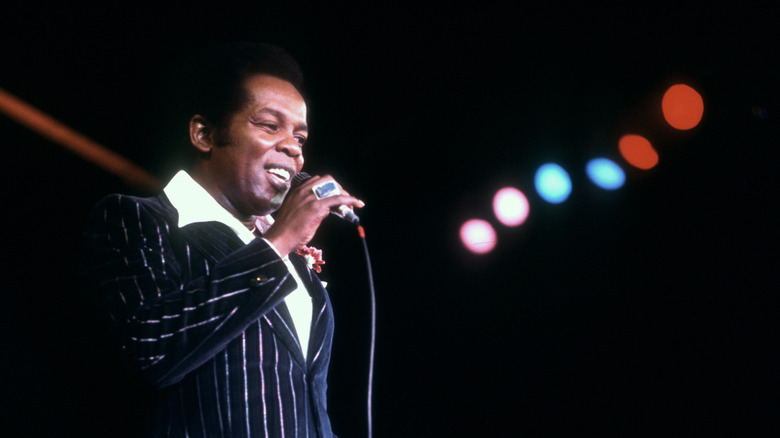
The most massive hit of Rawls' career, by far, was the sweetly sung but sternly admonishing breakup song that left a door open for reconciliation, "You'll Never Find Another Love Like Mine." It reached the lofty spot of No. 2 in September 1976. Just about three months later, Rawls turned 43 years old.
Nadia's Theme (The Young and the Restless) – Barry De Vorzon and Perry Botkin, Jr.
After laboring in the music industry in a variety of capacities, it took many years, and the arrival of the big 4-0, for Barry De Vorzon's full name to grace the label of a hit single. In the early '60s, he fronted one-hit wonder vocal group Barry and the Tamerlanes, best known for "I Wonder What She's Doing Tonight," and after a stint as a higher-up at Valiant Records, he grew entrenched as a film and television composer. For the 1971 movie "Bless the Beasts & Children," De Vorzon co-wrote a romantic and dramatic orchestral piece titled "Cotton's Dream." In 1973, a producer of a new CBS soap opera called "The Young and the Restless" asked De Vorzon if he could use it as the show's theme song.
The show was a hit, and the song entered the cultural consciousness, but it took about three years before a 45 of the song started selling at America's record stores. Requiring music to play over footage of Soviet Union gymnast Nadia Comeneci, a breakout star of the 1976 Summer Olympics, ABC Sports used "Cotton's Dream." Comeneci's popularity triggered the commercial release of the instrumental piece. Remixed and renamed "Nadia's Theme," it reached No. 8 on the Hot 100 in December 1976, some months after De Vorzon marked his 42nd birthday. De Vorzon's credited collaborator on the track, Perry Botkin Jr., was 43 years old at the time.