

What Is The Lifespan Of Guitar Strings?

Who doesn't love the shimmering zing of newly strung guitar strings? You'd hear the difference even if you never played. Old strings stretch out, get worn, accumulate dirt and oil, and eventually sound dead. But how often should you change guitar strings? What exactly is the lifespan of a single set? The real answer is just as complicated as asking how long an entire acoustic guitar lasts: It depends.
There are many, many factors involved in determining how long a set of strings lasts, not the least of which is string type. In general, nylon is more durable over time and more resistant to humidity, but is limited to classical guitars, not acoustic guitars, which are non-interchangeable guitar types with different bodies and string tension requirements. Bronze strings go with acoustic guitars and nickel or steel with electric, and bronze strings can lose their luster fairly quickly. Then there's coated versus non-coated, the former of which lasts longer but is missing the crisp sparkle of new strings.
In general, any string can die in mere weeks with greater use and exposure to the elements (humidity, heat, light, etc.). A semi-frequent, gig-playing guitarist may have to change strings every week, while a touring professional musician should change their strings every show. But even if your guitar just sits around in a case all day and is rarely played, it should still be changed once or twice a year. And don't think you can store strings indefinitely — they can rust even in a supposedly airtight bag.
Differences between string types
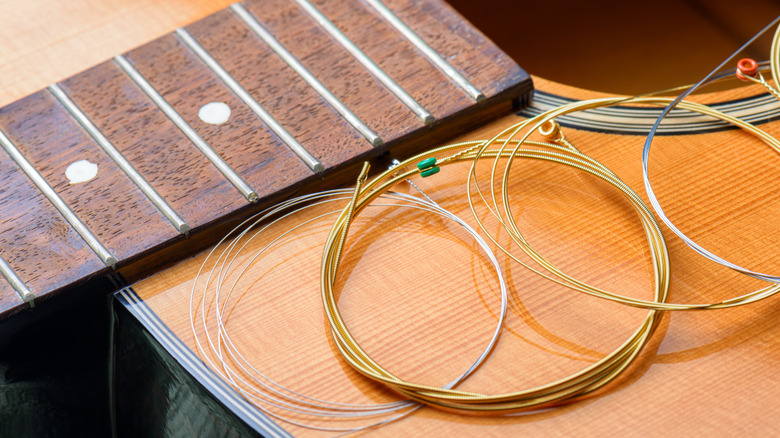
String type plays a big role in determining how often you should change your strings, and that, in turn, depends on the guitar type. From least-often changed to most-often changed, it typically goes nylon (classical guitar), then stainless steel followed by nickel-plated steel (electric guitar), and then phosphor bronze followed by regular bronze (acoustic guitar). We're all familiar with stainless steel, a corrosion-resistant alloy that lasts longer than nickel-plated steel. Phosphor bronze, meanwhile, has had some of its oxygen removed, so it won't deteriorate as quickly as regular bronze.
There are caveats to our durability ranking, however. Higher-pitched acoustic and electric guitar strings (the B and high E strings on standard six-string guitars) are usually just a simple wire, while the lower strings are coiled, meaning there's a wire core with another wire wound around it. Pure wire strings are significantly more fragile and prone to going out of tune, or even suddenly snapping if played a lot (even nylons). Coiled strings, meanwhile, tend to collect oil, dirt, dust, and so on that you can't see. Overall, this generally means it's safer and less corrosive for your guitar to change your entire set of strings before any one of them reaches its literal and figurative breaking point.
Then there are polymer-coated strings, the EverTune of strings. Coated strings will universally last longer than uncoated strings. However, you sacrifice some of the glistening, shining, new string sound. If you just care about changing your strings less often, this is the way to go, but generally, casual players will be fine with cheaper, less durable strings and changing them when they start to sound bad.
Helping your strings last as long as possible

The best rule of thumb for changing your guitar strings is the most common-sense rule possible: Use your ear. If you play a lot, have sweaty hands that grind lots of oil, water, salt, and skin cells into the coils of your strings, take poor care of your guitar by leaving it out of a case, don't wipe down and clean the guitar after each use, etc., your strings aren't going to last for too long. They'll sound like garbage and possibly turn green where you pressed down a lot.
On that note, how you play makes a difference, too. Do you press the strings really hard? Do you aggressively slide up/down the fretboard while playing your favorite killer rock guitar solo? On top of this, some people have corrosive, acidic sweat that hastens decay. This is why you should keep your guitar well-maintained to prolong the lives of its strings as much as possible.
Yes, changing guitar strings is a hassle. You need special tools if you want to do it the right way. You've got to extract the bridge pins and stick the little balls at the ends of the strings into the pin holes. You've got to uncoil the strings, wind them around the tuning pegs, and cut the ends of the strings so you don't stab your eyes out while playing. It's such a pain that some people even pay guitar shops to do it. And while strings aren't the priciest things in the world — certainly not in comparison to some of the most expensive guitars — costs add up. But if you care about keeping your instrument at its best, you've just got to suck it up and do it.