

The 5 Best Bee Gees Songs That Aren't Stayin' Alive Or How Deep Is Your Love
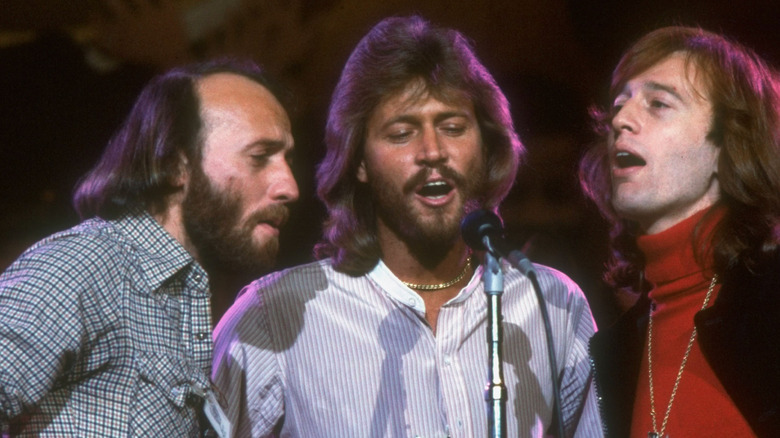
The Bee Gees — brothers Barry, Robin, and Maurice Gibb, usually — was such a popular act in the disco era, particularly due to the blockbuster success of the "Saturday Night Fever" soundtrack, that its songs from that time overshadowed everything else that came before or after. Sure, "Stayin' Alive" and "How Deep Is Your Love" are a hard-charging disco classic and a beautiful and dreamy love ballad, respectively, but the Bee Gees could do and did a whole lot more than provide the falsetto-powered, violin-and-horn-backed songs that played almost endlessly in '70s dance clubs.
While 1978 may have been the best year of the Bee Gees' career, decades of output generated timeless songs and unheralded gems that deserve a contemporary listen. Prior to the Bee Gees embracing disco, the group had pop, rock, dance, folk, and soft-rock phases, and it continued on for several decades, churning out tunes just as good as "Stayin' Alive" and "How Deep Is Your Love." Here are five Bee Gees songs "to love" — no "joke" and no "lying" — that it would be a "tragedy" to sleep on.
To Love Somebody
The disco songs for which the Bee Gees are most widely known displayed a mastery of studio production techniques and often utilized impossibly high falsetto vocals. Buried under all of that, or often ignored completely, was what made the band a consistent and well-received hitmaker during its early years: impressive singing and harmonizing, laid bare and full of emotion. All three of the Gibb brothers had tremendously powerful and evocative voices, and in the late 1960s, their material — folk-influenced and traditional pop ballads — showed what they could do. At the top of the list of highlights of that Bee Gees era: "To Love Somebody," a No. 17 hit in the summer of 1967.
Sweeping in its music and raw and profound in its lyrics, "To Love Somebody" is a love song that grapples with the idea of love. Not even the person that the narrator is in love with can understand how deep and extraordinary his feelings can be. The combination of the Gibbs' insistent, deeply felt vocalizing and a grand but not intrusive orchestral backing makes "To Love Somebody" gorgeous and lush, and it tugs on all the emotional centers of the brain to leave an impression that one has just heard a singular song about a love that's just as precious and rare.
I Started a Joke
Traditionally, most praise going to the Bee Gees focuses on the melodies and arrangements, and not its lyrics. Often relying on cliches and hoary love metaphors, the three songwriting Gibb brothers could turn out an odd phrase or a song that was wholly quirky and captivating, if they felt like it. Case in point: the tricky and wordplay-dense "I Started a Joke," a No. 6 hit in early 1969. Despite the name, this isn't a fun song about comedy at all, but one full of melancholy, head-scratching couplets, and references to death. It's a fascinating, sad, and weird song, like an old folk ballad or choral piece interpreted for a 1960s audience. It's also the rare Bee Gees hit with Robin Gibb, not Barry, on lead vocals.
Beautiful but unsettling, the song was inspired when Robin Gibb rode in a commercial jet, and in its overwhelming cacophony of noise, claims to have heard a choir-like tone. The lyrics are adjacent to the psychedelic movement with its seemingly profound but often ultimately nonsensical lyrics. (For example: "I started a joke / Which started the whole world crying" and the reversal, "I started to cry / Which started the whole world laughing.") In the end, the joke of "I Started a Joke" is that it's self aware of how pretentious and enigmatic it is.
Tragedy
Just before the disco movement cratered, the Bee Gees succeeded the monumental "Saturday Night Fever" soundtrack with the 1979 studio album "Spirits Having Flown." No act scored more No. 1 hits in the '70s than did the Bee Gees, and "Tragedy" is among its nine chart-toppers. It's a mature slice of dance music that's been outfitted with hooks on top of hooks but which is also foreboding and epic, as if the Bee Gees took cues from old Richard Wagner operas as much as they pulled from the discotheques.
"Tragedy" indicated that the Bee Gees had come a long way in less than two years, seeking to move disco into new places as the '80s beckoned. The group blended tropes of that genre with some of the things that made the emergent arena rock of the time so intriguing. Frenetic and propulsive, "Tragedy" was built out of layers of synthesizer lines, sound effects, hard-rocking and soaring guitar riffs, and chugging drums. The Bee Gees knew how to capture the listener's attention, such as how most of the instruments (except for the drums) drop out to emphasize a pleading, high-range note from singer Barry Gibb, and then the anthemic chorus kicks in. "Tragedy" is also a playful and clever song, as the harmonies played by guitar suggest the Gibb brothers' historic ability to do that kind of thing with their voices.
He's a Liar
After disco grew passé as the 1970s turned into the 1980s, mainstream music purveyors and bands sought to embrace the next big thing, and for many, that was new wave. Jerky and stripped down like early rock 'n' roll while also incorporating punk-rock cynicism as well as synthesizers, new wave sounded fresh and futuristic, and the ever-evolving Bee Gees took a stab at the sound with its 1981 single "He's a Liar."
There remain traces of the disco that made the Bee Gees one of the biggest acts on the planet just a few years prior, but "He's a Liar" is primarily a rock song, albeit a radio-ready, MTV-friendly one. Tightly constructed and agitated, "He's a Liar" piles on gloomy synth stabs and solos as well as effects-laden backing vocals and flourishes that feel improvised and authentic. The song is also sinister and hard-charging, and significantly darker than anything the Bee Gees had ever attempted before. If it also reminds listeners of the harder side of the Eagles, that's because that band's Don Felder played lead guitar on the song. It was a solid and serious attempt at something new, but the Bee Gees saw limited reward for the ominous "He's a Liar," which peaked at No. 30 on the Hot 100 in 1981.
Paying the Price of Love
One false thing commonly believed about the Bee Gees is that they fizzled out after the death of disco. Actually, the trio rolled with the punches of the changing sound of mainstream pop music and enjoyed a few minor comebacks. After the 1989 pop hit "One" and before the 1997 soft-rock hit "Alone," the Bee Gees emerged in 1993 with a very of-its-time single, "Paying the Price of Love." Disco didn't die — it evolved and splintered into numerous types of dance and club music, and on this song, the Bee Gees embraced the sound that it helped inspire.
Fifteen long and eventful years after the Bee Gees dominated pop culture with the "Saturday Night Fever" soundtrack, "Paying the Price of Love" showed that the group could still make really excellent dance music. Not only does the song have a good beat and a catchy melody, it's packed with Bee Gees hallmarks: emotional heft, ruminations on love and devotion, airtight harmonies, and the impossibly high falsetto theatrics of lead singer Barry Gibb. "Paying the Price of Love" sounds like a Bee Gees disco classic remixed as a '90s club banger, although it was mostly overlooked upon release, topping out at No. 74 on the pop chart and No. 35 on the adult contemporary chart.