

How To Keep An Electric Guitar In Good Condition

So you've decided to play the guitar, huh? Or have returned to it after a spell and forgotten not only the main riff from "Layla" but how to keep it in good condition. In a general sense, caring for an electric guitar is only marginally different from caring for any other guitar: Don't set it on fire, treat it like a trampoline, leave it out collecting dust, give it to the dog as a chew toy, or smash it against a brick wall. All common sense stuff. Also, there's regular maintenance.
Electric guitar maintenance is fairly straightforward, with a couple of quirks specific to the whole electric thing. First off: When you're not using it, you should store your guitar in a case, not on a stand. This will shield the instrument from accidental collisions, humidity, light, dust, and other destructive and/or corrosive guitar killers — except skin oil, that is. For that, you've got to wipe down the strings, fretboard, and body (especially where your arm laid on it) after playing. Use a proper guitar-only cloth and cleaner, not paper towels and multipurpose spray or other generic cleaners. If you're going to ship the guitar somewhere or not play for a long time, detune the strings to release pressure on the neck.
And since dust and moisture are the nemeses of circuit boards, electric guitar owners have got to be especially careful of them. Fiddle with the dials to loosen hidden grit, and use a compressed air can to (carefully) blow your guitar clean.
The finer details of electric guitar maintenance
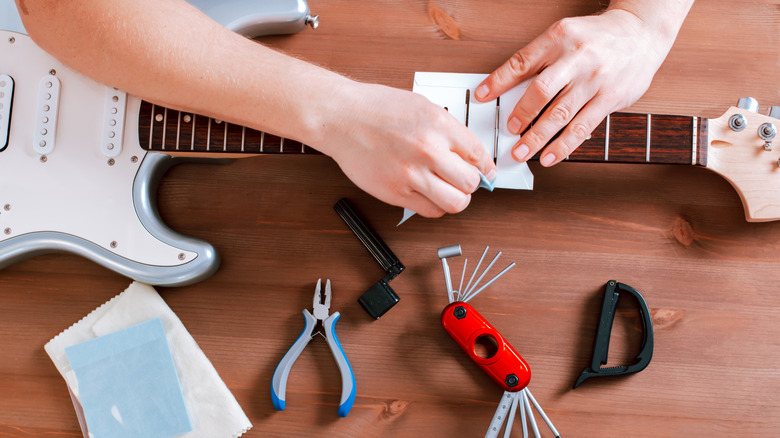
It's easy to go overboard with taking care of your guitar, like that neighbor who scrubs his car by hand every summer weekend when it doesn't have a smudge on it. Just stick to sensible, common-sense care, dependent on wear and tear. Solid-body electrics are sturdier than hollow-body acoustics, which can still survive hundreds of years under optimal conditions, but we've also got sensitive electronic components to consider.
You should wipe down your guitar every time you're done playing before you stow it in its case — it takes mere minutes and safeguards the hundreds or thousands of dollars that the instrument may have cost you. Make sure to get the strings as clean as possible, too, as corrosice oil and sweat can seep into the coils of thicker strings (the lower E, A, and D strings on a six-string guitar) and can damage the uncoiled wire of higher strings (G, B, and high E). This is true whether or not you've got nickel-plated steel strings or the more durable stainless steel. String maintenance is a part of guitar maintenance; when the guitar loses its crisp sound, it's time to swap out the strings. That's an excellent time to polish the guitar, too. Guitar-friendly cleaners and polish often come together in a kit, which is helpful.
And finally, there are the electric components. Unless you're keen on physically taking apart your guitar to clean it, your only line of defense is prevention. Keep an eye on crevices or holes like the output jack (where you plug the guitar in), the pickups, and bridge. If something sounds extra noisy when you plug into an amp or hardware, you might have some schmutz lingering somewhere.