

What Is The Best Electric Guitar For Beginners?
We may receive a commission on purchases made from links.
Sometimes it's hard to remember what a "beginner" guitarist really faces. Before all the intimidating tutorials and complicated music theory, one question must be answered: What electric guitar should you buy? This choice might annoy some guitar snobs, but a simple, standard S-style or SG guitar will do just fine.
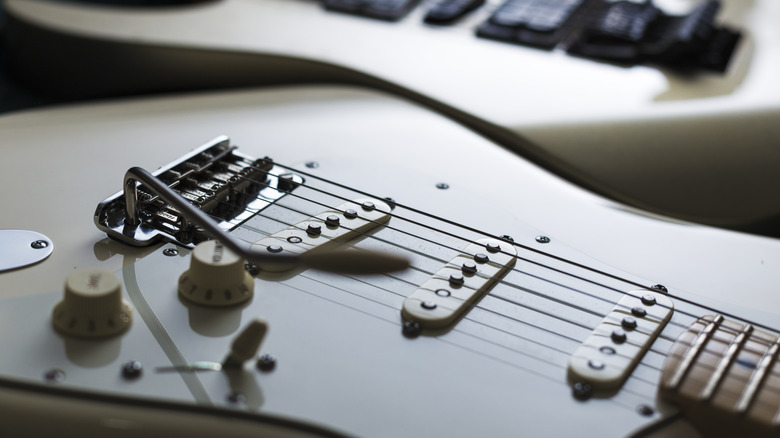
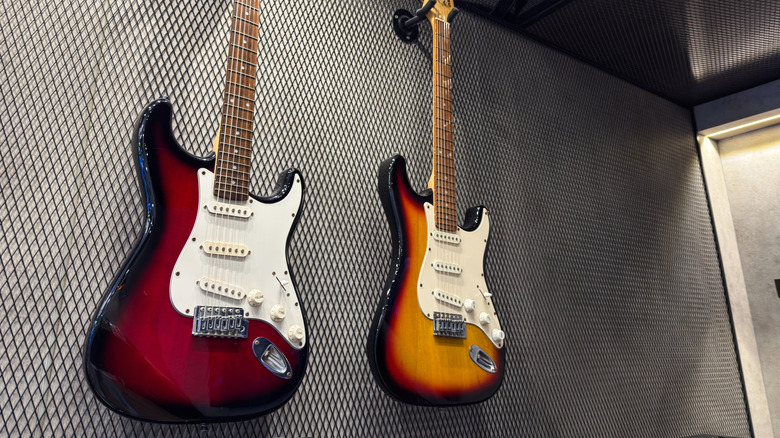
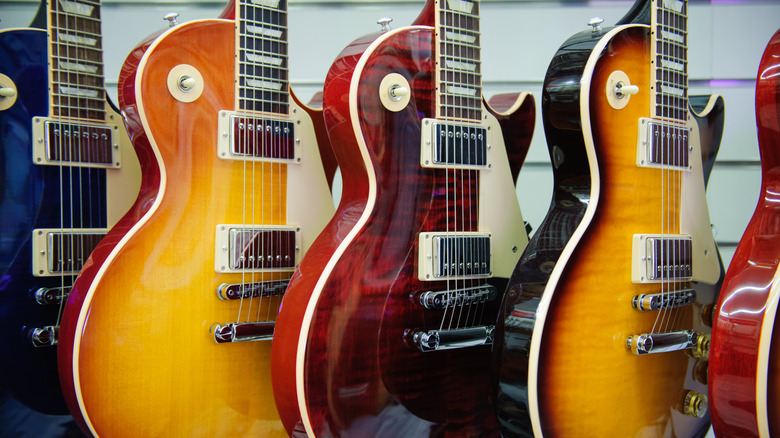
An S-style guitar is what we've all seen tons of generation-defining guitarists play decade after decade, including Pink Floyd's David Gilmour and his Black Strat, the most expensive guitar to ever sell at auction ($14.5 million). "Strat" means Stratocaster, as in Fender, the world's most recognizable guitar company. It's responsible for popularizing the now-typical S-shaped body that has a cutaway on either side of the fretboard to allow guitarists to more easily reach higher frets. An SG guitar, meanwhile, is a solid-body guitar with a single cutaway on the bottom. It's a very classic look, and Gibson Les Paul Tributes are its best representatives. A Fender Strat Squire goes as low as $200 (you can even buy one from Amazon), while a Gibson Les Paul Tribute hovers at around $350.
But before going further: Electric guitar beginners need to focus on fun, not drowning in a deluge of details. They need to bash out the power chords for "Brain Stew" by Green Day, not fret about economizing their alternate picking patterns. This is the focus, no matter the guitar — the instrument is just the facilitator. If you want something fancy after you've committed to practicing, then go for it, and keep your OG beater as a backup.
The case for an S-style or SG guitar
Each novice guitarist has some specific goal in mind — play a certain song, develop a hobby, emulate a certain genre style, etc. Some of these objectives might require a guitar with a particular feature, like dual humbucker pickups to make your favorite riff sound heavy enough. But, just like how a beginner pianist doesn't need a $150,000 Steinway grand piano to tackle Chopin's Études, a beginner guitarist doesn't need a $14,000 PRS to pretend to be Eddie Van Halen (he built his own makeshift "Frankenstein" for under $500, anyway). Don't try to be cool — be patient.
At the same time, no one wants to buy trash. A guitar needs to actually sound and feel quality enough to properly learn on. The thickness and curvature of the fretboard as your hand wraps around it; the height of the action (how high the strings are from the frets); the utility of the knobs/dials; the presence of a whammy bar (not needed — someone tell Kirk Hammett); the overall shape and heft of the guitar, which influences how/where you hold it in place: All these things do need to be considered.
A typical S-style guitar like a Fender Stratocaster or an SG guitar like a Gibson Les Paul Tribute is the simplest, tried-and-true, inexpensive, all-around, "I don't want to think about it" choice that gets passing marks for all the above criteria. It's versatile enough to learn rock, blues, metal, jazz, whatever. Whichever one you choose, the neck will be easy to grip, and there are dials for volume, tone, and pickup switches to control the sound of the guitar. Plus, it won't break the bank.
The details on Squires and Tributes
Out of the two options we recommended, a Fender Squire Stratocaster (an S-style guitar) is arguably the most ideal introductory guitar for players of any bend, available directly from Fender or loads of retailers. The neck is possibly wider than might be comfortable for some people's hands, but this might force your precision when learning chord shapes and make you better later on. Prices span from about $200 to $600, which includes a variety of colors. Plus, you'll be joining the likes of Eric Clapton, Jimi Hendrix, Buddy Holly, Jeff Beck, etc.
The Gibson Les Paul Tribute (an SG guitar) is the other option. Possibly prettier and a bit less generic-looking than the Squire, the Tribute has a slimmer neck, which might make it easier for newbies or people with smaller hands. But the neck is also a tad flatter (the Squire has more of a bowed, "C" shape), which might make it more difficult to grip than a Strat. Also, Tributes are a bit heavier and chunkier, which might make them tougher to hold and harder to deal with if you're standing up and using a strap. We'd go with the sunburst design over a solid color, but that's just us.
If you've got money and are jonesing to use it, sure, you could shell out for a PRS, Suhr, Charvel, Gibson SG, etc. (the former three look like copy-pasted Strats, and the last looks like an actual double-bladed axe). But prices can reach $3,500 or more, and beginners won't be able to tell what they paid for. No matter what: Focus on fun and feeling encouraged. Improvement will come so long as you practice.