

This Might Not Be Cat Stevens' Most Popular Song, But It's Nearly Perfect In Every Way
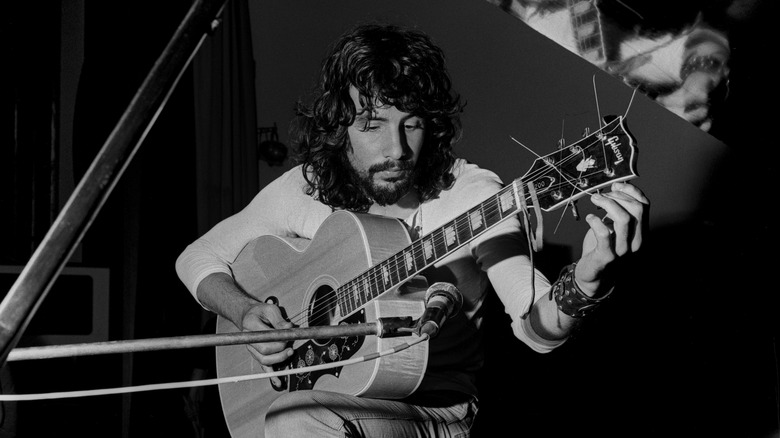
There's a Cat Stevens song you may not have heard, but it's about as good as a song can get, and it's called "How Can I Tell You." Stevens could barely put a foot wrong in the early 1970s. Having become a megastar thanks to the release of 1970's "Tea for the Tillerman," featuring numerous classic Stevens tracks like "Wild World" and "Father & Son," he cemented his reputation as one of the decade's most appealing singer-songwriters with the equally strong "Teaser and the Firecat" album in the following year. That LP also contained some of his best-loved tracks, such as "Morning Has Broken," "Moonshadow," and "Peace Train," but with such heavy-hitting singles, one of Steven's most extraordinary deep cuts on the album, "How Can I Tell You," has become somewhat overshadowed.
"How Can I Tell You" appears as the final track of the first side of "Teaser and the Firecat." It is the longest track on the album, coming in at just under four and a half minutes. It opens delicately, with a few dispersed acoustic guitar chords before Stevens' distinctive voice arrives. And what follows is one of the most spine-tingling and romantic songs in his entire oeuvre.
How Can I Tell You – Cat Stevens' deep-cut love ballad
Cat Stevens may be acclaimed as one of the finest lyricists of his generation, but "How Can I Tell You" begins with him telling his lover that he is so in love he finds himself tongue-tied. "I love you, but I can't think of right words to say / And I long to tell you that I'm always thinking of you / I'm always thinking of you, but my words just blow away," his narrator admits.
But there is a sting in the tail of "How Can I Tell You." As the lyrics soon make clear, the narrator's love interest is absent. Nevertheless, the narrator remains dedicated to the person they long for: "Wherever I am, girl, I'm always walking with you / I'm always walking with you, but I look and you're not there."
Bare and minimalistic in terms of structure, the instrumental tastefully builds toward the end of the track with the introduction of subtle strings and rich backing vocals provided by singer Linda Lewis, and by the time the song delicately comes to its end, the four and a half minutes have just flown by. Sadly, the song hasn't remained a mainstay of Stevens' concert set lists in recent years, but footage from the year it was released reveals its power in a live setting. A true hidden gem.