

5 '70s Rock Songs With The Energy Of One Wild High School Party
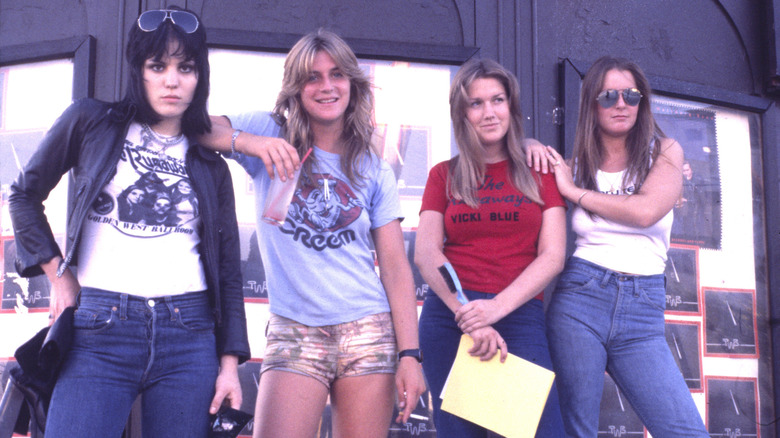
As sophisticated as rock 'n' roll got in the 1970s, it never strayed too far from its roots in teenage rebellion and freedom. As '60s icons like the Rolling Stones (and their fans) grew older and graduated, a new class of musicians showed up to pull the fire alarm, smoke in the bathroom, and cut class. They made rock songs that both soundtracked high school parties and captured their wild energy: stone-cold classics rinsed in the vibes and emotions of being young and cutting loose. And some party anthems from that decade are extra special; blasted from the speakers of unsuspecting out-of-town parents then, they trigger serious party flashbacks now.
Few songs scream with more excitement about being free from school and lame rules than Alice Cooper's "School's Out" and the Runaways' "Cherry Bomb." In different ways and for distinct sets, J. Geils Band's "(Ain't Nothing But a) House Party" and the Ramones' "Rockaway Beach" celebrate getting wild on teenagers' own terms. And for secondary students across the pond in England, Sweet's "Teenage Rampage" dresses up the fight for the right to party in glitter and glam rock.
No doubt, we've missed some ripping songs. In making this list, we tried to reflect the broad range of rock styles across the '70s. What we can say is that five decades on, these tunes sound as young as ever; they refuse to grow up and listen to teachers, parents, or principals. Transporting younger boomers to their first high school party, these tracks are ready to cut loose.
School's Out — Alice Cooper
No matter what decade you graduated, you're familiar with the anxiety and excitement depicted in "School's Out." It's that feeling, as Alice Cooper explained to Songwriter Universe, "[w]hen you're sitting there, and you're watching that clock tick down on the last day of school." But when the time's up, "You're free. You're gonna have so much fun!" From its iconic opening riff to the school bell letting us all out of class at the end, that longing and desperation builds and explodes. It urges us to wad up our notebook paper, throw our algebra textbooks out the window, and go feral.
Who doesn't sing along to the bridge, delivered by a children's chorus: "No more pencils / no more books / no more teacher's dirty looks"? Like Pink Floyd's "Another Brick in the Wall, Pt. 2," the lyrics urged teenagers in the '70s to tell authorities to stuff it and grab freedom by the devil horns. And as it was a hit, peaking at No. 7 on the Billboard Hot 100 in 1972, you can bet it blasted at some bitchin' high school parties.
Cooper knew exactly what he was going for when he wrote the lyrics to "School's Out," telling Songwriter Universe that he wanted to write a teenage rebellion anthem in the vein of The Who's "My Generation." For high schoolers in the '70s — or at least the "bad" kids who cut class — it was.
(Ain't Nothing But a) House Party — J. Geils Band
As that unforgettable Saturday Night Live sketch makes clear, sometimes you need "more cowbell." That, and John Geils' blistering guitar riff, kick off the party vibe in the aptly named "(Ain't Nothing But a) House Party." The good-times anthem showcases J. Geils Band at their best. It's an R&B-inflected rock stomper that, in 1973, caused floorboards to shudder under the weight of packed living room dance floors.
Kicking off the Boston sextet's third studio album, "Bloodshot," the song paints a picture, and it's bumping. "They're dancing on the ceiling, they're dancing on the floor / People everywhere coming through the door," it opens. From there, expressions of teenage abandon: "Come on baby dig that crazy soul / I know you're gonna lose control." We suspect that if you were in high school in the '70s, you went to a party like this. Hopefully, someone stuck around to help clean up.
Written by Del Sharh and Joseph Thomas, the original version of "(Ain't Nothing But a) House Party" was released by Philadelphia-based soul vocal group the Show Stoppers in 1967. That version is just as much a party, but J. Geils Band add a teenage, anarchic edge to the proceedings. Hitting record players nine years before they'd top the charts with "Centerfold," so somewhat overlooked, the track nails that feeling of limitless possibility on the dancefloor, when "all you got to do is move / every time you steal that groove."
Cherry Bomb — The Runaways
One thing high schoolers have always longed for is the freedom to be themselves (and party). With their explosive anthem of teenage rebellion "Cherry Bomb," all-female hard rock and punk legends the Runaways lit that fuse and let it fly. The chorus of this supremely singable '70s high school hit, "Hello, daddy, hello, mom / I'm your ch-ch-ch-ch-ch-ch cherry bomb," is defiant, suggestive, and guaranteed to get stuck in your head.
While "Cherry Bomb" and the Runaways didn't really blow up in the U.S. — during their short run from 1975 to 1979, their largest audiences were in Japan — they've since become synonymous with a specifically '70s type of wild good times. That's in no small part due to the song's appearance on the soundtrack of 1993 stoner comedy "Dazed and Confused," depicting the lives of high school students on the last day of classes in 1976.
No doubt, "Cherry Bomb" struck a chord (and also some heavy guitar riffs) with high school audiences because they sensed that it came from one of their own. Joan Jett, who co-wrote the song with band manager Kim Fowley, was 16 when she dropped out of school to join the Runaways, and singer Cherie Currie was just 15 when they recorded "Cherry Bomb." "We wanted to be and do what Led Zeppelin was doing," Jett said in a 2009 interview with Jackson Free Press, "get up on stage and be ... just like the boys." With "Cherry Bomb," they proved they could do that and much, much more; they could make parties explode.
Rockaway Beach — The Ramones
Hear us out: If the Sex Pistols are the Beatles of first-wave punk, then the Ramones are the Beach Boys. Maybe. But undoubtedly, there's a little slice of "Surfin' USA" in "Rockaway Beach" off the Queens, New York, band's 1977 album "Rocket to Russia," helping to make that year the decade's best for punk rock. Between crashing waves of distorted guitars, the song contains splashes of Brian Wilson-like harmonies and tight pop arrangements. We've swapped coasts and exchanged our surfboards for leather jackets, but it's the same story: The teenagers are bored, overheated, and desperate for a beach party.
Of course, what makes "Rockaway Beach" such a punk party jam — beyond the breakneck pace and distorted guitars — is that it's filled with the most teenage of feelings: longing. "We can hitch a ride to Rockaway Beach," Joey Ramone sings, "Up on the roof, out on the street / Down in the playground the hot concrete / Bus ride is too slow." The lyrics capture that desperation and anticipation building as we're stuck in traffic and dreaming of escape, something teenage beachgoers on both coasts could relate to. In the '70s, this anthem elicited fierce pogoing and jerky dancing; almost 50 years on, it still has a hold on punks young and old.
Teenage Rampage — Sweet
In the early '70s, David Bowie kitted up in sequins and glitter, Alice Cooper learned to apply make-up, and glam rock took over, opening the doors for London-based quartet Sweet. Making loud records and wearing louder fashion, this band and their ilk gave teenagers in the U.S. and U.K. novel ways to shock their parents. And with "Teenage Rampage," a follow-up single to their hit "Ballroom Blitz," they turned high school (or as it's called in the U.K., "secondary school") desires for freedom and independence into a rock 'n' roll manifesto.
Where '60s cuts might have focused on peace, love, or political change, the central thrust here — like much of glam rock — is youth revolt on its own terms. Including a "we want Sweet" chant and crowd noises to give the track a raucous, live feel, the anthem lays everything bare. To protect teenagers' right to party and boogie, singer Brian Connolly urges, "Get yourself the constitution / And join the revolution now / And recognize your age." It's got wild party energy because it takes teenagers' desire for independence from authority to its logical extreme: "the formation of teenage legislation" in a state run by 16-year-olds. Sweet's guitar licks, grooves, and impassioned delivery made that prospect sound fun and enticing to teenagers in the '70s, even if it must've terrified their parents.