

This 1978 Disco Smash Energized A Generation — 18 Years Later, A Deadpan Cover Made It Cool Again
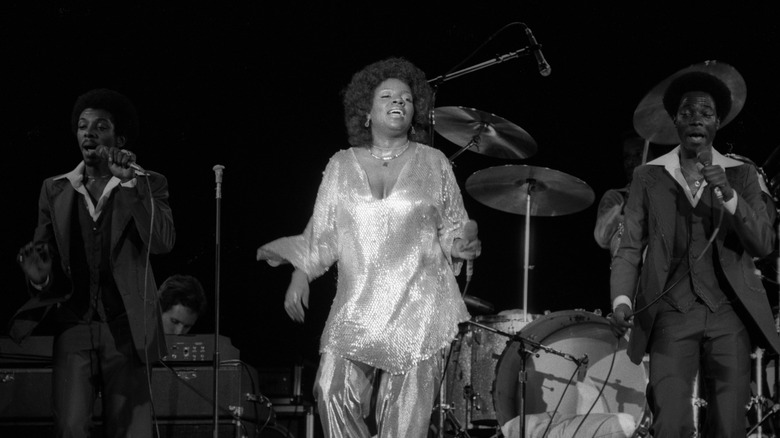
The right cover of a song can change the way you'll hear it forever. In the '90s, there was no better example than when Cake released their cover of "I Will Survive," the signature song by Gloria Gaynor.
If you were glued to rock radio at the time, you may have wondered how exactly this happened. Gaynor's 1979 original is a lush empowerment song and an era-defining disco anthem. You'd never expect to hear it with a shuffling tempo, a very different kind of vocal delivery, and — who could forget? — a mariachi-style trumpet solo. But that's exactly what "I Will Survive" became under Cake's guidance, proving that it was a pretty cool song, no matter who was singing it.
This tale of two versions is the story of a singer and songwriters who wouldn't give up, and a band who rarely followed the rules. Gaynor might have appreciated what Cake did to her song a little more, too ... if it weren't for one tiny change they made in their version.
The original I Will Survive was a match made in heaven
From the first notes of Gloria Gaynor's original take on "I Will Survive," it was clear she could sell the feeling of overcoming the worst obstacles. The duo who wrote the song knew a thing or two about resilience, too.
Writers Freddie Perren and Dino Fekaris were working to rebuild their careers after being let go from the staff at Motown Records. Fekaris recalled in an interview with Songfacts how catching part of a movie on TV that featured a song he wrote for Motown act Rare Earth inspired him to keep writing. "I remember jumping up and down on the bed saying, 'I'm going to make it. I'm going to be a songwriter. I will survive!'" he said.
But "I Will Survive" took time to find a worthy singer. In 1978, Perren, who was also a producer, was hired to work with Gaynor, a disco singer struggling to follow up her 1975 hit cover of The Jackson 5's "Never Can Say Goodbye." Gaynor's year before recording "I Will Survive" was marked by hardships, from the death of her mother to a back injury that required a brace while recording her vocals. Perren and Fekaris' track perfectly matched the singer's mindset.
Gaynor put her heart and soul into the track, and it paid off: the song, originally placed as a B-side, topped the U.S. pop charts for three weeks in 1979 and won the only Grammy Award for Best Disco Recording. Gaynor, Perren and Fekaris' willingness to overcome their hardships made an anthem for the ages — one that still resonated in the '90s.
Cake's cover of I Will Survive made a change that Gloria Gaynor didn't like
Cake's 1997 take on "I Will Survive" is a master class in adapting a great song. It was the first single the band released after scoring a breakthrough in 1997 with signature song "The Distance." Their take on "I Will Survive" possessed a similar musical style, down to John McCrea's distinctive, almost-spoken vocals. (A critic for music magazine Cash Box called it "charmingly mangled.") Add in the oddball video (where McCrea played a cop dispensing traffic tickets) and a general wave of nostalgia around disco at the time, and you'd be forgiven for thinking Cake were mocking the track.
But that couldn't be less true, McCrea insisted years later. "I don't think there's any irony in the way I deliver that song at all," the frontman told Billboard in 2021. "The 'disco sucks' movement was weirdly white supremacist, I think that's partially why everybody just assumed it must be a joke song." Indeed, ever since disco-hating DJs made headlines for literally blowing up dance records, critics have reckoned with how that backlash unintentionally silenced the often female, non-white and queer voices that propelled the genre to blockbuster status.
Unfortunately, the band's intentions mattered little to Gaynor — because McCrea changed the adjective in the line "I should have changed that stupid lock" into a swear word. "The one [version] I don't like is the one by Cake," she told The St. Louis Post-Dispatch in 2008, "because they used profanity." Still, she, the band and the song managed to (what else?) survive.