

5 ABBA Songs That Prove 1976 Was The Best Year Of Their Career
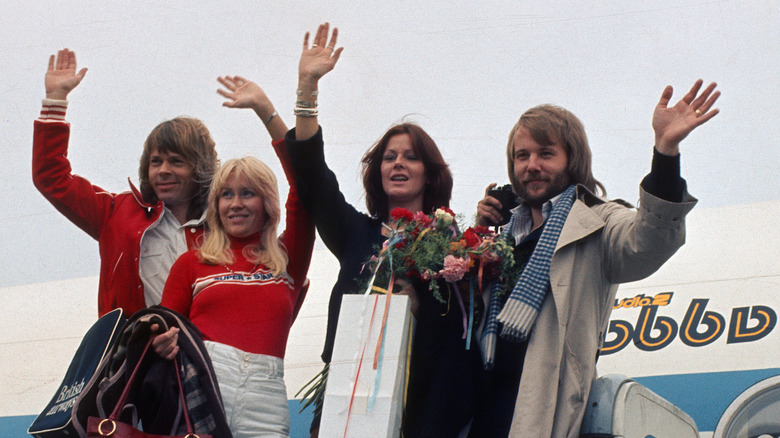
One of the most successful and widely known musical acts of all time, ABBA delighted the world with their catchy pop and disco throughout the 1970s and beyond, and they reached their commercial and cultural peak in 1976. Having only emerged from Sweden in 1974 with "Waterloo," the greatest song in the history of Eurovision, ABBA quickly made good on that track's promise of frothy music with a wide appeal that was also ambitious and genre-bending. Musicians and songwriters Benny Andersson and Bjorn Ulvaeus, and main vocalists Agnetha Faltskog and Anni-Frid Lyngstad, also constituted two married (then divorced) couples, but these bandmate romances helped shape rock history. While ABBA has often been written off as a disposable disco act, the group demonstrated mastery at all kinds of musical styles.
ABBA truly showed what it was capable of in 1976. That's the year they recorded or released some of their biggest and most beloved songs, the ones that have endured and show off their versatility. Here are five ABBA songs that made 1976 their best year ever.
I Do, I Do, I Do, I Do, I Do
ABBA's third studio album was a self-titled affair, released in Europe in 1975 before its singles took off in the U.S. in 1976. The first one to make a stateside impact was the shuffling and lightly danceable "I Do, I Do, I Do, I Do, I Do." Powered by saxophone and the almost alien perfection of the blending of the voices of Agnetha Faltskog and Anni-Frid Lyngstad, the marriage vows-alluding tune sounds like it extols a happily-ever-after for a couple, or like it could play over the credits of a romantic comedy. Showing off ABBA's playful lyrical complexity toward affairs of the heart, the narrator declares their love for the subject while also daring them to love them back, or at least make a choice about the trajectory of the relationship.
ABBA's first big hit of 1976 in the United States, "I Do, I Do, I Do, I Do, I Do" appropriately enough entered the Hot 100 on Valentine's Day. In May, it reached its peak position of No. 15.
Mamma Mia
With the last major single from their 1975 self-titled LP, ABBA showed that they were getting more comfortable outside their wheelhouse of dance pop. "Mamma Mia" is an uptempo and jaunty song that belies some dark and troubled lyrics about a complicated romantic relationship. Even though the departed ex was habitually unfaithful, the narrator regrets letting them walk away, and they're embarrassed that they miss the cad so much. All those feelings getting worked out are delivered with precision and musical candy. "Mamma Mia" begins with, and makes frequent use of, a jerky, back-and-forth rhythmic melody played on the marimba, an instrument seldom used in rock music, as well as some sunny and wailing electric guitar work. That's a big reason why "Mamma Mia" is ultimately a rock song, and from an unlikely source.
By the summer of 1976, "Mamma Mia" had made its way up to No. 32 on the Hot 100 in the U.S., and it also occupied the No. 1 spot in the U.K. for two weeks. It's enough of a legacy hit, so forever associated with ABBA, that it served as the title for the 1999 jukebox musical, and the 2008 spinoff global movie blockbuster, featuring the group's songs.
Fernando
While "Fernando" was a major reason why 1976 was a stellar year for ABBA, it previously helped make 1975 an important time for one of the band's singers, Anni-Frid Lyngstad. Co-written by ABBA's Benny Andersson and Bjorn Ulvaeus, "Fernando" was a solo single for Lyngstad and originally performed in Swedish. A remake with English lyrics was subsequently recorded by ABBA and issued to some territories. Demonstrating ABBA's increasing importance outside of its home nation, "Fernando" was heartily embraced by the U.K., where it occupied the No. 1 spot for four weeks. In the U.S., the single peaked at No. 13 in November 1976.
"Fernando" was far different from ABBA's usual dance and pop-rock fare, but the group was so immensely popular in 1976 that their fans were more than willing to give it a chance. A bittersweet, nostalgic ride through the memories of a couple of characters, "Fernando" is partially a disco song with some traditional and historical musical elements added to the mix. And while on the surface it seems like it's a dreamy song about a long-ago romance, it's actually about two people looking back on their freedom-fighting days in the Mexican Revolution of the early 20th century.
Dancing Queen
With "Dancing Queen," a '70s song that nails what it means to be young and free. ABBA captured and preserved a magical life moment and then made it the soundtrack for countless similar magical life moments. "Dancing Queen" is a lavishly produced and intricately crafted disco tune about the blissful, carefree, and transcendent state achieved through dancing, and it's a song that helped others reach that very same blissful, carefree, and transcendent state on the dance floor in 1976. ABBA figured out that this is what disco was all about, and why it was so enormously popular in the otherwise often dour and dreary 1970s. Told from a second-person viewpoint, "Dancing Queen" celebrates young people cutting loose on a Friday night in front of strangers by feeling the music. It's not hard for listeners to feel this music, bolstered by the passionate vocals of two lead singers and a wall of noise featuring propulsive drums and a pervasive piano.
Found on ABBA's album "Arrival," "Dancing Queen" marked the group's final single to debut on the U.S. charts in 1976. But it would be their biggest American hit of all time, as it's the only ABBA song to reach No. 1 in the States. It also spent six weeks at No. 1 in the U.K.
Money, Money, Money
ABBA is famous and well-liked for their bright, shiny, and hook-laden pop music, but in 1976 they experimented with social commentary in lyrics and music that sounded uncharacteristically sinister. Those far-reaching ideas coalesced in the hypnotic "Money, Money, Money," a track off of ABBA's 1976 album "Arrival." In "Money, Money, Money," many musical passages resolve awkwardly or in a way unsatisfying to the ear, and some of the backing vocals seem slightly off-key, supporting the dissonance and cautionary-tale vibes of the lyrics. The operatic, call-and-response verse lyrics tell a familiar tale of a character who toils at two jobs and barely makes ends meet; the chorus finds them proverbially throwing their hands up in defeat, declaring it to be "a rich man's world" in the end.
The single climbed to No. 3 in the U.K. in 1976 but didn't break out in the U.S. until 1977, where it was a minor success and didn't make much money at all, peaking at No. 56. Nevertheless, "Money, Money, Money" was big enough that it was included on "Gold (Greatest Hits)," ABBA's 1992 best-of collection that went on to sell 30 million copies around the world.