

5 Rod Stewart Songs That Prove 1971 Was The Best Year Of His Career
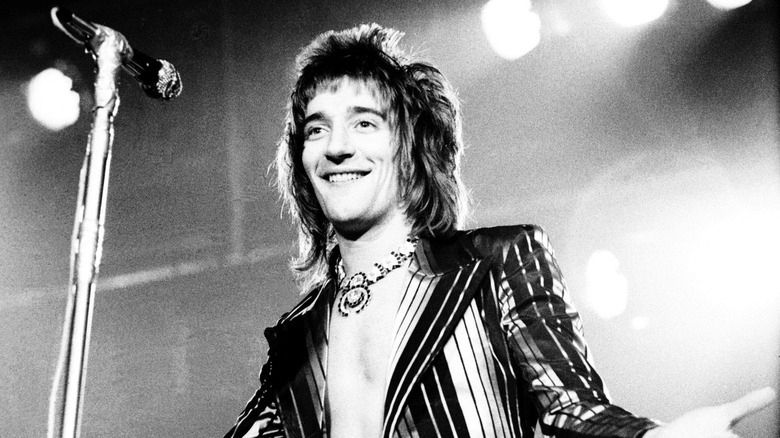
Rod Stewart's career is long, storied, and successful, but the songs he recorded and released in 1971 strongly suggest that he peaked relatively early on, in that very year. Possessing one of the most distinctive voices in rock, Stewart's raspy and emotionally hefty style carried with it a respect and love for both folk music and American R&B. Unbothered by a strange urban legend, Stewart became one of the biggest and best rock stars of the 1970s after kicking off the decade with a boisterous and near-perfect 1971. As the years went on, Stewart frequently adopted new formats, but he never quite went away, dipping into disco, synth-pop, and traditional standards. It was all a far cry from 1971, when Stewart was at the top of his game with his creative and commercial breakthrough LP "Every Picture Tells a Story" and his work with the rock band the Faces.
Stewart has had many good years, of course, but none as favorable or as important as 1971. Here are the five songs that demonstrate why those 12 months were so crucial to the legend that is Rod Stewart.
Reason to Believe
"Every Picture Tells a Story," Rod Stewart's third album, showcases the artist's songwriting, but he didn't always write his own material. His version of Cat Stevens' 1965 "The First Cut is the Deepest" demo became one of his biggest hits, and in 1971, he made a smash out of a mid-1960s song by relatively obscure American folk singer-songwriter Tim Hardin. Stewart makes it his own, embracing his favored folk-style instrumentation and singing from the heart and with palpable frustration, Hardin's lyrics, which are full of wordplay and mixed emotions that try to make sense of a complicated romantic attraction.
"Reason to Believe" was the first single off "Every Picture Tells a Story," and it made a modest run up the Hot 100 in the summer of 1971. Then so many DJs around the U.S. turned over their Mercury Records-issued 45 and found the other song on the other side to be a bit more jaunty. Changing places with the original B-side, "Reason to Believe" hit No. 1 as the reverse of "Maggie May."
Maggie May
In 1971, Rod Stewart scored his first of four career No. 1 hits in the U.S. when "Maggie May" topped the pop chart for five weeks. A propulsive rhythm and a spirited, sing-songy melody mask the lyrics, which detail the rise and fall and postmortem regrets of a relationship with an older woman, based on one that Stewart personally experienced when he was much younger. Stewart belts out the happy-seeming song with a playful tone, vying for airtime with a folky mandolin and warm guitar solo, but clues about the dark episode of his past remained in the final cut. "You stole my soul," songwriter Stewart alleges, adding "You led me away from home / just to save you from being alone."
Mercury Records didn't even initially have faith in the power of "Maggie May." As previously mentioned, in 1971, the song was utilized as the B-side of "Reason to Believe," a single promoting the album "Every Picture Tells a Story." Radio influencers preferred "Maggie May" to "Reason to Believe," however, and the voluminous airplay helped take the song to No. 1, marking the true arrival of Stewart as a major star of the 1970s.
Stay With Me
Singer and guitarist Steve Marriott made gestures to leave the popular British Invasion era rock band the Small Faces by 1969, and the remaining members recruited guitarist Ron Wood and singer Rod Stewart and called the substantially new project the Faces. Parallel to the slow launch of his own solo career in the early 1970s, Stewart also performed heavily blues-influenced hard-rocking numbers for the Faces. This permutation slowly started disbanding in 1973 in large part because of Stewart's dazzling extracurriculars, but the Faces at least churned out "Stay With Me," a single written by the two newest members of the band. Musically, it's a relentlessly boisterous party rocker; lyrically, it's a cold dismissal of a potential one-night stand.
"Stay With Me" benefited from the still-new cross-Atlantic superstardom of Stewart. It's the only Top 40 hit in the U.S. for the band in their era as the Faces. A single from the album "A Nod's as Good as a Wink...To a Blind Horse," "Stay With Me" was issued as a 45 in 1971 and would crawl up to No. 17 on the pop chart by February 1972.
(I Know) I'm Losing You
Rod Stewart's soft spot for classic, 1960s R&B has been a celebratory through-line in his recording career. In the early 1990s, he squeaked into the Top 10 with a cover of the Isley Brothers' 1966 hit "This Old Heart of Mine (Is Weak For You)" and the generalized tribute to the era, "The Motown Song," but Stewart hinted he'd be engaging in such musical activities back in 1971. Buried deep in the track list of his solo album "Every Picture Tells a Story" came Stewart's take on "(I Know) I'm Losing You," made famous and propelled into the Top 10 in 1966 by the Temptations. The singer plays up the innate soul music elements while also adding in plenty of loud and heavy guitars and drums.
While released on a Stewart LP, "(I Know) I'm Losing You" was co-credited to the Faces. At any rate, it was yet another hit for the singer in 1971 and his last one of the calendar year. It peaked at No. 24 on Christmas Day.
Mandolin Wind
"Mandolin Wind" didn't exactly storm the charts in 1971, but it's as important to Rod Stewart and his sound as his many objective commercial smashes from that year. Included on the "Every Picture Tells a Story" album, Mercury Records used the song to fill out the B-side of the moderate hit "(I Know) I'm Losing You," but then released it as its own A-side six years later, whereupon it failed to make the pop chart in the U.S. or the U.K.
Both written and produced by Stewart himself, the five-minute-plus acoustic ballad employs expert-level mandolin, and it comes across as an ageless, timeless piece of folk, a genre Stewart pulled from throughout "Every Picture Tells a Story." Stewart clearly likes "Mandolin Wind" a great deal, as he allowed the non-hit to make the cut on his 1973 hits compilation "Sing It Again Rod," and he performed a fully acoustic version for his 1993 live, MTV-branded album "Unplugged...and Seated."