

5 Bee Gees Songs That Will Take Boomers Back To Their First Crush
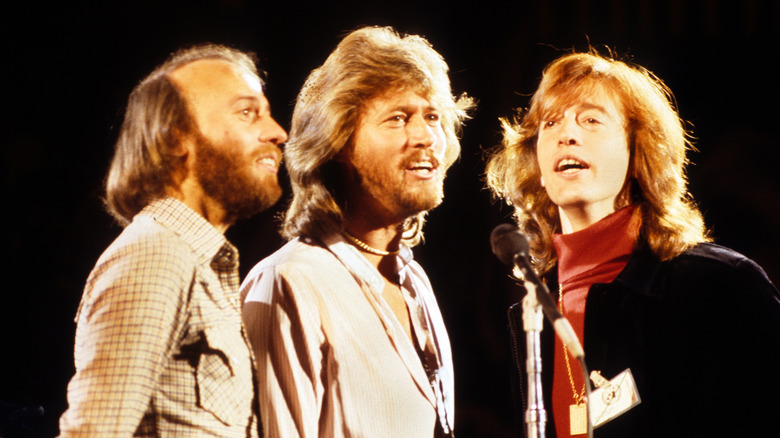
As the act that scored more No. 1 hits in the '70s than anyone else, the Bee Gees pre-disco works are a treasure trove of romantic pop ballads, songs tailor-made for the lovestruck, lovelorn, and lovesick teen boomers of the era. These were kids who met the incoming rock 'n' roll movement with open arms, graduating from Buddy Holly to the Beatles to the Bee Gees in quick succession. Having music this sweet and perceptive gave plenty of boomer teens a lifeline during those awkward moments when first crushes teetered on the edge of either becoming first loves or first heartbreaks.
How many different ways did the Bee Gees express the unspoken romantic thoughts of the middle- and high-school lovers of the boomer age? We leafed through the catalog and found songs that explore the inexpressible depth of new love, such as "To Love Somebody." We also chose pieces about the fragility of love, which serve as perfect soundtracks for finding out your crush isn't crushing on you in return. And the ultimate anthem of unconditional love, "Run to Me," bubbled up for us as the perfect way to tell your new boo that no matter what, you'd be there to take away their pain — even if you hadn't yet reached the hand-holding stage of your pairing.
How Can You Mend a Broken Heart?
For the first crush that turned out to be a heart-crusher, the Bee Gees spun out a perfect pre-emo tune meant for bemoaning an unhappy ending. "How Can You Mend a Broken Heart?" expresses the carefree days of youth before love comes knocking and turns everything on its ear. Sung by a teenager who's feeling the searing pain of a lost romance, it's practically a prayer for guidance, a stepping stone to the next crush that will hopefully have a happier ending.
This isn't one of those happy-go-lucky love songs, obviously; it's a rumination on getting over a lost love. "How can you mend a broken heart?" the Gibbs sing, "How can a loser ever win? / Please help me mend my broken heart and let me live again." It's a philosophical musing that's been covered by crooner Andy Williams (whom songwriters Barry and Robin Gibb actually intended to have sing the song) and R&B king Al Green.
Despite its application to romantic themes, the tune was actually an expression of Robin Gibb's regret at leaving the band over creative differences (he wanted to sing lead). The lyrics were a reunion story, and the song became the band's first No. 1 smash in 1971, helping heal the hearts of the Bee Gees and countless crestfallen boomer teens along the way.
To Love Somebody
If an unrequited crush on someone during the teen boomer era had an anthem, "To Love Somebody" from 1967 would be a prime candidate. "There's a light / A certain kind of light / That never shone on me / I want my life to be lived with you," Barry Gibb sings, admitting that this lonely heart's feelings may never be matched by the one he adores. The heartstrings of many adolescents surely felt this line was written expressly for them, a direct hit on the bullseye of pining for a perfect partner.
One of the many songs the Bee Gees wrote for others to sing, "To Love Somebody" was meant for R&B hero Otis Redding, though he died before recording his version. By that time, it was already a hit for the Bee Gees, and would go on to be covered by Aretha Franklin and James Carr. But the Gibb Brothers' version set the tone of heartbreaking desperation with a timeless chorus: "You don't know what it's like, baby / To love somebody / To love somebody / The way I love you."
Anyone who's ever felt the overwhelming pull of early love knows the sentiment of potentially unrequited love is a nugget of truth set to an achy-breaky melody. To a young heart discovering the breadth and depth of love's inner workings for the first time, "To Love Somebody" is a perfect summation of how you may feel about your crush, and how you may hope they feel about you in return.
Words
Imagine you're a boomer youth with heart-eyes for a sweet someone at a time when love poetry could still make a winning impression. Hearing "Words," in which Barry and the boys confirm the complexity of using verbal skills to win hearts, was enough to lock in core memories of those who needed to hear your spoken soul. These were deep times indeed. Be it love letters, deep conversations, or simple declarations of affection, the boomer teen romance was a word-dependent phenomenon — without memes or GIFs to express their deeper feelings.
When the Bee Gees spoke to boomer souls in their 1968 hit "Words" with the lines, "It's only words, and words are all I have / To take your heart away," they were speaking to a generation aching to verbally express themselves. For the romantic underdogs shooting their shot with someone they may have felt was out of their league, it's both a hopeful admission and a sorrowful plea.
Inspired by senseless disagreements both Robin and older brother Barry had been engaged in, the two came to understand the power of words to alter emotions. And so, they crafted a classic that spoke to the hearts of boomer youngsters who could latch onto a sentiment like "And I will give you all my life / I'm here if you should call to me," even if it was a tad on the dramatic side.
Lonely Days
The brothers were channeling their inner Beatles with the semi-psychedelic winner "Lonely Days," a depiction of the all-encompassing sensation of being so deeply in love, you can't imagine being without your boo. It showed that the trio could update their sound without losing the fundamental Bee Gees spirit, while also giving the boomer teen a tune to represent their romantic longings. With its split personality and catchy tempo shift at the midway point, it was a perfect song for serenading your crush before showing off your best dance moves, for better or worse.
The two-tiered tune begins dreamy and dirge-like with a rosy image: "Good morning, mister sunshine / You brighten up my day," then gives way to a stompy chorus that changes the tune's personality, declaring, "Lonely Days, lonely nights / Where would I be without my woman?" The juxtaposition of choir-like happiness against bluesy truth-telling gave crushing boomers a song that covered the entire spectrum of young love. Sure, it may be all hearts and flowers at the start of the day, but come nighttime, the realization that you're in deep and anything but being with your sweetheart is sheer loneliness falls like an anvil.
This mood-swinging single may not have been deliberately modeled after the patterns of adolescent love, but it sure spoke volumes to the ones who took it to heart. It also helped it become a No. 3 hit in 1971.
Run to Me
Oh, the sweet devotion of new love, when your crush is fresh and your dedication to them all-encompassing. Or at least that's what a boomer teen likely felt when they first heard "Run to Me" light up their transistor radio in 1972. It was a pitch-perfect poem about locking in your feelings, set to a honey-sweet melody sung by some of the most romantic voices in the business. The sheer pop magic of this soul-stirring ballad endures as one of the Bee Gees' best straightforward pop songs, launched just before the team dove headlong into the glittering pool of disco glitz.
For the middle- or high-school boomer whose world has been lit up with new love, the song provided a way to communicate those very deep yet very real feelings. The approach was highly literary, too: "And let it be like they said it could be / Me loving you girl, and you loving me / Am I unwise to open up your eyes to love me." Is this a modern take on Romeo and Juliet or a pop song that professes utter commitment?
If you were trying to figure out how to tell your potential bae how you were feeling, "Run to Me" was both, and it gave new love a jumping-off point; imagine hearing this song as a radio dedication made just for you. For the tongue-tied and sweaty-palmed teen of the day, there may never have been a surer way to get your point across.