

5 Nearly Perfect Beach Boys Songs That Should Be Required Listening For Younger Generations
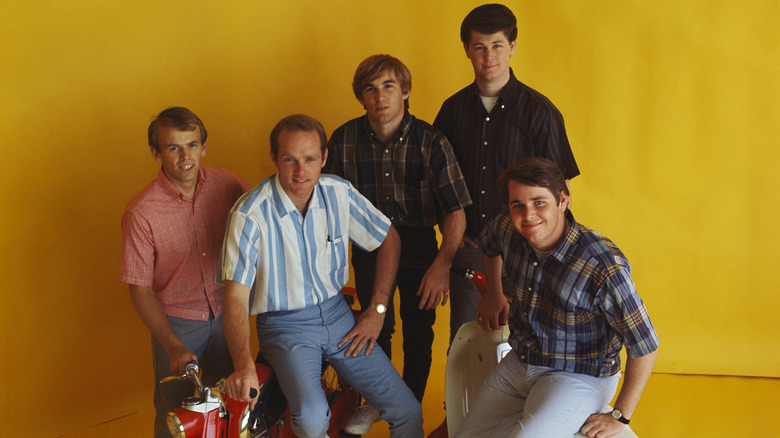
Listen up, kids: Respect your elders, at least when it comes to seminal bands that changed the history of popular music, like the Beach Boys. Brothers Brian, Carl, and Dennis Wilson, their cousin Mike Love, and high school friend Al Jardine created the California sound when they formed their group in Hawthorne, California in 1961. The Beach Boys' complex close harmonies and songs about fun in the sun shot them to the top of the charts, and that was before they rewrote the book on what pop could be and became one of the most important bands of the '60s. The act inspired the Beatles to push themselves further, resulting in their masterpiece "Sgt. Pepper's Lonely Hearts Club Band," and influenced later artists from David Bowie to Weezer.
The Beach Boys also changed rock history in 1966 when they recorded one of the greatest albums of all time, "Pet Sounds," which includes the gem "God Only Knows." But they were already crafting masterpieces, with Brian Wilson acting as the main songwriter and producer. Songs like 1964's "Don't Worry, Baby" shifted gears into a newer, lusher sound with introspective lyrics. Likewise, after "Pet Sounds," Wilson and the rest of the band continued to move the needle forward. Just look at 1971's "Surf's Up" from the album of the same name — it builds off of "Pet Sounds" and goes further with profound lyrics and an even more complex construction. So if you're from a younger generation, here are five Beach Boys songs you need to listen to.
Surf's Up
At their best, the Beach Boys' music can be described as three-minute-long symphonies, thanks to their complexity, depth, unusual instrumentation, and Brian Wilson's tendency to piece songs together over multiple sessions. "Surf's Up" perfectly encapsulates all of these characteristics. He wrote the music in one night with his writing partner at the time, Van Dyke Parks, who provided beautifully poetic lyrics. But it took much longer to record, around four years. It was originally tracked as part of the failed "Smile" album sessions in 1966-1967, spurred on by the friendly rivalry with the Beatles that nearly broke Wilson. The finished version eventually appeared on the band's 1971 album of the same name.
Musically, the song is a three-movement suite with gorgeous harmonies, intricate instrumentation (from horns to Moog synthesizer), and a breathtaking, sweeping feel. The legendary composer and conductor Leonard Bernstein considered it to be an important, complex work. Lyrically, it's nearly as intricate. Parks' words evoke the loss of childhood, the struggles of manhood, and spiritual rebirth. Wilson later added the lyric "A child is the father of the man," which directly references William Wordsworth's 1805 poem "My Heart Leaps Up" and helps center the song around the idea that our childhoods directly affect us as adults. It's a masterwork that requires multiple listens.
Don't Worry Baby
"Don't Worry Baby," from the band's 1964 album "Shut Down Volume 2," predates "Pet Sounds" by two years, but the song hints at what Brian Wilson and the rest of the band would later achieve. He had become obsessed with the Ronettes' "Be My Baby," listening to the track up to 100 times a day, and "Don't Worry Baby" was created in response to this fixation. What resulted was a song miles away from the Beach Boys' oeuvre at that time, which was centered around subjects like fast cars, surfing, and girls.
"Don't Worry Baby" takes a mature tone about male vulnerability uncommon for the era. What at first blush appears to be just another song about drag racing unfolds to reveal itself to actually be about the male narrator's fear and anxiety and need for comfort, which his girlfriend provides with the refrain "Don't worry baby / Everything will turn out all right." With Brian Wilson's soaring falsetto and the close harmonies of the rest of the band buoying him, the track has a lushness that presages the sound and lyrical content of "Pet Sounds" and later works. The Rock & Roll Hall of Fame included "Don't Worry Baby" on its list of the 500 Songs that Shaped Rock and Roll, along with four other Beach Boys tunes.
God Only Knows
"Pet Sounds" is Brian Wilson's magnum opus full of a long list of incredible songs and is best taken as a whole. Wilson himself suggested you listen to the album in the dark with headphones to best catch everything that's going on, and we concur. With this LP from 1966, Wilson used the studio as an instrument and combined actual instruments to create new sounds in the style of Phil Spector's "Wall of Sound" production. "God Only Knows" included an orchestra and a dizzying array of instruments from French horn to accordion to harpsichord, with Carl Wilson singing lead with incredible sensitivity to construct an audacious and uncompromising pop masterpiece.
The lyrics, by collaborator Tony Asher, play with preconceived notions of what a love song is supposed to be and instead delve into the complex nature of love relationships. This is achieved by slyly shifting between what sounds like a negative "I may not always love you" and a positive "But as long as there are stars above you / You never need to doubt it / I'll make you so sure about it." This lyrical sleight-of-hand continues throughout the song. "God Only Knows" has come to be considered one of the greatest pop songs ever made. Paul McCartney has admitted he tears up every time he hears the song, and U2's Bono described the track's string arrangement as "fact and proof of angels" (via Brian Wilson).
Good Vibrations
The same year the Beach Boys put out "Pet Sounds," they also released "Good Vibrations" as a stand-alone single. In December 1966, it hit No. 1 on the Billboard Hot 100 and became their first million-seller. As with "Pet Sounds," Brian Wilson indulged his vision to the hilt to create "Good Vibrations." He spent around six months on this single song, using multiple LA recording studios. Sometimes he had the band and orchestra work on small sections for a few minutes, while other times they crafted longer sections for hours. Wilson pieced the track together from these fragments of recordings, building up a unique sound that he already had in his head. The cost was enormous and is considered the most expensive single ever made, running as much as around $520,000 in today's dollars. The track uses a vast array of instruments from the theremin — an electronic instrument played by waving your hands between two antennas to control pitch and volume — to the cello.
The structure of "Good Vibrations" is as unique as the sound, with a push and pull giving it a truly dynamic feel. Besides shooting to the top of the charts in both the U.S. and the U.K., the song was hailed by reviewers at the time as "imaginative" and "hypnotic." The track later appeared on the Beach Boys' 1967 album "Smiley Smile," which was pieced together from some of the abandoned "Smile" sessions. Even 60 years on, "Good Vibrations" continues to be lauded as a groundbreaking pop tour-de-force.
This Whole World
"This Whole World" may not be as well known as some of the other Beach Boys' songs, but it's by no means any less important. Brian Wilson wrote the song for the 1970 "Sunflower" album, again spending hours and hours to get it right with the band (including Bruce Johnston, who joined the group as a touring bassist and vocalist in 1965 before becoming a permanent member). It's one of Wilson's favorites, which says a lot. He's called it a "spiritual tune," and indeed it is (via "God Only Knows: Faith, Hope, Love, and the Beach Boys"). "This Whole World" has a joyful sensibility both musically and lyrically. The instrumentation includes tubular bells and glockenspiel that give it a bright tone that matches Carl Wilson's angelic vocals.
Like the music, the lyrics of this short song (just under two minutes) resonante with a sense of universal love: "Late at night I think about / The love of this whole world / Lots of different people everywhere / And when I go anywhere / I see love, I see love, I see love." It's an under-the-radar Beach Boys song that, like the other songs on this list, should be required listening for younger generations.