

What Thickness Should Your Guitar Pick Be?

When considering pick thickness — less than 0.45mm to over 1.20mm — you've got to ask yourself one fundamental question: Are you strumming on an acoustic guitar or shredding on an electric guitar? Thinner picks are generally better for strummy-strummy playing, and thicker picks are generally better for lead lines. Sure, classical guitarists will always balk and say, "My weirdly long fingernails are just fine, thanks," but the rest of us guitar players need picks.
Thin picks are flexible and bend more easily to accommodate upstrokes and downstrokes when strumming across multiple strings, but they're too flimsy for muscling through power chords or challenging riffs. Thicker picks, by contrast, are rigid and tend to get caught when strumming, which produces uneven sound across the strings, though they're firm enough for precision playing. Then there's medium thickness, a general all-purpose pick decent for all play types and also good for beginners getting their first electric guitar.
Beyond this general overview, there are plenty of addendums we've got to go through. But most importantly: Even though you might think that a half-millimeter difference couldn't possibly matter too much when playing the guitar, it really does. It makes an enormous difference, just like the pick material and type.
It's all in the feeling
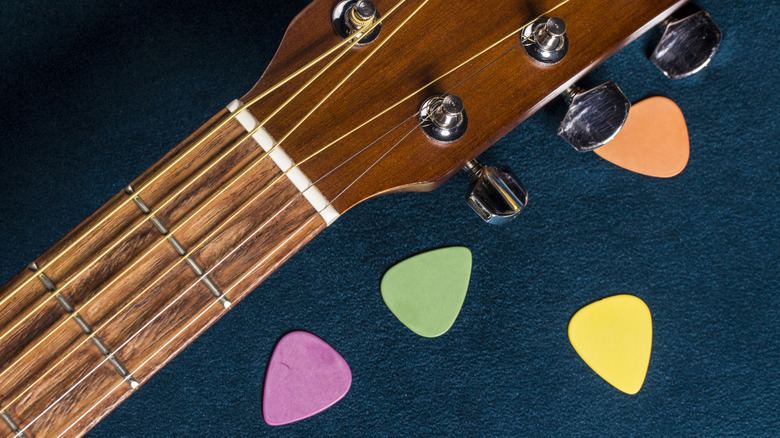
Picks are generally separated into five categories of thicknesses: extra thin (less than 0.45mm), thin (0.45mm to 0.69mm), medium (0.70mm to 0.89mm), heavy (0.90mm to 1.20mm), and extra heavy (1.20mm and over). These are the names you'd call these picks if you went to a music shop to buy some like you're ordering fast food (e.g., "Can I have a couple medium picks, please").
But before you get overwhelmed thinking that this is too many numbers, don't worry. You can't really tell what feels right until you pick up a pick and wield it in your hand, squeeze it, waggle it around a bit, pluck a few notes, etc. Just buy a bunch of different picks, take them home, and see what works (they're cheap). Then, you'll not only see that there's a big difference in feeling even between a thin and medium pick but also understand that it's all about feeling. Pick preferences depend first on what kind of music you're playing and then wholly on personal preference. This is a big deal, as pick thickness also influences your hand mechanics and muscle memory.
No matter what, remember that thickness also impacts tone. If you use a thin pick to try and play through a killer classic rock solo (maybe the kind that's been imprinted on fans for life), it probably won't work. The tone won't be snappy enough, and the flexibility of the pick will make things imprecise when playing tight movement patterns. On the other hand, if you just want to play Bob Dylan's "Knockin' On Heaven's Door," you'd be mad to use a heavy pick because the strumming will sound jagged and feel unsmooth.
Material, type, and brand
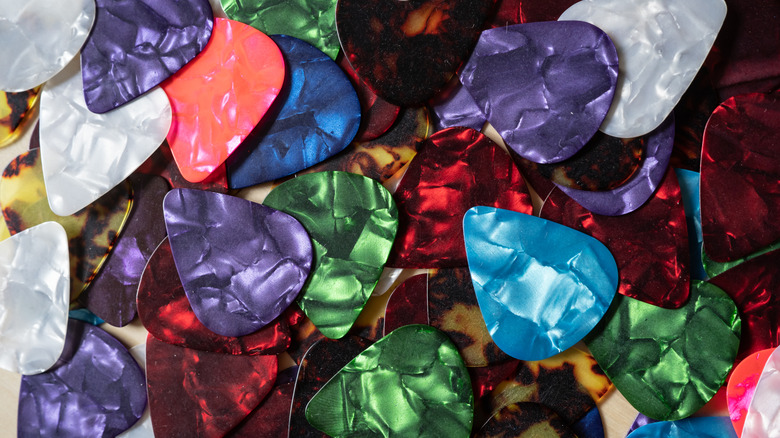
The thickness of your guitar pick is also influenced by material, type, and brand of pick. Material, like thickness, determines the tone and flexibility of the pick, and certain materials go hand-in-hand with certain thicknesses. In other words, don't buy a pick made from metal and expect it to be flexible or thin (also, it'll dramatically reduce the lifespan of your strings). By contrast, the most common and time-honored pick material, celluloid, is super flexible. On and on it goes for every material — nylon, Ultex, and tons more.
Then there's the pick type. Jazz players, for instance, sometimes use a less-triangular, more rounded jazz pick. Thick nylon is a good choice for this model, as it produces a mild tone suitable for the genre that doesn't explode into the mix. There are also picks shaped like equilateral triangles (aka triforce picks) that allow you to rotate each one to any one of three points when one of the points wears out. These are good for bass players or players who play aggressively, meaning they're super thick ("extra heavy" by pick terminology). Folk or rock players can go with the typical teardrop design, the most common you might envision when hearing "pick." These come in all thicknesses.
And of course, there's the pick brand. Some brands, like Timber Tones, specialize in wooden picks (which will not be thin) and other outré types. Beyond this example, there are tons of brands to choose from, each with their own features and strengths. But if you go to a music store and just ask for a pick, you'll likely get the Fender 351, a teardrop-shape design inscribed with the Fender logo. Just specify the thickness and you're good to go.