

5 Stone-Cold Classics You Didn't Know Bob Dylan Wrote
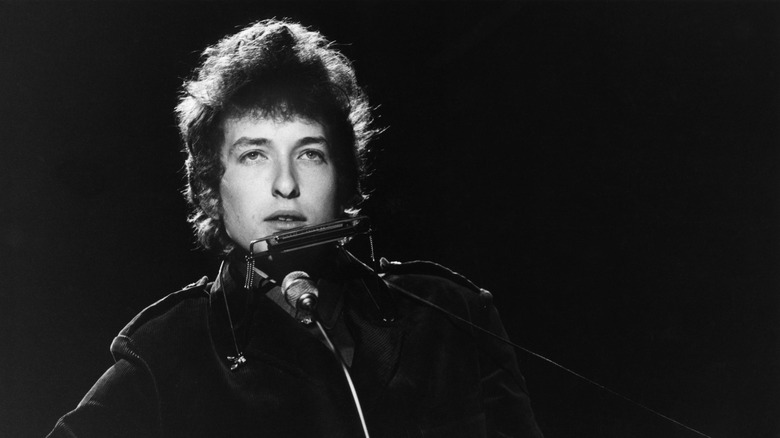
From the hard-hitting protest songs he penned in the early 1960s to his achingly beautiful love songs, as well as the historical panoramas of America offered by his most recent releases, Bob Dylan's best songs are typically raw, honest, challenging, and poetic. And down the years, his oeuvre has also proven to be inspirational to other performers, who have recorded a huge number of cover versions of his songs, some of which have arguably come to overshadow the originals and achieved classic status in their own right.
Bob Dylan's sprawling discography is one of the most rewarding listening experiences in the history of popular music, but here are five classic Bob Dylan songs that, to most listeners, will likely be more recognizable by their famous cover versions. In each case, both the Dylan original and the cover versions, such as "All Along the Watchtower" and "Knockin' on Heaven's Door," have received significant critical acclaim, but it's the covering artists who claimed the prime real estate in the public consciousness.
All Along the Watchtower
You may instantly recognize it as a Jimi Hendrix classic, but "All Along the Watchtower" first appeared as a deep cut on Bob Dylan's 1967 LP "John Wesley Harding." The album saw the previously folk-oriented performer grow even rootsier, broadening his palette further after the kaleidoscopic 1966 album "Blonde on Blonde" and his exploratory collaboration with the Band, "The Basement Tapes," recorded the previous year.
Employing an elliptical lyrical approach that is now considered definitively Dylanesque, "All Along the Watchtower" imagines a discussion between a joker and a thief, ruminating on their place in the world while seemingly residing or being held in the titular watchtower. Despite the sparse images and dialogue on offer, Dylan paints an epic world populated by princes and riders that summons the sense of an impending catastrophe.
It is this aspect, perhaps, which fired the imagination of the song's greatest interpreter, Hendrix, who recorded his iconic version with the Jimi Hendrix Experience for the album "Electric Ladyland" in 1968. Hendrix's freewheeling take is studded with evocative solos that lend a cinematic aspect missing from the original. Even Dylan himself admitted that Hendrix's version is better, and has since adopted the guitarist's arrangement of the song in his own performances.
Make You Feel My Love
"Make You Feel My Love" is perhaps one of the most perfect ballads in Bob Dylan's entire discography, a tender, emotionally charged piano track with just Dylan's raw vocals on top. The piece is the most widely celebrated track on "Time Out of Mind," his 1997 studio album that many fans and critics agree represents a late high watermark for the songwriter.
But Dylan's own version of "Make You Feel My Love" was instantly overshadowed by the fact that the original was recorded by someone else. Billy Joel was actually the first musician to record the song, releasing it as the lead single of his "Greatest Hits Volume III" album a month before Dylan's recording appeared.
The song has since attracted a great number of cover artists, with Garth Brooks taking it to the top of the Hot Country Songs chart in 1998. However, arguably the most famous cover of the song nowadays is by British singer Adele, who included it as the only cover song on her debut studio album "19" in 2008. As she explained at the time of its release: "The lyrics are just amazing and summed up exactly what I'd been trying to say in my songs. It's about regretting not being with someone and it's beautiful. It's weird that my favourite song on my album is a cover, but I couldn't not put it on there. I'm not normally a Dylan fan either" (via Yorkshire Live). There are now estimated to be over 450 professional recordings of the song in existence.
Knockin' on Heaven's Door
Despite being somewhat weighty in its subject matter, "Knockin' on Heaven's Door," a balladic meditation on mortality, was a huge commercial success for Bob Dylan when it was released in 1973. The highlight of his "Pat Garrett & Billy the Kid" soundtrack album, it peaked at No. 12 on the Billboard Hot 100 chart when released as a single, proving to be one of the biggest hits of his career. The song had a long afterlife as a fixture of his live shows, too, with Dylan performing the song hundreds of times for nearly three decades.
It remains popular in the 21st century, with more than 900 million streams on Spotify as of mid-2026, so chances are that even if you're not a Dylan fanatic, you've likely encountered it by now. But surprisingly, "Knockin' on Heaven's Door" is even more popular as a cover version, with Guns N' Roses' bombastic take on the track having hit the 1 billion streams mark.
Axl Rose et al. recorded their hard rock version of "Knockin' on Heaven's Door" in 1990. Like Dylan, they recorded the song for a soundtrack, this time for the movie "Days of Thunder," and it was included on the 1991 album "Use Your Illusion II." And like their biggest ballad "November Rain," the track amps up Slash's guitar parts, with Rose in fine vocal form that lends the song a more muscular feel than Dylan's original. Countless other big names have covered the song down the years, including Eric Clapton, Nick Cave, and Lana del Rey, but both Dylan's and GNR's remain the most famous.
You Ain't Goin' Nowhere
"You Ain't Goin' Nowhere" was a song that first emerged during Bob Dylan's famous sessions in the basement of Big Pink, a house in West Saugerties, New York, he used for composition and recording with the Band — then known as the Hawks — following his 1966 motorcycle crash. Dylan's version with the Band was released on "The Basement Tapes," a compilation of the work they made together that only came out in 1975, some eight years after most of the tapes were recorded.
"You Ain't Goin' Nowhere" is the most popular of the song on "The Basement Tapes," with the most streams on Spotify of any song on the album, as of mid-2026. But its popularity as a recording pales in comparison to that of the Byrds, who recorded the song in 1968 as the opening track of their album "Sweetheart of the Rodeo." Their version, which peaked at No. 74 on the Billboard Hot 100, dials up the country influence, featuring lively lead guitar and an atmospheric organ part.
If Not for You
1970 threatened to be tough for Bob Dylan. That year, he released "Self Portrait," a double album that was widely panned and saw critical consensus largely turn against him for the first time in his career. It would have been enough to rock another artist, but Dylan carried on unperturbed. Just months later, he released "New Morning," a fresh suite of songs that drew on his earlier styles but continued his habit of penning songs that sound as though they were pulled from the Great American Songbook. The opening track "If Not for You" is one such song.
A richly lyrical paean apparently inspired by Dylan's wife, Sara, "If Not for You" took on a life of its own just a month after "New Morning" was released in October 1970, when it was included on George Harrison's much-loved triple album "All Things Must Pass." Harrison reworked the song with a new arrangement that featured prominent slide guitar, and which elevated the song beyond Dylan's original.
Harrison's version was popular, and remains one of the most-streamed songs on the album. His arrangement gained a boost in 1971 when "If Not for You" was recorded by Olivia Newton-John, who stuck closely to Harrison's version and scored a No. 1 Adult Contemporary hit with the single, also hitting No. 25 on the Billboard Hot 100. She became so closely associated with the song that "If Not for You" was also used as the title of her debut studio album.