

5 Defining Duets Of The '60s That Cast A Spell
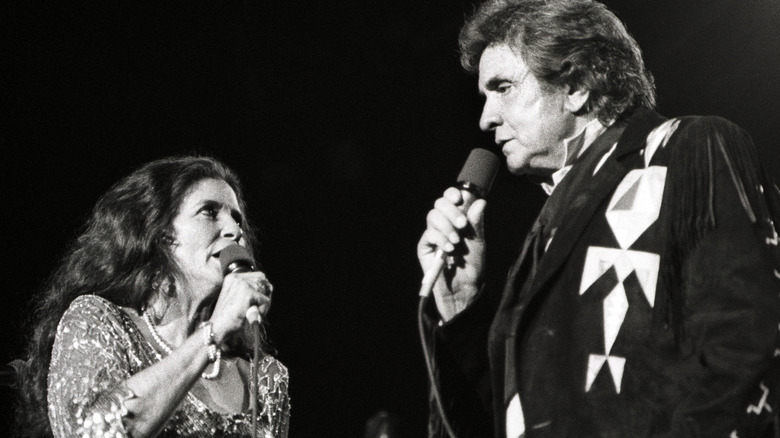
In the 1960s, the public grew enamored with major-star duets across genres that included pop, rock, soul, and country, and the phenomenon would endure for decades. However, only a few of these blockbuster '60s duets would enchant listeners and earn their place in music history. Whether the two-singer structure was a permanent arrangement or a limited-time-only event, these star-loaded smash hits were something to behold. An eventful collaboration that often captured artistic electricity or romantic chemistry on wax, they two-stepped up the charts and became some of the biggest hits of the era.
We didn't just choose partnerships that sold a lot of copies and won awards, we've also focused on entries that were foundational to the consistently progressive music scene of the '60s. As far as we're concerned, these are the duets that best represent the state of '60s pop culture, inspiring those that followed in the decades to come. Here then are five singles that showcased the wide variety of '60s music and showed where music was headed, so long as it employed the duet structure.
Deep Purple — April Stevens and Nino Tempo
Rock 'n' roll music and its underlying excitement and reliance on the electric guitar broke in the 1950s but became fully entrenched in the mainstream in the 1960s. With that shift, some of the dominant pop music styles of the past became increasingly passé, like crooners singing the same familiar standards. Nino Tempo and April Stevens, a brother-and-sister duo, helped bring about the 1960s rock 'n' roll revolution by adapting a stale old chestnut, "Deep Purple," into a shimmering banger.
"Deep Purple," the song from which Deep Purple got its name, was composed in 1934 and quickly became one of the most commonly heard songs in the U.S., with versions recorded by bandleaders including Jimmy Dorsey, Guy Lombardo, and Paul Whiteman. For their 1963 take on the song about the intoxicating effects of memory, Tempo and Stevens threw in some piano and harmonica with the 1930s lyrics to make a bouncy and engrossing rock song. Not only was the duet a No. 1 hit, it was also one of the first in that style to win a Grammy Award.
I Got You Babe — Sonny Bono and Cher
While the 1960s birthed a disparate mix of styles, sounds, and looks, the cultural archetype perhaps most associated with the decade is that of the hippie. While that may conjure up images of Woodstock, Vietnam War protestors, and psychedelic rock, all those late '60s hallmarks wouldn't have happened without the slow infiltration of a youthful, boomer sensibility in the middle of the decade. After years of toiling in various capacities on the fringes of mainstream music, Sonny Bono and Cher broke through in 1965 with their sweet, hypnotic, folky, and slang-packed pop-rock devotional, "I Got You Babe."
An iconic '60s love song that went gold, "I Got You Babe" spent three weeks at No. 1 in the summer of 1965. Listeners loved the song on its own merits and appreciated that the duo responsible for it, billed as Sonny and Cher, were a real-life couple. That monster hit launched the Sonny and Cher phenomenon, a recording act as well as the stars of variety TV shows. "I Got You Babe" is also where the public got its first taste of Cher, one of music's most legendary stars who remained an evolving hit-maker well into the 21st century.
Jackson — June Carter and Johnny Cash
"Jackson" represents the landmark personal and professional coming together of two icons: solo star Johnny Cash and June Carter, a member of the Carter Sisters and part of the foundational Carter family of country music. While Carter co-wrote Cash's 1963 hit "Ring of Fire" and sang with his band, "Jackson" featured both vocalists singing in unison on the rapid-fire tale of a fiery relationship turned tumultuous. The song was released in 1967, the same year that Cash's divorce from his first wife was finalized — he proposed to Carter on stage in 1968, just after they sang "Jackson" together.
A No. 2 hit on the country chart, "Jackson" is driven by the palpable and intense chemistry of its performers. Cash and Carter permanently raised the bar on what would be expected of singers' love song duets with "Jackson," which became a demarcation point — performers now have to sell the attraction written into the song, whether it was real or something to be acted out.
You're All I Need to Get By — Marvin Gaye and Tammi Terrell
With a factory-like volume and precision, Motown Records generated tons of joyful, emotionally driven pop-R&B in the 1960s. Utilizing in-house songwriters and session musicians, it pushed a handful of performers to the fore, including Marvin Gaye and Tammi Terrell. In addition to their own significant solo careers, the singers teamed up for a string of smash hit duets, including "Ain't Nothing Like the Real Thing," "Ain't No Mountain High Enough," and "You're All I Need to Get By."
Vulnerable admissions and declarations of undying love power "You're All I Need to Get By," as do the sweet and infectious vocals of Gaye and Terrell. There's also a through-line of retrospective melancholy, as Terrell tragically died in 1970, about a year and a half after the duet marched up the pop chart. Lush, enveloping, extremely romantic, and representative of the Motown brand, "You're All I Need to Get By" peaked at No. 7 on the Hot 100.
Some Velvet Morning — Nancy Sinatra and Lee Hazlewood
One of Frank Sinatra's kids teamed up with an experimental producer and songwriter to make a fascinating and bizarre song that probably wouldn't have been a hit before the late 1960s. Best known for his behind-the-scenes work with rockabilly artists, Lee Hazlewood created Nancy Sinatra's disaffected 1966 breakup anthem, "These Boots Are Made for Walkin'," as well as many more of the singer's big and off-kilter hits, and contributed his own low-end, droning vocals on "Some Velvet Morning."
Peaking at No. 26 in early 1968, "Some Velvet Morning" finds Hazlewood and Sinatra alternating verses, with the former delivering inscrutable, cloudy lines like "Some velvet morning when I'm straight / I'm gonna open up your gate / And maybe tell you 'bout Phaedra." Sinatra counters with surreal, sweetly sung couplets evoking imagery of "dragonflies and daffodils" while also claiming to be Phaedra. That trippy, non-traditionally structured song proved that psychedelic music had not only arrived, but had also infiltrated pop.