

What Is The Best Acoustic Guitar For Beginners?
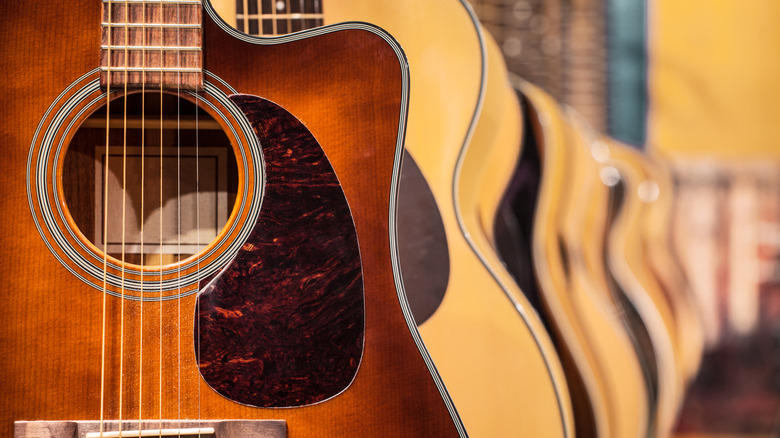
Acoustic guitars are a better place to start your guitar journey because they're better for beginners, overall. But no matter that you might want to just stroll into a shop and pick up a random six-string and be on your way; there's an ocean of guitar choices to swim through. If you just want a clear-cut answer to which acoustic guitar is best for beginners, then go get a Takamine GN11MCE. Beyond that basic fact, much more info awaits.
When buying a guitar, cost vs. quality is easy enough to understand. Beginners don't need a $6,000 Martin, but they also don't need crap, which means scrapping Amazon deals for $50 guitars with cases and straps. You also don't want to confuse an acoustic guitar with a classical guitar, the latter of which uses nylon strings and has a different body. Speaking of body, your guitar body affects everything about how the guitar feels in your hands and arms, which affects your core muscle memory. Dreadnoughts are a common beginner recommendation, but their large size can be off-putting, while parlor guitars can look and feel like toys. A guitar like the Takamine GN11MCE is similar to an auditorium or grand auditorium size, which is in the middle but doesn't sacrifice fullness of sound. On and on it goes.
Suffice it to say that the Takamine GN11MCE ticks all boxes. It's even got a cutaway, is made from solid wood and not laminate composite, looks pretty, and can retail as low as the $300 to $550 range.
Size, wood type, and construction

We already mentioned dreadnaught guitars (big), parlor (small), and auditorium (medium), to which we could add jumbo (really big), acoustic electric (acoustic with technological components like amp jacks), weird plastic-backed Ovations, and many, many more. Buying your first acoustic guitar isn't as simple as walk in store, get guitar, leave and be awesome. Size not only affects how you handle the guitar, but it affects the guitar's tone, which itself is affected by wood type and construction type.
No matter that big, voluminous dreadnought bodies are hard to handle, especially for smaller people or smaller hands, they keep getting recommended, possibly because they fit what folks envision as a fireside "acoustic guitar." But new players shouldn't have to struggle to get their arm around their guitar and reach the fretboard. Bigger-bodied guitars also have wider frets, so you've got to stretch your fingers more to play chords, which is another difficulty that will also increase finger pain for new players. Smaller is better, but not baby-sized parlor. Technically, the Takamine GN11MCE uses a proprietary "NEX" body size equivalent to a mid-sized auditorium.
Then there's wood type (tonewood, it's called), like mahogany, rosewood, spruce, cedar, etc. Most guitars are made from a variety of wood, like the body vs. the fretboard, that affects its resonance and sturdiness. This intersects with solid-body guitars (the sections are made from whole pieces of wood) vs. laminate guitars (sections are made from super-flat layers of wood), the latter of which can admittedly be more resilient to the elements and help your guitar last longer. The Takamine GN11MCE is largely made from solid mahogany, which tends to be bright, warm, full in the mid-range frequencies, and a solid (so to speak) overall choice.
Cutaway, finish, and electronics
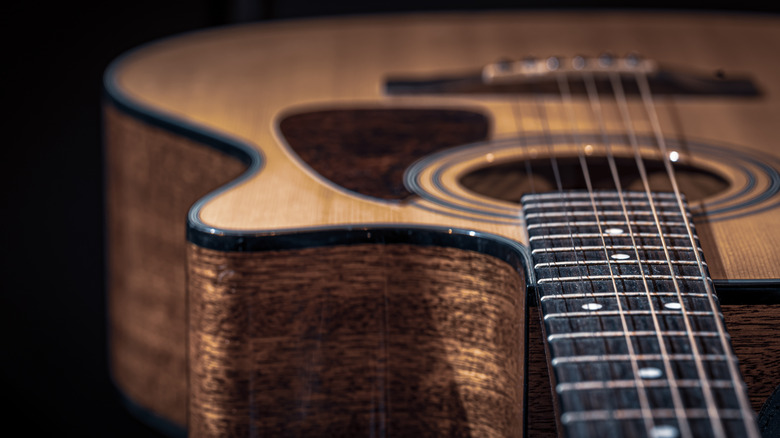
Let's be honest and admit that it matters if your guitar looks nice. At least, it matters if you ever want to emerge from your bedroom and not feel ashamed to play an easy beginner song for your tolerant loved ones. No worries here, because there really isn't a Takamine guitar that looks bad, no matter the model or price range. The Takamine GN11MCE is no exception, especially when it comes to wood grain and finish, which looks classy and not like cheap trash (it has what's called a "natural satin," semi-glossy finish).
On that note, the Takamine GN11MCE also has a pickguard on the bottom that's good for protecting the wood from strumma-strumma happy fingers. The pickguard is right next to a cutaway, a section of the guitar carved out to make it easier to reach higher frets. It's easy to make the argument that beginners won't use high frets very much, or to automatically associate high frets with Shreddie Van Halen or something. Not so. Why not just make it easier for new players to mess around and learn their instrument as easily as possible?
Plus, the Takamine GN11MCE is acoustic-electric, meaning you can plug it into an amp or equipment for your computer. It has a small set of controls to adjust the sound as it leaves your guitar: standard treble, mid, and bass frequencies plus volume. The cool thing is that you don't ever need to use these functions if you don't care about them, and it won't change anything about your playing, but they come with the guitar if you do. This is the final element that makes the Takamine GN11MCE a one-stop shop for every beginner's guitarists every need.