

Can Sudden Temperature Changes Damage Your Guitar — Even If It's In A Case?
We may receive a commission on purchases made from links.
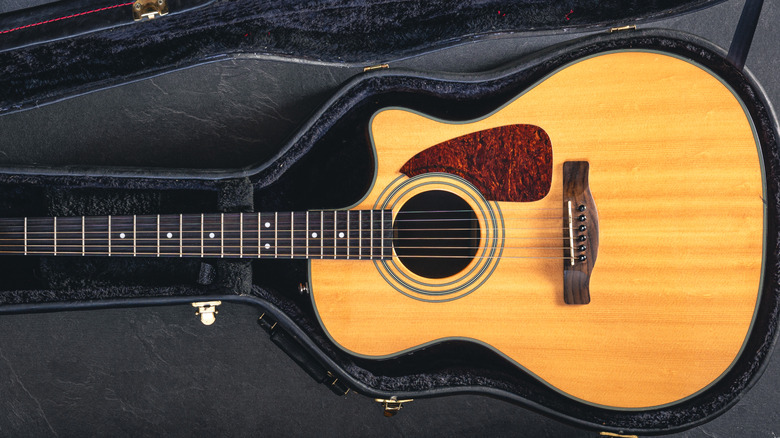
Whether you're a complete newbie to owning a guitar or someone who has owned the instrument for quite some time, you've likely wondered if you should store a guitar in a case or on a stand. After all, while putting your guitar in a case when not in use offers obvious protective benefits, it's pretty hard to beat the convenience of simply putting your guitar on a stand and being able to pick it up whenever you want to play it (especially if it has some slick decals on its body that make it a visually striking display piece for your room). But this might help you settle that internal debate: Keeping your guitar inside a hard, protective case can slow the detrimental effects of sudden or extreme temperature and humidity changes on your guitar.
Due to the type of materials used in crafting a guitar — primarily wood, but also the strings, the plastic or metal knobs, the glue that holds them together, and even the varnish — the instrument's longevity and playability can severely deteriorate beyond restoration. Your guitar's wooden neck and body may expand or contract due to moisture or extreme heat, affecting its durability and sound quality. Humidity also does a number on glue, causing failure or swelling, and can cause metal strings to rust.
This is where a guitar case comes in. It protects the instrument from moisture and temperature changes (or sunlight damage) better than a gig bag would. Some cases even have built-in climate systems that keep the guitar under consistent environmental conditions. It must be stressed, though, that a case won't make your guitar invincible against temperature and humidity; it merely offers protection to a reasonable extent.
Minimizing the effects of temperature and humidity on your acoustic or electric guitar

For beginners using an acoustic guitar, a hard case would be a smart investment, as it serves the dual purpose of added protection and easier portability. As for the temperature of the room in which you can safely keep the guitar, experts recommend an environment that's around 70 to 75 degrees Fahrenheit (21 to 24 degrees Celsius). Meanwhile, for humidity, between 40% and 55% relative humidity is ideal. Placing a guitar humidifier inside a case with a guitar that's dried out due to a period of low-humidity exposure may help restore the guitar inside its case, while a hygrometer that's properly calibrated helps you monitor humidity levels and prevent guitar over-humidification.
Interestingly, securing a reliable case is also a crucial step in how to keep an electric guitar in good condition, as electric guitars are equally sensitive to harsh environmental conditions. To stay on the safe side, strive to create a storage environment for your electric guitar that matches the aforementioned ideal temperature and humidity guidelines for acoustic guitars.
One thing you should never do to your acoustic or electric guitar, though — whether or not it's inside its case — is to leave it exposed directly to sunlight. The case may prevent the visually obvious signs of sunlight damage (e.g., faded colors, discolored finish), but it won't be able to stop the concentrated heat of the sun from expanding the strings, cracking or warping the wooden neck and body, and generally making the instrument unplayable.