

The 5 Best Rock Albums Of 1976
1976 was a stellar year for rock music, with countless classic albums released that still rank among the best the genre has to offer. At the time, hard rock reigned supreme, while punk rock was about ready to explode and change the musical landscape forever. But which rock albums from 1976 were the best the year had to offer? Here are our top five.
Taste is subjective, and the fact is that with the mid-1970s being a commercial high water mark for several rock genres, there are so many albums that could reasonably rank among the best that were recorded that year. With that in mind, for this list we have also stipulated that the records in question also need to represent a critical peak within an artist's discography. For instance, 1976 was the year that Led Zeppelin released "Presence," a fine album certainly, but not one which ranks with their self-titled LPs or "Physical Graffiti," so it doesn't make the list. Read on to find out which albums have.
Hotel California – The Eagles
Hotel rooms are closely associated with the rockstar lifestyle, with the on-the-road accommodation closely associated with all forms of rock 'n' roll hedonism. But for the Eagles, who in 1976 were busy crafting their fifth studio album, hotels also came to mean something else.
The legendary title track of the album is a biting satire of fame and money-hungry California, where the band's members spent eight months together living in a hotel as they recorded the album. But while such subject matter may be overt, the subtext suggests that the song is actually a critique of America itself after years of political and social upheaval. The lyrics to other songs, such as "Life in the Fast Lane," focus more directly on the rock 'n' roll lifestyle and the pitfalls that the band was trying to navigate at the time. The band itself was also going through changes at the time, with country-focused guitarist Bernie Leadon leaving the group and Joe Walsh taking his place.
The change meant a move toward a darker, heavier rock sound on much of the album, with the Eagles' genius for crafting effective arrangements still intact. It would prove to be a commercial and critical triumph for the Eagles, with "Hotel California" selling 28 million copies in the U.S. alone and becoming one of the best-selling albums ever.
Boston – Boston
Casual listeners may associate Boston with their perennially radio-friendly rock epic "More Than a Feeling," a Top 5 smash that has remained their most popular song despite higher chart success later in the band's career. But the truth is that the band's self-titled debut, which has sold more than 17 million units since it was released in 1976, was a record that in many ways defied the expectations of the music industry of the day. Rather than the creation of a group of musicians that had spent years performing together to hone their craft, the music on "Boston" was masterminded largely by one man: Tom Scholz, who didn't fit the stereotype of what a stadium-filling rock star ought to be.
A technically-minded engineer with a master's degree from MIT and a full-time job at Polaroid, Scholz began experimenting with musical instruments and recording equipment in his basement, before eventually crafting single-handedly the huge rock sound that would make "Boston" such a hit. He then recruited members including Brad Delp, whose instantly recognizable vocals became part of Boston's signature sound. While Scholz was under pressure from his record label to complete "Boston" in a professional studio, he secretly finished the album in his basement without their knowledge, working with the gear he had amassed and grown used to over the years, and the final result is unquestionably all the better for it. Boston would go on to enjoy a career as one of America's biggest touring rock acts, but in terms of impact, they never would reach the heights of their classic debut again.
Rocks – Aerosmith
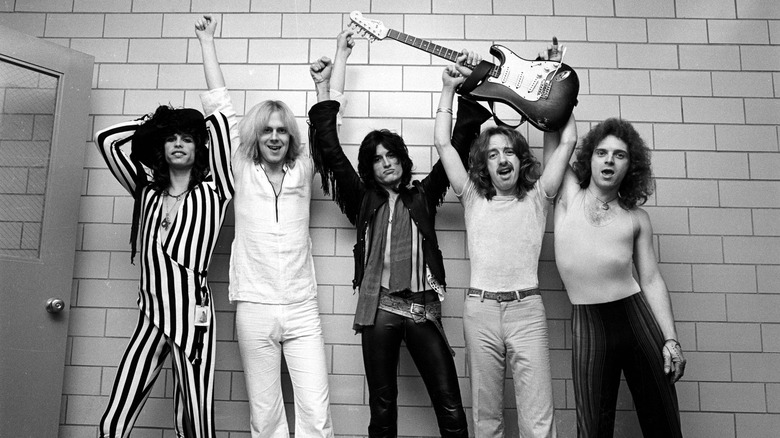
Aerosmith's commercial peak may have come two decades into their career in the late 1980s and early 1990s, when tracks like "Crazy" and "I Don't Want to Miss a Thing" dominated the charts, but for many fans the band was never better than when they were first becoming rock superstars in the mid-1970s. In 1975, Aerosmith released "Toys in the Attic," held by many to be their finest album, but 1976's "Rocks," which picks up where "Toys" left off, arguably surpasses it.
Written and recorded when the band was at its most drug and alcohol-fueled, "Rocks" was the first record Aerosmith created in their new "Wherehouse" studio and offices in the suburb of Waltham on the outskirts of their home city of Boston. As with previous albums, producer Jack Douglas highlighted the contrasting guitar styles of Joe Perry and Brad Whitford, and encouraged members to swap instruments and try new things. The result was some of the best material in the band's catalog. Tracks such as the Western-themed opener "Back in the Saddle," the riff-heavy "Get the Lead Out," and the pounding "Rats in the Cellar" show Aerosmith at their most rocking, and explain why they were one of the world's favorite live acts for more than half a century.
Station to Station – David Bowie
David Bowie's long and chameleonic career had many high points. He was at his most iconic, perhaps, in the early 1970s, when he took on the guise of extraterrestrial rockstar Ziggy Stardust, while his worldwide commercial peak came in the 1980s with his chart-dominating "Let's Dance" album. However, it was in 1976 that he released the album that many fans now agree is one of his very best: "Station to Station."
For the album, Bowie adopted a new persona that began to emerge during his shows supporting the 1975 soul-inspired album "Young Americans": the "Thin White Duke." This new character was a steely neo-romantic, inspired, it turned out, by fascist imagery, which Bowie himself was criticized for, with many interpreting comments he made in interviews around this time to mean that Bowie himself was a fascist. He claimed not.
Bowie was in the throes of a cocaine addiction at the time of "Station to Station," which may explain the dark, twisted worldview of the character he created; indeed, Bowie retired the Thin White Duke soon after. But the album he made while inhabiting him is unquestionably exceptional: a taut, paranoid masterpiece that contains a world in just six tracks. The most rewarding song is arguably the title track, which builds through several movements from pained ballad to funked-up march, over which Bowie spins his abstract, luminous lyricism. But the album is full of highlights, from the catchy "TVC-15" to the gorgeous "Wild is the Wind," revealing several aspects of Bowie's artistry. "Station to Station" made it to No. 3 on the Billboard 200, making it his highest charting album in the U.S. to that point and the third highest of his entire career.
Ramones – The Ramones
They say that 1976 was the year that punk exploded, and though there were countless so-called proto-punk artists who may be said to have invented punk, or something approximating it, before then, this really was the year that things began to coalesce around a definitive aesthetic. The debut album by the Ramones was made on a shoestring budget that at one time might have had a negative impact on a record's commercial prospects.
But the distinctive lo-fi aesthetic of "Ramones" struck a chord in 1976, standing in opposition to everything in rock music that had grown bloated and self-indulgent over the previous decade. Incorporating the catchiness and studio trickery of the Beatles with the distortion and rawness of bands like the Stooges and MC5, from the two-minute opener "Blitzkrieg Bop" onward, "Ramones" created a new template for much of the rock music of the late 1970s. Though the album charted outside the Top 200 at the time of its release, it remains a touchstone to countless artists with punk leanings 50 years later.