

5 Nearly Perfect Kenny Rogers Songs That Deserve A New Generation Of Fans
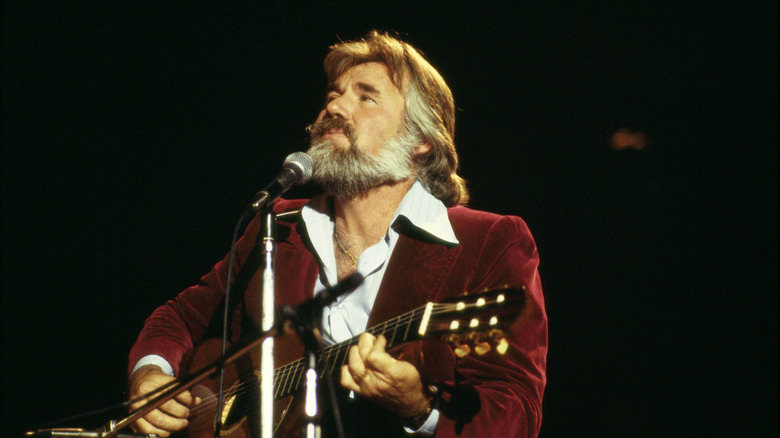
Back in the late 1970s and early '80s, it was nearly impossible to avoid Kenny Rogers, with his signature silver-feathered hair and beard. With a string of Grammy-winning cross-over hits and a television and film acting career (a decade before the launch of his rotisserie chicken chain), Rogers was seemingly everywhere. And with good reason. Rogers had a voice that could go from gritty to tender on a dime, and he made you believe every word he sang.
Rogers' early musical career in multiple genres that included doo-wop, folk, rock, and jazz helped forge his signature sound on his country and pop hits during his heyday. While he may have been the king of soft rock for Boomers, and his career highs had long past before his death in 2020 at 81, his music deserves a new generation of listeners. He was equally adept with narrative story songs as he was with love ballads. From the great life advice of his classic "The Gambler," to his gorgeous duet with Dolly Parton on "Islands In the Stream," there's a lot to love from his catalogue that younger generations should explore, starting with these five.
Just Dropped In (To See What Condition My Condition Was In)
In 1967, Kenny Rogers was part of the First Edition, a group that combined folk, rock, and country, which had splintered off from the folk group the New Christy Minstrels (which had also been the launching pad for other artists like Gene Clark of the Byrds and Kim Carnes, among others). The First Edition had a hit with "Just Dropped In (To See What Condition My Condition Was In)," an anti-drug tune about a bad psychedelic trip written by Nashville singer-songwriter Mickey Newbury (who also deserved a new generation of fans).
The psychedelic rock song features Rogers' gritty vocals amid swirling fuzz-heavy guitar, Rogers' rumbling bass, electric organ, and soulful backing singers. It may be an odd introduction to Rogers' career, but it's a song so wild it had to be included and displays an unusual side of his early career. It was with the First Edition that Rogers got his first real taste of success. The song was a Top 5 hit, and the band performed on "The Ed Sullivan Show" and had their own TV variety show. "Just Dropped In" also had a resurgence after being featured in the Coen Brothers' 1998 film "The Big Lebowski," providing yet another pop culture connection for this off-the-wall tune.
Lucille
By 1977, Kenny Rogers had become a solo artist and had begun to more deeply explore country music. That year, "Lucille," from his self-titled album, shot up both the country and pop charts and earned him his first Grammy Award. This is one of Rogers' masterfully interpreted story songs that he was so adept at performing. Written by songwriters Hal Bynum and Roger Bowling, "Lucille" tells the story of a woman leaving her husband and family behind as told through the perspective of a man she's just met at a bar in Toledo, Ohio. The narrator witnesses Lucille's jilted husband break down in front of them.
The song features an impossible-to-forget chorus: "You picked a fine time to leave me Lucille / With four hungry children and a crop in the field / I've had some bad times, lived through some sad times / But this time your hurting won't heal." Rogers' quiet, world-weary, raspy baritone perfectly matches the emotional tone of "Lucille" that ends with the narrator rejecting her after being haunted by the words of her husband. "Lucille" packs in an emotional journey in just over three and a half minutes, and Rogers does it without vocal fireworks, preferring a subtle approach that proves he was a masterful singer.
The Gambler
Riding high on the success of "Lucille," Kenny Rogers' next hit would be even bigger. "The Gambler" became an international hit, topping the Billboard Country chart and crossing over into the Hot 100. The song earned Rogers' his second Grammy, and even spawned a TV movie starring Rogers, proving 1978 was the best year of Rogers' career. "The Gambler," written by Nashville's Don Schlitz, tells the story of the narrator meeting an older gambler on a train "bound for nowhere" who dishes out his philosophy on life via the metaphor of gambling.
Other artists, including Johnny Cash, recorded the song before Rogers, but his interpretation was, and remains, the ultimate version. In Rogers' capable hands, the song maintains an air of mystery and magic, providing a riveting rendition that puts the listener in the center of the story. Beyond this, the song gives a fairly solid pragmatic approach to life exemplified by the chorus: "You got to know when to hold 'em, know when to fold 'em / Know when to walk away and know when to run / You never count your money when you're sittin' at the table / There'll be time enough for countin' when the dealing's done." Yes, besides being a great song, "The Gambler" provides a roadmap for life.
Lady
With its delicate piano, lush violins, and other orchestral flourishes, "Lady" signaled a very different sound for Kenny Rogers when he released the Lionel Richie-penned tune as a single in 1980. Rogers had felt that his sound was stagnating when he reached out to Richie, who was then in the Commodores. "The idea was that Lionel would come from R&B and I'd come from country, and we'd meet somewhere in pop," Rogers once told Billboard in 1980. The new sound proved to be a massive success. The song, which appeared on "Kenny Rogers' Greatest Hits," topped all of Billboard's charts (Hot 100, Country, Adult Contemporary, and Top Black Singles) and solidified Rogers' hit-making cross-over status.
Since "Lady" is a classic love song, Rogers took a different vocal tack than he had on other tunes. Unlike his earlier hits like "Lucille," on which his voice has a gravely timbre, on "Lady," his approach is much smoother while remaining distinctly his own. And like his previous work, Rogers stays away from pyrotechnics, instead using subtle vocal shifts to convey feeling. It's a love song for the ages.
Islands In the Stream
The legendary duet between Kenny Rogers and Dolly Parton on "Islands in the Stream" wasn't the first time Rogers had recorded duets with other female singers, including Sheena Easton and Kim Carnes, but the combination of Parton and Rogers' voices was something truly special. The song, which first appeared on his 1983 album "Eyes That See in the Dark," included Maurice and Barry Gibb — who produced the track — singing back-up. Between the Bee Gees-like musical touches, Parton's soaring soprano, and Rogers' grounding baritone, it made for a truly special song. It hit No. 1 on three Billboard charts (Country, Adult Contemporary, and Hot 100).
It was one of Rogers' many songs that were not only hits when they were released, but have remained classics. By the time of his death, Rogers had racked up a slew of awards and honors, sold more than 100 million albums, and even today remains a beloved singer with countless older fans. And, we hope, a new generation of fans will soon discover these nearly perfect Rogers songs and the many others he recorded over his long career.