

Out Of Kenny Rogers' 39 Studio Albums, These 5 Are So Underrated
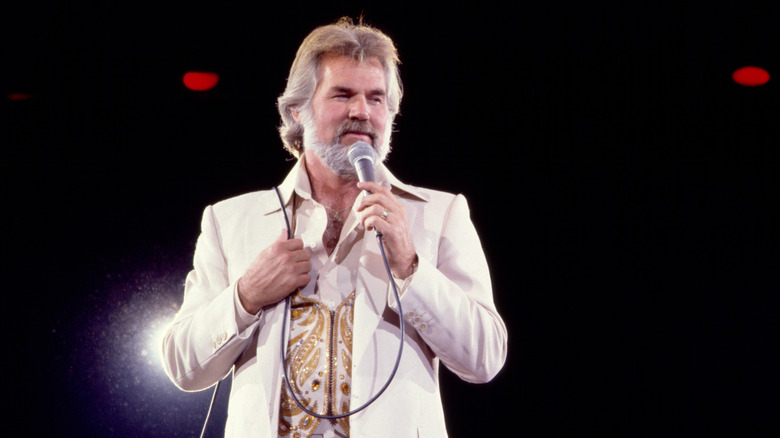
The late, great Kenny Rogers was celebrated for many things over the course of his more than 60-year career. He was a country music legend, a crossover pop hit, and the king of soft rock, among others. But among his extensive discography, there are a number of albums that remain hidden gems to this day. Unlike seminal works like "The Gambler" and "Kenny," which have been rightly praised to no end, a lot of Rogers' earlier, later, and more experimental albums, especially, sit among his vast collection, waiting for their due.
In compiling this list, we chose albums that showed a different side of Rogers than the as-straightforward-as-it-gets country of "The Gambler" and others like it. These LPs also didn't chart at the same level as such classics. Whether it be his more pop-oriented work with "Kenny Rogers and the First Edition," his dalliance with synthesizers on "Love is Strange," or even a concept album about a ghost town, there is a lot of Rogers left to appreciate. Out of all of his studio albums, here are five of the most underrated.
Love Is Strange
If a Kenny Rogers fan from "The Gambler" days circa '78 — the best year of his career — heard a track from his 1990 album "Love Is Strange," they might not believe it. Not due to a lack of quality, but rather thanks to its production and tone, both of which are eclectic. They are very much products of the late '80s/early '90s and only tangentially country. Just from the title track, one of Rogers' many career duets with Dolly Parton, it's clear that he is drawing from new wells of inspiration and letting himself be playful with what he draws up. In this case, the bouncing, almost Caribbean feel and bright guitar evoke singers who have dipped into world music, like "Graceland"-era Paul Simon without the complexity. "Listen to the Rain" is much the same.
Another oddity is "Soldier of Love," which, although a catchy tune, feels much more like the catchall anthems of Phil Collins's soundtrack for "Tarzan" than it does anything from the cowboy who wrote "Gideon." Throughout the album, pianos, synths, and string arrangements dominate, evoking fewer images of Rogers out riding in the plains of Texas than they do him hunched over a mixing board in a recording studio. The singer uses that softer, more lush instrumentation to his advantage, though, filling the LP with touching ballad after more touching ballad. The overall effect, though surprising, is a coherent and at times genuinely moving album.
The Ballad of Calico
Before Kenny Rogers was known as one of the best-selling and most beloved singers of his time, he fronted the First Edition before they later rebranded as Kenny Rogers and the First Edition. For most, they're simply that band that produced a couple of isolated hits with their cover of "Ruby, Don't Take Your Love to Town" and "Just Dropped In To See What Condition My Condition Was In." But the group had more to offer than just what the radio showed, and one underrated example is the double-length concept album "The Ballad of Calico."
Guitarist Terry Williams once said the album was recorded "much like you would shoot a movie." Though he meant specifically the songs being tracked out of order in the same way movie scenes are, he inadvertently described what makes the entire project so unusual: The album is cinematic from skin to marrow. Along with Rogers, almost every band member takes turns singing on the LP, each playing a different character in its overarching story about the real-life ghost town of Calico, California, and its diverse residents. It is hardly recognizable as country. Instead, it remains generally pop while occasionally veering into the symphonic and the strangely psychedelic, like on "Write Me Down." In the same interview, Williams also called first hearing the album "the most magical, emotional moment" in the band's tenure, and given the bold artistry that went into it, it's easy to see why.
Timepiece
Kenny Rogers' 1994 album "Timepiece" — comprised mostly of '30s and '40s jazz standards recorded with a full orchestra — is one of those albums that was clearly made by an artist with no intention of financial success. Instead, it aimed for personal fulfillment. When Charlie Rose asked Rogers about the business plan for the album, the singer, in his protracted way, admitted he simply wanted to try something different. That goes a long way toward explaining its almost nonexistent sales figures and complete lack of chart performance, but it also explains why Rogers went at the album full steam ahead, with an audible passion for the material.
As evidenced by the inclusion of more contemporary (compared to the '30s and '40s) hits like Frank Sinatra's "In the Wee Small Hours of the Morning" and Billy Preston's "You Are So Beautiful," Rogers was out to record whatever made him happiest. Unsurprisingly, his official website confirms that "Timepiece" was "one of the records [he] most loved to record." A track like "In the Wee Small Hours of the Morning," in which his vocals occupy only about a third of its length, suggests he had little to prove with his renditions and was largely happy to let his fellow musicians shine while he sat back and just enjoyed the music. That combination of reverence and selflessness alone makes "Timepiece" worthy of more consideration than it's been given.
Something Inside So Strong
For all but an elite few recording artists, an album reaching gold status would essentially guarantee it being considered a success. This is less true for Kenny Rogers, whose "Greatest Hits" album, for example, has long since gone beyond Diamond. And though his 1989 album "Something Inside So Strong" did earn a gold certification, it never reached the heights of many of his other albums, especially those in the '80s. It's certainly not for a lack of interesting songs, but maybe it's because Rogers chose to open the album with "Planet Texas," one of the weirdest songs — and even weirder music videos — Rogers ever released.
The song tells, in extended detail, the story of an Earth cowboy who is abducted by alien cowboys and then taken to their home planet, which they eventually reveal to be "the biggest place in outer space / A planet known as Texas." Virtually every moment of the song is baffling lyrically, and the same is true of its music video. Highlights of which include a blink-and-you'll-miss-it cameo from country star John Denver, who appears trapped in a space shuttle, and a scene showing that J. R. Ewing, the fictional oil baron from the classic soap "Dallas," once carved his name into an asteroid. In addition to all the legitimate musical merits of "Something Inside So Strong" (including the title track, a powerful anti-apartheid ballad by songwriter Labi Siffre), the album is a must-listen for anyone interested in witnessing one of country music's wackiest chapters.
Water & Bridges
Anyone with a career as long as Kenny Rogers — according to his official Facebook page, he charted singles in eight consecutive decades — is almost certain to lose some considerable steam toward the end, if for no other reason than their biological clock. The same could certainly be said of Rogers, although the stripped-down tenderness of his 2006 album "Water & Bridges" makes a strong case that the Gambler was right to keep from folding early.
The record's most successful single was "I Can't Unlove You," which would come to be his last to break the Billboard Top 20. It's emblematic of the album as a whole: Soft, slow, and looking backward with melancholy. The first lyrics of the opening song are "I was young, so was she / Life didn't stay a mystery for very long," and the final lyrics of the final song are "And I've only got one life and I give it all to you." We can fairly assume the "you" Rogers refers to is at least in part his listeners. Taken together, they sure make the LP seem like a final reflection and a final farewell. Luckily, Rogers still had three albums left to give in his time (as well as the posthumous "Life Is Like a Song"). But for lifelong listeners looking for the work that sounds the most like a sincere goodbye with all the bittersweet emotion that comes with it, look no further than "Water & Bridges."