

5 Power Ballads That Brought Fading Music Careers Back To Life
A proper power ballad is more than just a mix of ear-searing rock and heart-scorching balladry; in the right hands, it can also be a musical lightning bolt that revives a dying career. The power ballad format changed rock forever, opening the doors for artists of all stripes to try their hand and rekindle their once-vibrant musical lives. There were so many comebacks led by power ballads in the '80s and '90s that for a while it felt like the only way to relaunch your brand. If an act wanted to rehab their sound and make it back onto the charts, a soaring love song sanctified by the power of rock 'n' roll seemed to be a sure-fire path to success.
Whose musical lives benefited from the healing touch of the almighty power ballad? Meat Loaf had a second act with one, as did Bonnie Tyler, both with an assist from master power balladeer Jim Steinman. Chicago, the semi-experimental rockers of the '70s, got a new lease on life with their early-'80s power ballad, too. Even more traditional rock units like Heart and Cheap Trick traded their street cred for another ride on the carousel, with power ballads that got them higher on the charts than they'd ever been before. With so much evidence on the table, it's clear that the power of the power ballad to pull a flagging musical act back into the spotlight was a true phenomenon.
Hard to Say I'm Sorry — Chicago
Once known as a jazzy prog-rock unit with a banging horn section, Chicago underwent an identity crisis in the late '70s. When the band blasted back onto the scene in 1982, they had a glossier, radio-ready sound that debuted with "Hard to Say I'm Sorry." An all-timer of a power ballad, it introduced the heavily produced influence of David Foster, whose classical-pop leanings left fingerprints all over this slab of dramatic Adult Contemporary enchantment. It may not have been the same Chicago aesthetic early fans were enamored with, but the updated sonic atmosphere was heartily welcomed when it showed up.
Not everyone in Chicago was happy with this new direction. With Peter Cetera becoming the overriding voice of the band and Foster sprinkling every song with his unmistakable audio glitter, the roots of the original Chicago sound were essentially abandoned. Maybe that was what had to happen to jumpstart the band's presence in the pop world. It did give them their second No. 1 smash — the first since 1976 — while paving the way for what the Chicago of the future would achieve ... and it included a slew of other power ballads like this one, many of which cracked the top 20.
Total Eclipse of the Heart — Bonnie Tyler
It had been five long years since Bonnie Tyler hit the charts with her top 10 country-pop tune "It's a Heartache." It was the single that put the whiskey-voiced singer on the charts before she did a bit of a disappearing act. But she made her comeback with one of the most striking and successful power ballads of the next decade with the release of 1983's "Total Eclipse of the Heart," a cinematic masterpiece of thundering melodrama that had serious heartstring-plucking capabilities. It was nothing like Tyler's previous play-nice music; she belted and crooned like the rent was due — and considering how long it had been between hits, it was probably overdue by a few months.
The song was another Jim Steinman contribution to the grand and growing power ballad tradition, a reintroduction to hard-rocking love songs that set up the next decade-and-a-half for a power ballad explosion. The song charged up the charts and became a Billboard Hot 100 No. 1 single for four weeks, ultimately spending 29 weeks — or more than half the year — on the charts. Tyler and Steinman would continue on the comeback trail with the classic 1984 anthem "Holding Out for a Hero" from the "Footloose" soundtrack the following year, another power-packed production that proved Tyler was a voice to be reckoned with.
What About Love? — Heart
After proving women could rock for a large chunk of the '70s, Heart sort of lost their footing as the '80s encroached. The Wilson sisters took a beat after the moderate reception of 1983's "Passionworks" album and came thundering into a whole new era in 1985 with the clarion call of "What About Love?" a power ballad that gave Heart a glamorous edge sharp enough to carve out a spot on the modern hard rock scene. All it took was some big hair, bigger costumes, and the biggest sounds the band had ever conjured.
"What About Love?" proved that keeping up with the times with a power ballad could be a power move, bestowing a top 10 single on Heart's Hot 100 punch card and signaling a sea change for the band. More power ballads would follow and find even greater reception: "These Dreams" in 1986 and "Alone" in 1987, both of which took the No. 1 spot in their respective years. The redesigned sound was just Heart enough to bring along the older listeners while inviting power ballad fans to latch on and come along for the ride.
The Flame — Cheap Trick
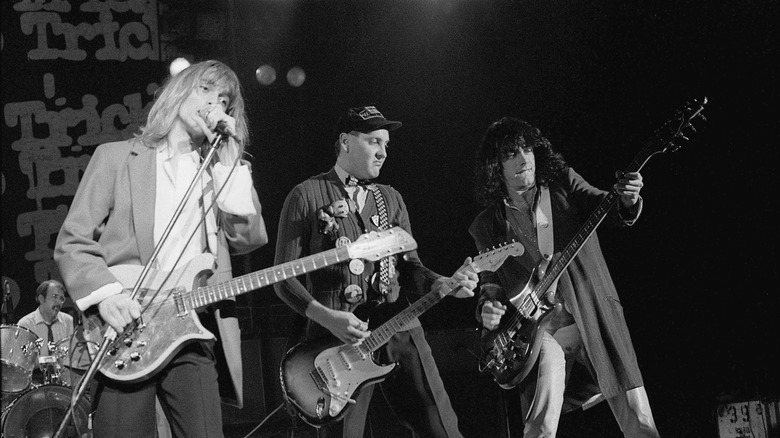
New wave favorites Cheap Trick seemed all but retired from the music industry when they clamored back onto the scene with the scorching love song "The Flame." This power ballad was a major shift from the flippant and edgier works the band had become famous for, overloading the circuits with almost too much sincerity. Crunchy, post-punk rockers like "Surrender" and "Dream Police" and their cheeky subversiveness were in the rearview mirror once the aching devotion of "The Flame" lit up the charts.
Cheap Trick's comeback power ballad spent 27 weeks on Billboard's Hot 100, two of which were at the No. 1 spot in the summer of 1988. It was the band's only single to reach the pinnacle, and it took a musical reinvention to make it happen. The renewed interest in the band resulted in a second hot track from the "Lap of Luxury" album, a cover of the Elvis classic "Don't Be Cruel" — the total opposite of a power ballad — that landed at No. 4. This blast of exposure helped Robin Zander and team close out the '80s on a high note, even if it came with slicker production and more corporate friendliness than Cheap Trick's usual fare.
I'd Do Anything for Love (but I Won't do That) — Meat Loaf
Seventies rocker Meat Loaf launched one of the most remarkable comebacks in popular music when he unleashed "I'd Do Anything for Love (but I Won't Do That)" on the world in 1993. It was a reunion with songwriter Jim Steinman, whose talents helped make the singer's 1977 "Bat Out of Hell" solo debut album a smash. It was such a cornerstone record that Meat Loaf named his return L.P. "Bat Out of Hell II: Back into Hell." That may not have been original, but it announced the ambitions behind the renaissance, and it all kicked off with an engine-revving ballad that served up currents of raw power. And the cinematic yearnings of the video, which cast the singer in a gothic rock 'n' roll "Beauty and the Beast" mini-movie, had the production values needed to sell the overwrought passion of the song.
The song became Meat Loaf's first and only No. 1 single, monopolizing the top spot for a stunning five-week run. The singer would break the top 20 with a few more Steinman power ballad collabs in the '90s, finding a cozy niche for his brand of searing vocals in a musical style he helped elevate with 1978's "Two Out of Three Ain't Bad." Considering the crazy way Meat Loaf lost all his money a decade before his resurgence, it was quite a full-circle moment.