

5 Solo Musicians Who Lost The Plot Chasing A New Sound
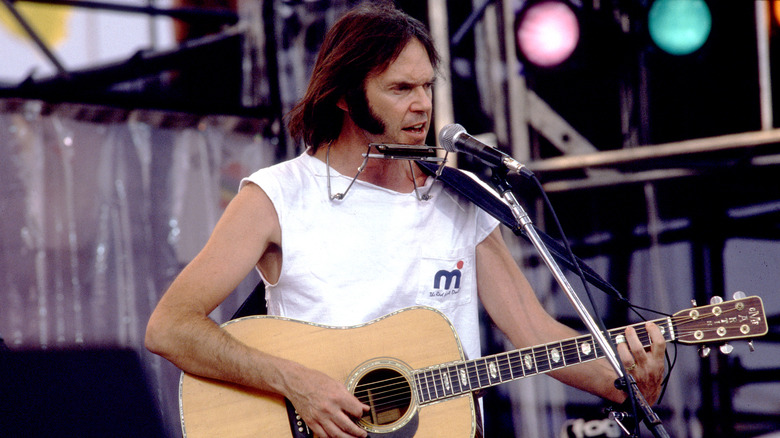
Unfettered by band members and collaborators, solo musicians have ample room to reimagine their sound and vision. When it pays off, the results are sterling; think of David Bowie's most famous looks or Beyoncé basically remolding country music into her image. But these experiments just as often fail. Even some of our most beloved solo artists have completely lost their way in search of inspiration and new creative directions. What's resulted are some of the most misguided, unfortunate, but also fascinating albums of legendary artists' careers.
Sting went back to the Elizabethan era, channeling a passion for traditional song and the lute to produce his baffling "Songs from the Labyrinth" album. In a transitional moment in his career, Stevie Wonder produced a charming but bizarre, surf-inspired, beach record. "Half Breed," Cher's attempt to honor Native American culture, was destined to age poorly, while Lou Reed's abstract noise epic "Metal Machine Music" has since become legendary. And on "Trans," Neil Young may have been a little overzealous with the synthesizers and drum machines.
These albums missed the mark largely because of the high standards they had to live up to. The creative journey can take you far afield of what put you on the map. Yet, if these musicians hadn't been willing to take risks, we might never have heard of them in the first place. And sometimes, the most interesting part of the story was when the artist lost the plot.
Sting — Songs From The Labyrinth
Catapulted by the success of the Police, Sting's solo journey has been eclectic and high-flying. On albums like "The Dream of Blue the Turtles" or "Ten Summoner's Tales," his music evolved, weaving together jazz and world music influences to craft shimmering pop. With roles on screen and stage, a musical ("The Last Ship"), and mega-selling tours, he gained the ultimate prize for a musician: the autonomy that comes with being an iconic artist.
However, freedom can lead you to unexpected pastures. It shepherded Renaissance man Sting to the actual Renaissance by way of 16th-century English lutenist and composer John Dowland. Far afield of his wheelhouse, his 2006 album "Songs from the Labyrinth" interprets his songs as they must have first emerged: with just voice and lute. It's music for court soirees, ale houses, and bustling town squares, with lyrics fit for a High School English class. "Where night's black bird her sad infamy sins / There let me live forlorn," goes the maudlin, proto-gothic "Flow, My Tears (Lachrimae)."
The album was part of the journey, Sting told BBC Music Magazine, "And you improve by putting yourself at risk creatively or entering a milieu that may seem uncomfortable at first" (via Sting.com). His passion for the material certainly emerged, but the results were polarizing. "If it's true that this album will probably not wholly please either Sting fans or those of Early Music," wrote music reviewer Chris Jones for the BBC, "it's also true that music this good is almost impossible to ruin."
Stevie Wonder — Stevie At The Beach
Stevie Wonder's 1964 album "Stevie at the Beach" is proof that even a generational talent and iconic singer, songwriter, and producer can make missteps. To be fair, he'd just turned 14 when it came out, and as a Motown artist at the time, he wasn't in charge of his creative direction. But on the heels of early "Little Stevie" hits like "Fingertips" and before defining records like "Innervisions" and "Songs in the Key of Life," a harmonica-driven beach-themed album was quite the detour. Looking back, Wonder has said he was deeply embarrassed by it.
Largely, "Stevie at the Beach" was Motown's attempt to catch the rising tide of surf-culture at the time and capitalize on Wonder's appearances in the movies, "Muscle Beach Party" and "Bikini Beach." Recorded with the Wrecking Crew, the legendary studio band that backed the Beach Boys, it features kitschy arrangements, oceanic themes, and pop orchestral flourishes. It didn't really catch the wave. The second single, "Hey Harmonica Man," which managed to reach No. 29 on the Billboard Hot 100 in 1964, is one of Wonder's least favorite.
And while going surf rock didn't pan out, the album is a fun, if odd, listen. "Castles in the Sand," the opener, has a swinging pop groove, plaintive singing, and squawking seagull and crashing wave sound effects. Were it made by another artist, "Stevie at the Beach" wouldn't be considered a flop or failure. But this is Stevie we're talking about.
Cher – Half Breed
Music can be a means to explore your roots and heritage. It can draw a line from ancestors' rhythms, harmonies, and traditions to your life today, showing how culture evolves and informs identity. The title track of Cher's 1973 album "Half Breed," a No. 1 hit for the singer, gives voice to a daughter of a Native American mother and white father, who faces stigmatization from both communities. On the album cover, she's on a horse, dressed in what can generously be called Halloween-costume-level "Native American" dress. That's painfully dated and culturally insensitive, sure, but at least the album's an homage to the singer's background, right?
Well, it's not really part of her real-life story, which makes the whole thing worse. Born Cherilyn Sarkisian, her father was Armenian American, and there's little to no evidence that she's part Cherokee on her mother's side, as she once claimed. But even stranger is the album's lack of continuity. The covers of the Beatles' "Long and Winding Road" and the Bee Gees' "How Can You Mend a Broken Heart?" are lovely, but they undermine the concept and sound like they belong on a different record, entirely.
Even though "Half Breed" was certified Gold in 1974, critics at the time panned it. "Cher's amazingly powerful voice is not being used effectively," wrote Paul Gambaccini in Rolling Stone, "and it is frustrating to hear it squandered on rubbish." It's a textbook definition of sloppy cultural appropriation, and the intervening years haven't made it any better.
Lou Reed – Metal Machine Music
During his time with the Velvet Underground and for the decades after the band called it quits in 1970, Lou Reed left his mark on rock 'n' roll. But his lengthy career didn't come without some missteps. The most polarizing and notorious of these is "Metal Machine Music" from 1975, a double-album of atonal guitar-squeal and distortion. To some, it's unpalatable and overly indulgent, but to others, like Thurston Moore of Sonic Youth, it's art. And to music nerds, it's one of the founding texts of noise rock, which would peak in 1984.
It's safe to say "Metal Machine Music" garnered more controversy than actual listens. A story often told about it is that Reed made it to get his label RCA to drop him. But in a 2013 interview, he denied it, telling The Quietus, "It's almost a shame to say it's not true. But in fact it's not true. I made it because I liked it, not to get out of a contract." In fact, the label was supportive and planned on releasing it as a classical record on their Red Seal imprint. "But then they put it out as a rock 'n' roll album," Reed said. "... Well, it was taken off the market in three weeks, it had the highest levels of returns of any record ever released."
Contemporary critics also wanted their money back. Calling its "droning shapeless indifference ... hopelessly old-fashioned" in Rolling Stone, James Wolcott quipped, "Lou Reed is disdainfully unveiling the black hole in his personal universe, but the question is, who's supposed to flinch?" Play the record today and you just might.
Neil Young — Trans
The early '80s saw many legendary artists from the previous decades adopt electronic sounds. The results were mixed. On the 1982 album "Trans," Neil Young gives these new technologies a bear hug, ditching the acoustic and harmonica for synthesizers, sequencers, drum machines, and vocoder effects. What emerged is an album that's bafflingly out of step with his overall creative arc. Whether you think it's kind of brilliant or an example of the folk rocker getting lost in the sauce, it seems designed in a lab to provoke old-school fans. Nothing on the album even comes close to seminal songs like "Heart of Gold" or "Cinnamon Girl."
Neil Young never shied from experimentation. In the '70s and early '80s, collaborations with Devo led to a frenetic cover of "Hey Hey, My My" and the quirky sci-fi B-movie "Human Highway." The opening track of "Trans," "Little Thing Called Love," is recognizably Neil, but from there, it's like Depeche Mode walked into the studio. The results are fun if hokey, with songs like "Computer Age" and "Computer Cowboy," featuring post-disco grooves and vocoded vocals. They're unabashedly new wave and super weird coming from Young.
The album was no "Harvest," which disappointed his record label, and it didn't really sell. But in taking on the alienation of living in the era of modern technology, it's since found its audience. As critic Sam Sodomsky put it in Pitchfork in 2017, "'Trans' has only grown more triumphant and singular as it's aged." Maybe it was worth it for Young to get lost in his computer.