

5 Famous Songs Carole King Wrote Before Her Solo Career Took Off
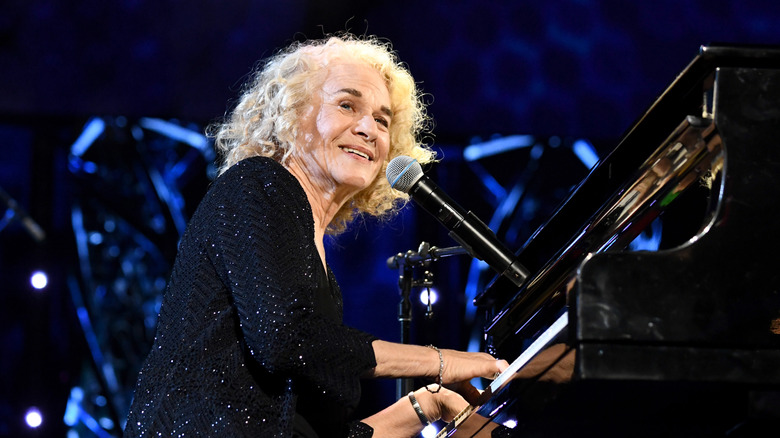
When Carole King became explosively popular with the release of her 1971 album "Tapestry," that success wasn't overnight or sudden: She'd been working as a songwriter for more than a decade, and since she was a teenager. In fact, before she became a headlining musician who sold millions of albums in the 1970s, Carole King wrote a slew of well-crafted and well-known tunes, along with writing partner Gerry Goffin, that went on to be recorded by a number of famous acts of the 1960s.
Furthermore, many of those songs went on to become hits for some of the era's biggest acts. It wasn't until 1970, and with the release of the album "Writer: Carole King," that the musician's career as a front-and-center singer took off. Along with plenty of newly generated material, King's back catalog of massively popular hit songs written for other artists gave her a built-in advantage, allowing her to become one of the best-selling acts of the singer-songwriter era. Here are five songs that define 1960s pop that were actually written by the definitive 1970s singer-songwriter, Carole King.
Will You Love Me Tomorrow — The Shirelles
Vocally-driven "girl group" songs are a definitive 1960s sub-genre, and the first single in that style to ever make it to No. 1 on the Hot 100 was "Will You Love Me Tomorrow," which sat atop the chart for two weeks in early 1961. The Shirelles had struggled for a few years to notch a major hit, and finally did so when they teamed up with Carole King and her writing partner Gerry Goffin. Their preferred producer, Luther Dixon, obliged to repay the songwriting duo for a previous assist, convinced the Shirelles to cut one of their songs, and they went with "Will You Love Me Tomorrow." Based on King's own demo, member Shirley Owens at first didn't like the song, a gently and subtly risqué song for the era in which the narrator expresses worry that a relationship won't continue with the person with whom she experienced an intense romantic connection. Dixon came around during the process, in large part due to King stepping in to play kettle drums on the track.
The tender ballad helped make King one of the go-to giants of the songwriting world. "Will You Love Me Tomorrow" was the first No. 1 single she ever composed, and she did so at the age of 17.
The Loco-Motion — Little Eva
While employed as a house songwriting team at publisher Aldon Music in 1960, married songwriters Carole King and Gerry Goffin needed a babysitter to help look after their newborn, and teenager Eva Boyd got the job. Aware she was a talented singer, King and Goffin earmarked Boyd to sing a demo of their entry into the early 1960s fad of singles that invented, celebrated, and instructed new dance crazes: "The Loco-Motion," which told of a dance that evoked the movements of a train. After the song's intended artist, Dee Dee Sharp, couldn't do it, Boyd, billed as Little Eva, got the lead vocalist gig. King not only co-wrote the song, but she arranged it and added background vocals.
Little Eva's version of "The Loco-Motion" went all the way to No. 1, spending a week at the top in 1962. King's song occupied the slot for another two weeks in 1974 after a '70s act many have completely forgotten about, Grand Funk Railroad, created a hard rock cover. That band went to No. 3 later in 1974 with a cover of another King-Goffin tune, "Some Kind of Wonderful," while Kylie Minogue revived "The Loco-Motion" again in 1988, taking it to No. 3 on the pop chart.
I'm Into Something Good — The Cookies and Herman's Hermits
Carole King and Gerry Goffin wrote some material for a '60s vocal group called the Cookies, and when member Earl-Jean McCrea went solo in 1964, the duo was tasked with composing an appropriate pop song. King came up with the melody for the jaunty "I'm Into Something Good." Upbeat, bouncy, and relentlessly sunny, King admittedly took inspiration from Brian Wilson's similar compositions for his band, the Beach Boys, around that time. "I make no bones about it, that song was influenced by Brian's music," King told Weekend Australian Magazine (via her website).
It wasn't much of a hit, however, reaching a mere No. 38. But a year later, it helped fuel the rise of British Invasion pop-rock band Herman's Hermits. Fronted by teen idol Peter Noone, who became a mega-successful musician before he turned 21, Herman's Hermits had a string of 18 Top 40 hits in the 1960s, and the first one was "I'm Into Something Good," peaking at No. 13 in November 1964.
Pleasant Valley Sunday — The Monkees
By the late 1960s, Carole King and Gerry Goffin's success meant that they were able to purchase a home in a suburb of New York City. While King felt comfortable with this new phase, Goffin loathed the dull uniformity of suburban life, and channeled his resentment into the critical and satirical lyrics of "Pleasant Valley Sunday," a song about empty middle-class living. As was often the case with their professional partnership, King composed the music for the song, which came under the purview of Screen Gems, a division of Columbia Pictures, and which then handled the musical side of the made-for-TV prefabricated rock band the Monkees.
One of the most phenomenally popular acts in music at the time, the Monkees scored four No. 1 albums in 1967, including "Pisces, Aquarius, Capricorn & Jones Ltd." "Pleasant Valley Sunday" landed on that LP, and in August 1967, it shot up to No. 3 on the singles chart.
(You Make Me Feel Like) A Natural Woman — Aretha Franklin
"(You Make Me Feel Like) A Natural Woman" is one of several signature songs of the "Queen of Soul," Aretha Franklin, who is widely regarded as one of the greatest singers of all time. It was also co-composed by Carole King at the behest of Atlantic Records head Jerry Wexler, who yelled the idea to her and Gerry Goffin from the inside of a passing limousine in downtown New York. Less than 24 hours later, the pair had written "(You Make Me Feel Like) A Natural Woman."
Franklin's recorded performance was nothing short of rapturous. Backed by strings and powerful support vocalists, Franklin took "(You Make Me Feel Like) A Natural Woman" to No. 2 on the R&B chart and No. 8 on the pop chart in 1967. "I hear these things in my head, where they might go, how they might sound," King told The New Yorker. "But I don't have the chops to do it myself. So it was like witnessing a dream realized." Nevertheless, King's own spin on "(You Make Me Feel Like) A Natural Woman" closed out her 1971 blockbuster LP "Tapestry."