

Elton John Almost Never Released This No. 1 Duet — He Thought It Was A Bust
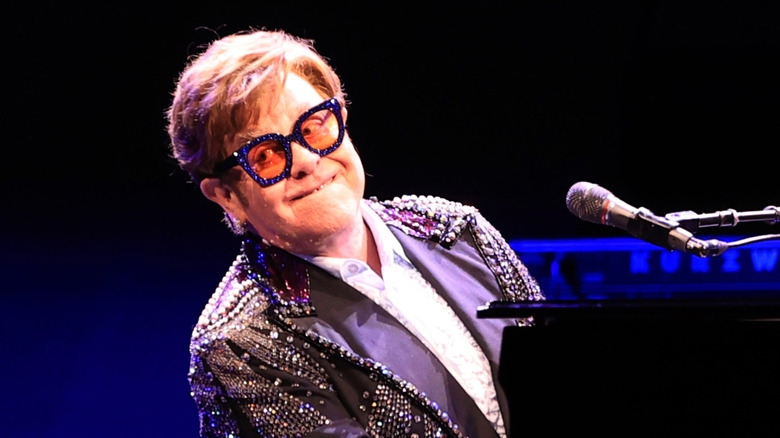
Sometimes, rock stars know instinctively that a track is going to be a hit even as they are recording the song. But in certain cases, they are way off, like Elton John was when he was busy laying down the lead vocal line for his 1974 single, "Don't Let the Sun Go Down on Me."
John was in his imperial stage during the mid-1970s, scoring hit after hit with popular songs on both sides of the Atlantic and enjoying a burgeoning reputation as a live act thanks to his kinetic live shows. He must have felt for a time that he could do anything, so when he found himself struggling with "Don't Let the Sun Go Down on Me" — with lyrics written by John's songwriting partner, Bernie Taupin — the British rocker became understandably frustrated. John had a difficult time getting the vocals right for the song, and was thrown into such a temper that he wrote it off as a bad piece of work, at one point even threatening to give it away to another artist.
But John's team persevered with the song, which is just as well. It was a respectable hit when it was released in 1974, but became even bigger in 1991, when it formed the basis of one of John's most iconic duets — and went all the way to No. 1.
Saving a difficult song
According to Bernie Taupin, he and Elton John were purposefully going for a big impact with "Don't Let the Sun Go Down on Me." "My only recollections of this is that we wanted to write something big. I mean, big in that dramatic [Phil] Spectory style, like 'You've Lost That Lovin' Feelin'.' Hopefully being powerful without being pompous," he said (via UDiscover Music).
For John, however, what listeners would later agree is one of the most emotionally affecting songs in his discography initially didn't sit well with him. According to Philip Norman's "Sir Elton: The Definitive Biography," he attempted various vocal styles, from mumbling to screaming, before writing the song off as "f***ing cr**," and telling producer Gus Dudgeon to give it to Engelbert Humperdinck or Lulu.
The saving throw came from Dudgeon, who added a great deal to the track in post-production. This included backing vocals from such luminaries as the Beach Boys' Carl Wilson and Bruce Johnston, as well as Captain and Tennille's vocalist, Toni Tennille, and swelling instrumentation from the go-to studio brass band of the era, the Tower of Power. The results struck a chord with the listening public, with the 1974 version of "Don't Let the Sun Go Down on Me" peaking at No. 2 on the Billboard Hot 100 and No. 16 on the U.K. singles chart.
A smash '90s duet
Like other hits Elton John released during the 1970s, "Don't Let the Sun Go Down on Me" achieved a great deal of success and came to be included in his live set lists. But its story doesn't end there, thanks to one particular fan of the song: George Michael.
Michael had performed lead vocals for "Don't Let the Sun Go Down on Me" during John's set at the phenomenal Live Aid charity concert in 1985. And in 1991, Michael contacted John again, asking to duet once more — again at London's Wembley Arena — where the two shared vocals on the song.
The recording of the performance was then released as a charity single. It was an international smash, hitting No. 1 in the U.S., U.K., and several other territories, an incredible result for a song that its own creator was initially skeptical of. Sadly, the relationship between John and Michael later broke down, but their duet remains a beautiful testament to their shared talent.