

The 5 Best Bee Gees Songs Hardly Anyone Talks About Anymore
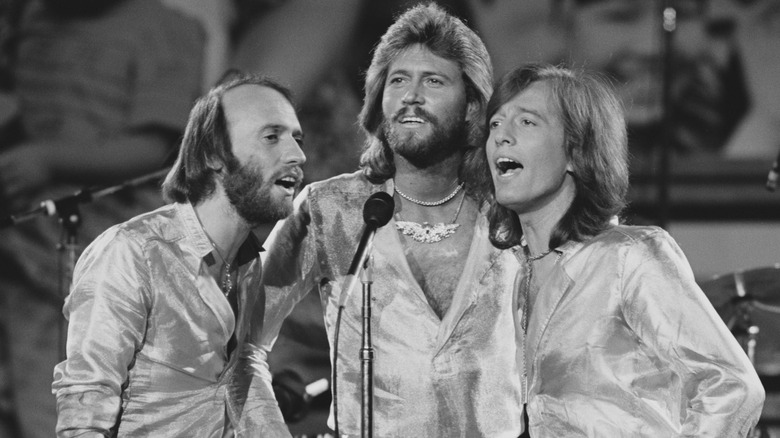
It's easy to forget about many of the best songs from the Bee Gees' historic catalog. Considering the trio's 43 chart hits, including 15 top-10 singles — nine of which went to No. 1, the most for any artists in the '70s — there's a lot of music to keep in mind. Among the trendsetting disco tunes and well-loved Bee Gees songs written for other artists, there's a subset of songs that almost no one seems to talk about these days. That doesn't mean they're undeserving of renewed attention, however, which is why we've taken the opportunity to bring our favorites back into focus.
You may not recall the choir-like harmonies of "Too Much Heaven," the forceful chug of "Tragedy," or the storytelling allure of "I've Gotta Get a Message to You," but we think they're some of Barry, Robin, and Maurice Gibb's most tuneful creations. And lesser-recalled songs like "Holiday" and "You Win Again" may not fit cleanly into the group's most-replayed tracks, but for us, they represent songwriting risks the brothers were always willing to take, even if they aren't as clean a fit into the nostalgia scenes as their other tunes.
Covering all eras of their career, we've picked five Bee Gees songs that should be required listening for anyone who's never heard them before, and necessary re-listens for everyone who's forgotten them.
Holiday
Haunting and minor-key vibey, with the brothers' Beatles aspirations on full display, "Holiday" is an eerie rumination on the joys of a simple life, delivered in a package of melancholy that contrasts the lyrics in a highly intriguing manner. Trippy images like "It's something I think's worthwhile / If the puppet makes you smile / If not then you're throwing stones" encode the secret to happiness in a verbal puzzle that just barely reveals its point. This juxtaposition feels like Barry and Robin Gibb getting playful with their songwriting and aiming for sounds in the same realm as John Lennon's stark and haunting "Because." The brothers keep a slightly lighter touch in their work, but the effect is a consciousness-expanding piece that shows how dark the Bee Gees could get.
And yet, for all its funereal foreboding, the song has one of the catchiest choruses in the Bee Gees' catalog, a simple "Ooh you're a holiday / Such a holiday," sung in a way that signals relief from suffering and lets a ray of light pierce the gloom, however brief its appearance may be.
I've Gotta Get a Message to You
Brother Robin Gibb grabbed the mic and shared lead vocals with older brother Barry on "I've Gotta Get a Message to You," a Bee Gees version of Americana-folk storytelling with a literary soul and an earworm chorus that digs in deep. This 1968 release was one of the threesome's earlier singles and a No. 8 hit, but it seems to get overlooked in favor of the group's flashier songs. But there's plenty of charm and character contained here, calling for a second listen even all these decades later.
It doesn't take much deep listening to pick up on the message here. A death row inmate has reached his final hour, making his last confession and pleading to have one more visit from his special someone — it's her lover he's killed, resulting in his fatal incarceration. The clock is ticking, and he's accepted his fate, if only he could ensure that the one he leaves behind knows how he feels. "I've just gotta get a message to you / Hold on, hold on / One more hour and my life will be through," Robin Gibb sings, in a voice more brittle than either of his brothers. He's the perfect choice for delivering a mortality lesson, and this song is a perfect display of the brothers' musical storytelling prowess.
Tragedy
There were still strains of dance-floor stylings in the Bee Gees' post-disco recording, most notably on the track "Tragedy" from the trio's 1979 album "Spirits Having Flown." It was clear the brothers were trying to head in a new direction, which gave this sharp-edged rocker a more forceful sound than their trendsetting "Saturday Night Fever" creations. There was high drama in the horns, a stirring string section that evolved the usual disco swirl into a classical cello thrum, and a heart-pounding thunderclap that was actually a recording of Barry Gibb blowing air through his cupped hands into the mic.
The use of pulsating synths shows the Bee Gees' moving toward a more electronic-friendly sound, without tossing aside the more intricate arrangements the band had become known for. It had legs too, spending two weeks at Billboard's No. 1 spot and helping the brothers shut down a decade that their music helped define. It's also a great transition between the group's performing phase and the age of the Bee Gees writing more songs for other famous musicians than themselves.
Too Much Heaven
One of the band's tenderest ballads, "Too Much Heaven" is one of those songs in which the brothers' falsetto tones feel more like gospel-lite than their usual dramatic delivery. That's not to say the Gibbs forego their usual dramatic flair, but there's a touch of cosmic wonder swirled in the mix that lends the lyrics a more aspirational sensibility. "Then my life, I can see beyond forever / Everything we are will never die," Barry sings, taking the long view of what commitment means, be it romantic, religious, or cosmic-themed.
And of course, the chorus points upward in a more traditional spiritual sense: "Nobody gets too much heaven no more / It's as high as a mountain and harder to climb." But the song had no trouble climbing to No. 1 and keeping the Bee Gees' hit-making streak alive, even as the disco era slid out of favor. This superior adult contemporary ballad may not get the love it deserves these days, but it's a sweet reminder of how flexible the brothers were at targeting musical subgenres.
You Win Again
The Bee Gees made a stellar comeback in 1987 with their modernized LP "E.S.P.," which ditched all the disco and focused on power pop. The album's standout single "You Win Again" is one of the band's most winsome creations, a simple love song about surrendering that comes with a bouncy industrial swing and the breathy delivery Bee Gees fans loved for so long. But rather than grandstanding with the vocals, there's a mature sense of restraint — a grown-up version of the brothers' gleaming musicality that feels fresh and newly alive.
Audiences didn't respond as lovingly to the brothers' return to form as the song deserved. But the turn-down from showier arrangements, which got the Bee Gees tagged as slurpy, overly-commercial pop dreck during their disco backlash, still stands as a smart move for a band trying to make themselves relevant again. It's also just a plain-old groovy pop tune, one that was too easily forgotten by their core fan base.