

6 Nearly Perfect Bee Gees Songs That Should Be Required Listening For Younger Generations
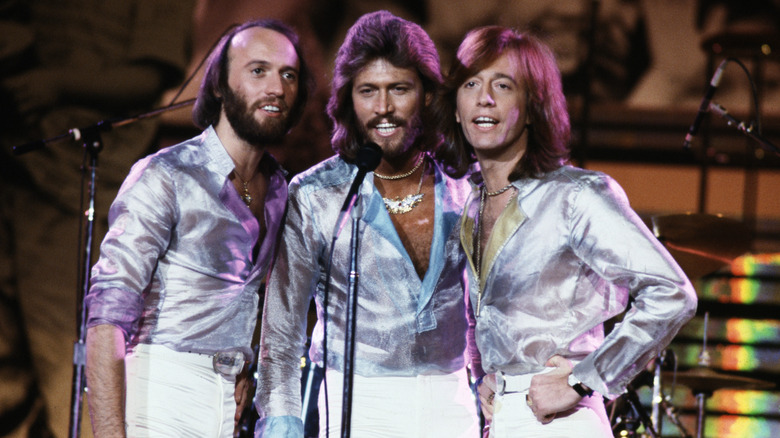
British-born siblings Barry, Robin, and Maurice Gibb went from being gawky teenagers trying to earn a buck in 1960s Australia to the Bee Gees, giants of the music world. Their list of achievements is truly staggering. Over 40 years they sold as many as 220 million albums, wrote chart-topping hits for a galaxy of stars, won armfuls of accolades, and became inductees in both the Rock and Roll and the Songwriters Hall of Fame. But with a catalog that includes 22 studio albums, several soundtracks, and best-selling compilations, where should a fledgling Bee Gees fan even start?
As every new generation quickly realizes, despite the Bee Gee's many ups and downs, they are — by every musical measure — A Bit Good. At first glance, it's easy to dismiss the trio (who were joined occasionally by brother Andy Gibb, who died tragically young) as unserious, especially in their early days. They were bouffant of hair, manly of chest, and tight of trow. Anyone in their right mind should run a mile — if it wasn't for their incredible sound. Their seamless, layered harmonies, backed by funky, infectious grooves, are the reasons for some of the choices on our list, but they could also pull on our heartstrings like no other, proving there is more to the Bee Gees than giving John Travolta something to shake his booty to. Here are six Bee Gees songs that are indispensable for any young music fan.
I Can't See Nobody
He looks like a stiff wind would blow him over, but there's something utterly compelling about Robin Gibb's voice. In a million other universes, we'd kick off this list with the chills-inducing "I've Gotta Get a Message to You," but we couldn't pass up this early outing. Released in 1967 and written by Robin and Barry Gibb, "I Can't See Nobody" was the B-side to the Bee Gees' first international hit, "New York Mining Disaster 1941." It was so popular in Japan and Germany that it was released as a double A-side record in those markets.
"I Can't See Nobody" was a complete 180 in terms of sound for the Bee Gees, proving they could carry off a more melancholy song every bit as well as their perkier '60s pop. It demonstrated the siblings' storytelling ability, which Robin's voice promptly took to another level. His plaintive delivery — "I never felt like this before / A love like yours so young and fine / And now as I try to forget you / It doesn't work out any way" — makes it almost painful to hear such vulnerability.
You Win Again
The 1980s became a different kind of high point for the Bee Gees, who penned hits such as "Chain Reaction" for Diana Ross and "Islands in the Stream" for Dolly Parton and Kenny Rogers. However, in 1987, the brothers Gibb said hello to a new generation with the thumping "You Win Again." It's not just a comeback song; it's an anthem that totally proved the Bee Gees still had "it," even after several years out of the spotlight, following the violent pushback against disco music in the 1970s.
We have Maurice to thank for that sick drum beat, while the lyrics set out the trio's intentions in the first couple of lines: "I couldn't figure why you couldn't give me what everybody needs / I shouldn't let you kick me when I'm down, my baby." Barry Gibb reportedly told the BBC years later that the chorus for "You Win Again" came to him in a dream, and he had to quickly find a way to write it down before he forgot it. Do they look a bit awkward in the video? Yes. Does it still slap, decades later? Absolutely.
Nights on Broadway
Where was there for the Bee Gees to go after their 1975 hit single "Jive Talkin'"? Higher, apparently — at least when it came to how they sounded, specifically Barry Gibb. The follow-up track "Nights on Broadway" was taken from the album "Main Course," which, according to some, features the debut of Barry Gibb's falsetto singing. The often-told story goes that producer Arif Mardin was looking for ways to make the song more interesting and asked the Brothers Gibb if any of them could "scream in falsetto" during the chorus. Barry duly gave it his all, inadvertently discovering his singing superpower — one that would become an integral part of the Bee Gees' iconic sound.
As for the song itself, "Nights on Broadway" serves up plenty of rich funk with a side order of hooky melody, but there's no denying it's a dark song. In fact, the lyrics may be a touch on the stalky side to 21st-century ears. Robin Gibb sings in the pre-chorus: "Well, I had to follow you / Though you did not want me to / But that won't stop my loving you / I can't stay away." Weirdly, Candi Staton's 1977 cover hits just as hard, but doesn't have the same creepy feel.
Trafalgar
Any band that has been around as long as the Bee Gees experiences peaks and troughs, and this song, taken from the 1971 album of the same name, was released between two extraordinary highs for the trio. Although "How Can You Mend a Broken Heart" gave them their first Billboard chart-topper, newcomers to the Bee Gees should skip it and head straight to side 2, track 1.
You could be forgiven for thinking you'd accidentally stumbled across a John Lennon recording, and while there's definitely more than a whiff of the former Beatle, we're thrilled to say "Trafalgar" is all Maurice Gibb's work. Of the three brothers, he sang harmonies more often than lead, and given the gorgeous quality of "Trafalgar," you have to wonder what more we could have had if Maurice, who died unexpectedly in 2003, had stepped out of his siblings' shadows a little more often. As a song, it quietly builds, the guitar and piano combining to lift you up to a place of gentle optimism so that, by the time it fades out, you're both surprised and sorry the song has finished. The hanging "Trafal ..." in the chorus (which isn't in the written lyrics) can be jarring, but it's forgiven because everything else about this jewel of a song is spot-on.
Massachusetts
Much has been written about the meaning behind the 1967 song "Massachusetts" (which was originally written for Australian supergroup, the Seekers) with one theory that it was about everyone in the titular state decamping to San Francisco. The truth is somewhat less romantic. As Robin Gibb, who died in 2012, explained in a clip posted to social media, "Massachusetts" was inspired by their love of the word itself — they had never even set foot in the place. It's a typical Robin-led song: gorgeous melodies with a hint of country and delicious harmonies that just about prevent it from being a wallow-fest.
"Massachusetts" gave the Bee Gees their first No. 1 in the United Kingdom — but for Robin, it was a poignant triumph. The song's chart-topping foray coincided with the 1967 Hither Green rail crash, which killed 49 people — and which Robin survived. In a 2009 interview (via Fifty Plus Advocate), he told The Mail on Sunday: "It was like something out of a Spielberg film. I thought, at least there is one consolation, we have our first U.K. number one."
You Should Be Dancing
Released in summer 1976, "You Should Be Dancing" topped the Billboard Hot 100 and the Hot Dance Club Chart, then got a new lease on life as part of the blockbusting "Saturday Night Fever" soundtrack. "You Should Be Dancing" was played relentlessly in clubs, and to this day it's regarded as a 40-karat disco classic. We dare you to sit still while that funky breakdown plays, that brass does its thing, and those falsettos ring out. Betcha it's impossible.
It took a fortnight to put "You Should Be Dancing" together, but Barry remembered working hard to get it right. "I remember that we cut the track at least four times," he told The Roxborogh Report, adding: "If somebody got something wrong, you had to do the whole thing again." Whether you come to the song via the movie "Saturday Night Fever," the kids' animated flick "Despicable Me," or stumble across it in your parents' music collection, it's a great gateway to the Bee Gees' sound.