

What Is The Best Bass Guitar For Beginners?

New musicians looking to buy a bass face the same questions as those looking to buy an electric guitar that's good for beginners, an acoustic guitar, or anything else. Price range is paramount, as are other attributes such as tone, fret size, and number of strings. In the end, we're going to recommend a couple of options: the Fender Squier Classic Vibe '60s Precision Bass for an older, classic rock sound, or the Ibanez GSR200B for a snappier, more modern tone.
In general, both the Fender Squier and Ibanez come with reasonable price tags, though the Squier costs more ($500 versus about $250 for the Ibanez, as of mid-2026). Note that Ibanez doesn't sell its guitars directly, but only goes through retailers, and you might be able to get a Squier for less if you don't buy from Fender directly. Also, beginners should stick with a standard, four-string, 34-inch-long, full-scale neck, which means a full-sized neck, not a truncated one. Full-length strings vibrate in a way that will help your bass produce a tone applicable to a variety of genres (rock, jazz, metal, pop, etc.) and play styles, including plucking, slapping, and tapping. No matter what, you're going to have to get used to stretching your fingers and dealing with hand pain.
Beyond these generalities, different types of bass come with quirks that make them best-suited to whatever music you want to play. And bear in mind that because all basses are electric (unless you're playing an upright double bass), you'll need to follow the same maintenance practices to keep an electric guitar in good condition.
The case for a Fender Squier Classic Vibes '60s
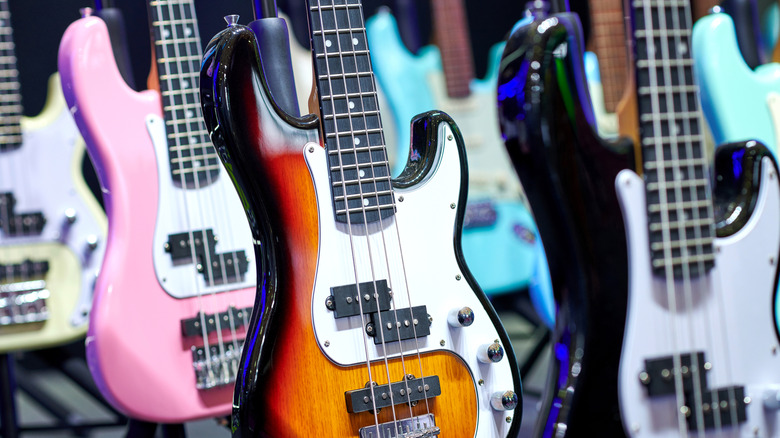
Visitors to the Fender website will notice that they have '50s, '60s, and '70s Classic Vibe (CV) Squiers to choose from. The main difference between the three CV decades is the type of wood used — the tonewood – which can dramatically affect a guitar's sound (especially when choosing the best acoustic guitar for beginners). Overall, we'd recommend the '60s CV thanks to its laurel and poplar wood, which make the overall tone a little less snappy and a little warmer. Hence the whole "'60s Classic Vibe" branding, highlighting that it emulates guitars of the era.
As far as the feel of the guitar is concerned, bass beginners are in for some pain, including the difficulty of just holding the big, fat strings of a bass down (it's harder than you think). Thankfully, the CV's neck is pretty thin and has a "C" shape to the back, so it'll at least be easier to wrap your hands around it when wowing your family with your first attempt at playing "Seven Nation Army." Critically, the guitar has narrow-tall frets, which means that your fingers might not even touch the fretboard. These kinds of frets are easier to press down and produce less noise. Also, the bass is a full 34 inches long.
Then there are the electric components. The bass has two knobs, one for volume and one for tone, and an output jack for plugging into an amp or computer console. These controls are very basic, but all that most beginners need to play around with and learn their instrument.
The case for an Ibanez GSR200B
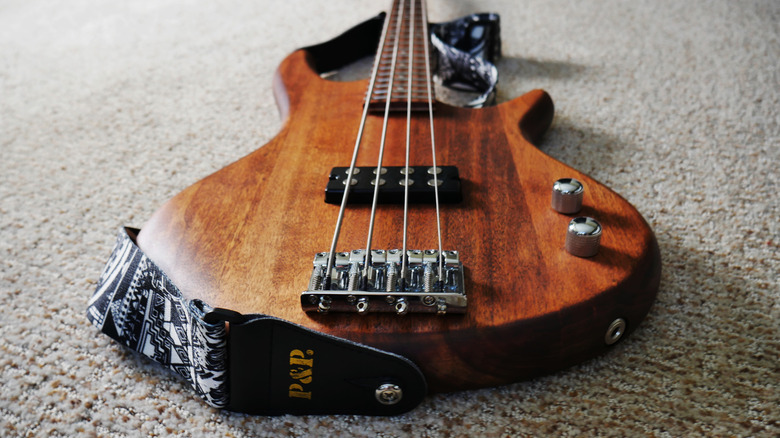
You can tell that an Ibanez GSR200B is a modern-oriented bass just by looking at it. Without getting into hairy technical territory, the Ibanez has sharper high frequencies, punchier low frequencies (thanks to its Phat II equalizer), and a less full middle — completely opposite to the Fender Squier Classic Vibe. It loses warmth, but gains a snappiness and power that makes it stand out in mixes and live performances across a variety of genres and play styles. For those who want to make their own music and mix it on their computer, maybe file share with friends and cobble tracks together, and occasionally play the bass live with others or at small gigs: This is the bass for you. At about $250, its quality far exceeds its price.
Physically, the Ibanez is a full 34 inches long, just like the Squier Classic Vibe, and has a thin neck that's easy to wrap your hands around. It's also got a satin finish, so your hands can slide along the neck better and not get stuck, especially when they're sweaty. Unlike the Squier, the frets are medium, not narrow-tall. This makes the fretboard more prone to buzzing if you press a string incorrectly, but then again, you're trying to learn an instrument. Might as well learn the right way.
On the electronics side, the Ibanez has more controls than the Squier. It's got two volume knobs, one tone knob for the whole guitar, and a separate knob for the low-end, Phat II Equalizer. For some beginners this won't matter, but for those who want to tinker with funk, hip-hop, metal, and other low-end heavy genres, this will give you the versatility you need.