

5 Concert Moments Every Classic Rock Fan Wishes They Witnessed
There are some moments in the history of classic rock that have become legendary, and for most of us, we could only imagine what it must have been like to be there. Some live concerts were so ground-breaking and consequential that they steered the course of rock 'n' roll — not only were they fantastic shows in their own right, but they were also incredibly meaningful both in terms of the artists' own careers and the story of rock as a whole.
We're revisiting five historic shows that every true classic rock fan surely wishes they witnessed. From a contentious moment in which a performer defied their own fans by going in a new artistic direction to a mind-melting festival performance that made a band's name overnight, as well as a 17-minute performance that many rock fans believe to be the best set of all time, if you were for any of them, you can count yourself incredibly lucky.
Bob Dylan at the Newport Folk Festival
Bob Dylan's legendary performance at the Newport Folk Festival in 1965 features as the climax to the 2024 biopic "A Complete Unknown," and for good reason. In many ways, this was the moment that defined Dylan's identity as a singularly headstrong musician who was willing to alienate a large portion of his own fanbase to protect his artistic integrity. In short, it was when Dylan went electric.
At the time, folk and rock fans were at each other's throats over the direction the music of the future was to take, and the use of amplified instruments was a major sticking point between the two camps. And so, Dylan caused a big reaction when he opened his set with "Maggie's Farm," playing a Fender Stratocaster and backed by fully electrified musicians in the form of the Paul Butterfield Blues Band. Dylan had previously appeared at Newport, the festival organized by his friend and mentor Pete Seeger, twice before, and enraptured audiences with his Woody Guthrie-esque performances on acoustic guitar and harmonica, playing folk and protest songs.
This performance, however, demonstrated that Dylan was unwilling to be pigeonholed and side with the old guard, instead embracing rock and deciding the trajectory of his own career. It may only have been a short set, but the atmosphere and the chance to witness one of the most iconic stands in rock history would be irresistible to any Dylan fan.
Santana at Woodstock
Some of the most iconic rock moments involved an act being entirely in sync with a crowd on an epic scale, as happened with the Latin rock band Santana at the Woodstock Music and Art Fair in 1969. Many sets from that famous festival have gone down in history, but arguably one of the best was Santana's performance on the afternoon of Saturday, August 16, the second day of the event.
The band, led by seminal guitarist Carlos Santana, had built a reputation as a live act known for generating incredible grooves with a huge cast of top-class musicians, but were little known outside San Francisco when they performed at Woodstock. The set proved to be an incendiary wider introduction to the band, with an exceptional performance from Santana himself as well as many of his bandmates, not least his drummer Michael Shrieve, who was just 20 years old when he picked up the sticks for the legendary set. The highlight of the set is undoubtedly "Soul Sacrifice," a delirious, percussion-rich number which made the band famous after footage was included in the iconic 1970 documentary "Woodstock.
Jimi Hendrix at Monterey
Another artist who made a big splash at the 1969 Woodstock festival was Jimi Hendrix, who finally performed with a reconstituted version of his band the Jimi Hendrix Experience, called Gypsy Sun and Rainbows, on Monday morning. He closed the event, delivering a set that included Hendrix's iconic, distorted rendition of "The Star-Spangled Banner." For many fans, it was the greatest show of his career, but Hendrix's 1967 performance in Monterey was far more pivotal. Not only did the Jimi Hendrix Experience release some of their best songs as singles and on their debut album, they also gave the performance that would finally make Hendrix's name in America.
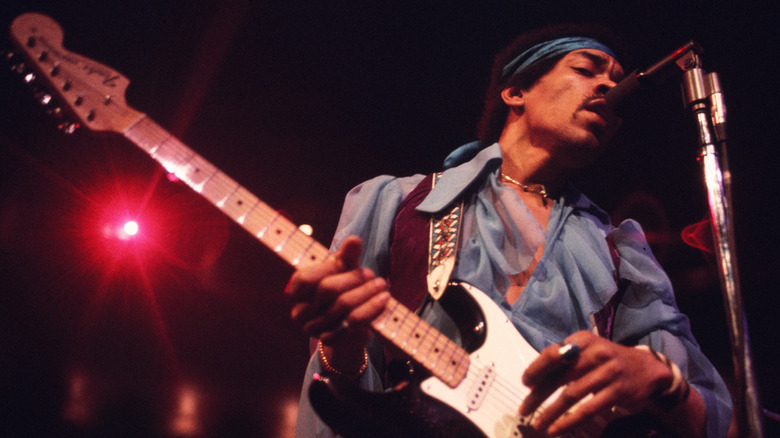
Despite years touring the U.S. with other acts, it was in the U.K. that he first became a star in his own right, while remaining relatively unknown in his home country. But with the support of famous admirers such as the Beatles' Paul McCartney, Hendrix was added to the line-up of the 1967 Monterey Pop Festival. Hendrix's nine-song set was drenched in distortion, feedback, and sonic chaos that made him a poster child of the psychedelic era. It also featured him performing stunts, including playing the guitar with his teeth and behind his head.
He finished his set with a cover of The Troggs' "Wild Thing," which famously ended with the guitarist setting fire to his own instrument before smashing it on the stage: truly one of the most rock 'n' roll climaxes to a show ever.
Queen at Live Aid
Queen had been famous on both sides of the Atlantic for over a decade by the time they performed at Live Aid in 1985. A huge charity show held at London's Wembley Stadium — a sister show was also being held the same day at John F. Kennedy Stadium in Philadelphia — the event attracted the cream of rock 'n' roll to perform in front of an enraptured live crowd of 72,000 people as well as a TV audience of over a billion. In the opinion of many fans, Queen's set was the greatest rock performance of all time, and all thanks to the unsurpassable performance by the band's supremely charismatic frontman, Freddie Mercury.
It takes a certain kind of showmanship to hold such an audience in the palm of your hand, but that's just what Mercury did, firing through a suite of Queen's biggest hits: "Bohemian Rhapsody"; "Radio Ga Ga"; "Ay‐Oh / Hammer to Fall"; "Crazy Little Thing Called Love"; "We Will Rock You," and "We Are the Champions." At one point, a white-undershirt-clad Mercury had what appeared to be every single person in the stadium pumping their fists in the air, creating one of the best-loved moments in rock history.
It is unbearable to think that Queen came close to not playing the show. Though the band were rock veterans, Live Aid's organizers were torn on whether they were the right act for the event, and a spate of shows in apartheid-era South Africa had damaged their image. But Live Aid proved to be the ideal showcase to remind the world that Mercury et al. were one of the finest live acts on the planet.
The Beatles' rooftop concert
Not all iconic rock moments take place in front of huge audiences. Sometimes, just a handful of people were in attendance, as was the case with the Beatles' last ever live performance together as the Fab Four on January 30, 1969.
The show in question took place on the roof of the London office of the Beatles' Apple Corps company, and was planned to be the climax of a proposed film by documentary maker Michael Lindsay-Hogg. The project never came to fruition — though the footage eventually became the basis for Peter Jackson's acclaimed "Get Back" TV series in 2021 — but thankfully it gave the world this show, which ranks among the Fab Four's finest moments.
The performance took place at lunchtime that day, with John Lennon and Ringo Starr each borrowing their wives' coats to protect them from the chilly winter rooftop air. Over the course of 42 minutes, the band plus guest organist and "fifth Beatle" Billy Preston performed multiple takes of new material including "Get Back," "Dig a Pony," "Don't Let Me Down," "I Got a Feeling," and "One After 909." It took place in front of a tiny audience of Apple staff, friends and family, and assorted office workers and shoppers who just happened to be passing in the street below, who were likely unaware — at least initially, since the crowd soon grew — that rock history was taking place above them. The show was broken up by the police, but demonstrated that the Beatles remained an exceptionally tight live unit, years after they had collectively retired from the road to focus on studio work.