

4 Best Bee Gees Songs That Prove They Were More Than A Disco Band
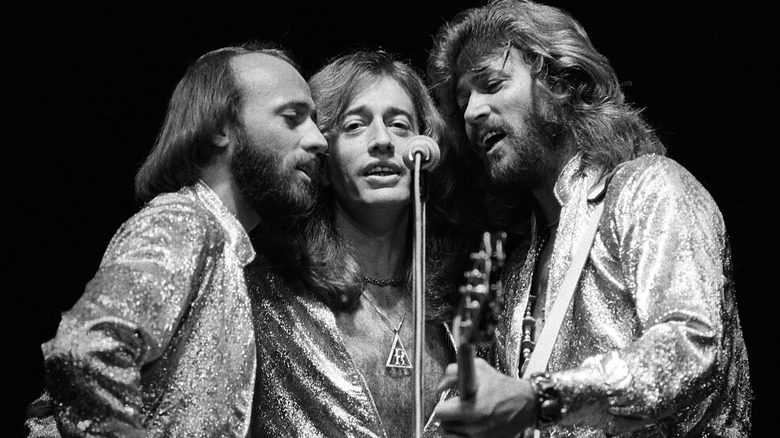
The Bee Gees were one of the most successful disco groups of the '70s, but their influence extends across several genres and decades, even if their non-disco music never quite reached the career highs of songs like 1978's "Stayin' Alive." But true fans know that some of their best, most groundbreaking and moving songs are not necessarily disco tracks.
The Gibb brothers went through many stages throughout their career, and those ups and downs led them to experiment with different sounds. They didn't only draw inspiration from the dance floor; they listened to their heroes, delved into folk, orchestral sounds, and gentle harmonies, and as a result, they were able to create entire careers separate from their disco years. They didn't chase the commercial hype and always looked to grow as artists, and thus inspired generations of musicians that followed them.
The songs we chose for this article show a completely different side of the disco kings, with a preference for songs that tap into a classic rock vibe. And while they don't all fit the same genre, they all predate the release of their most popular tracks in the latter half of the '70s, proving that the Bee Gees were always more than just a disco band.
Lonely Days
The Bee Gees went through a rough spot in 1969, but it also gave fans one of their most moving ballads. When drummer Colin Petersen and Robin Gibb quit the band that year, Barry and Maurice Gibb were devastated. They were the only two remaining members of the group, and while they were keen on continuing their musical career, they couldn't see a way forward. Fortunately, they had reconciled by 1970, and their short but meaningful time apart helped them realize how much they cared about the band. Out of that experience of separation, the song "Lonely Days" was born.
The track was released as a single in 1970 and appeared on their album, "2 Years On." The year before, the Beatles had released "Abbey Road," which has a clear influence on "Lonely Days," particularly the medley on the second side of the Beatles' LP. For one, the opening lyrics – "Good morning, mister sunshine / You brighten up my day / Come sit beside me in your way" — have parallels to those of the Beatles track "Sun King," as does the song's tempo and overall sound.
The Beatles comparison is a positive one, though. "The nicest compliment I ever heard about 'Lonely Days' was when a manager in a restaurant turned around and said, 'You know, this was the best Beatles song ever,'" Maurice told Billboard magazine.
How Can You Mend a Broken Heart
If "Lonely Days" was a sad reflection on the Bee Gees' short but painful separation, "How Can You Mend a Broken Heart" is the other side of the coin. Their disco years were still ahead of them, yet with this country-style ballad from 1971, the Gibb brothers were trying to find a new path: They were reunited and ready to make music, but the separation weighed on them.
In addition to being a reflection on the changes they were going through, it was also a way for them to express feelings they weren't always comfortable putting into words. "And how can you mend a broken heart? / How can you stop the rain from falling down? / How can you stop the sun from shining? / ... Please help me mend my broken heart and let me live again," the chorus sings.
"'How Can You Mend a Broken Heart' was how we felt about coming back together. So, while we weren't saying these things to each other, we were writing songs that said these things," Barry Gibb explained in Billboard magazine.
New York Mining Disaster 1941
"New York Mining Disaster 1941," released in 1967, was the Bee Gees' debut international single. The song was inspired by a British tragedy, the 1966 Aberfan coal mine disaster, mixed with a story about a mining accident in New York from decades before, and the result was a beautiful, moving folk-rock tune that showed the world what the Gibb brothers could do.
In fact, when they first started, there was a rumor going around that they were actually the Beatles putting out music under a pseudonym. Just the fact that people mistook "New York Mining Disaster 1941" for a Beatles song should be enough to make two things clear to modern listeners: It's not a disco song, and is of such high quality that people actually thought it was the Fab Four. Indeed, its simple guitar riffs and lilting vocal harmonies belie a darker lyrical content, with haunting lines such as "Have you seen my wife, Mr. Jones? / Do you know what it's like on the outside? / Don't go talking too loud, you'll cause a landslide, Mr. Jones."
With the '60s music industry being what it was, that was the move at the time, as Barry Gibb explained in the book "The Bee Gees: Tales of the Brothers Gibb": "It was good for us because everyone thought it was the Beatles under a different name."
Massachusetts
"Massachusetts" was the Bee Gees' first No. 1 U.K. single, and sounds nothing like what modern listeners might expect from the disco legends. This song appeared on their 1968 album, "Horizontal," and it represented a period of experimentation for the band. With a mix of country and psychedelia, backed with orchestral elements, this song was written by all three Gibb brothers and is an early masterclass of collaboration between them.
It was also an early preview of the phenomenal songwriting talent that they would bring to bear not only on their '70s disco hits, but also in the Bee Gees' later years as a lyrical powerhouse for other famous artists. Penned while bobbing around on a boat in New York, Barry Gibb admitted in Daniel Rachel's "The Art of Noise: Conversations with Great Songwriters" that the inspiration simply began with the title, saying, "When you look back it's quite a good exercise if you are songwriters to challenge yourselves to do something; we'd never been to Massachusetts."
Indeed, the whole album is experimental, being released the year after "Sgt. Pepper's Lonely Hearts Club Band," and was all about psychedelia. So while "Massachusetts" is anything but disco, it put the Bee Gees on the map.