

Rock Bands With The Most Billboard Hits Of The '70s
Throughout the 1970s, artists representing myriad styles competed for spots on the Billboard Hot 100, the chart of record in the United States. A handful of rock bands were more successful than all of their peers, notching a staggering number of hits before the decade was out. While mainstream music of the time was melting pot with room for soul, funk, folk rock, arena rock, punk, new wave, soft rock, and disco, among others, hard-charging rock 'n' roll remained dominant thanks to the bands of the day creating and releasing what would someday be referred to as classic rock. Their reward: chart hit after chart hit.
While other collectively named acts did very well for themselves on the Hot 100 in the 1970s — particularly the Carpenters and the Bee Gees — they don't really count as "rock bands." The Carpenters were an easy listening duo with nearly two dozen Hot 100 placements, as did the Bee Gees, which was more of a vocal-based pop-folk trio turned disco act. Only five true bands — Chicago, Wings, Three Dog Night, the Eagles, and Grand Funk Railroad — rocked their way into the Hot 100 pop chart more times than any other groups did during the 1970s.
Chicago
One of the longest-lasting bands ever, even after transforming into a soft pop institution, Chicago was first known as the Chicago Transit Authority, an outgrowth of a project assembled by three collegiate brass and woodwind players in the 1960s. Settling into a lineup with a variety of instruments and multiple vocalists, Chicago approached the 1970s with a mixture of traditional and progressive rock along with a hefty amount of jazz elements.
The band was among the most prolific of '70s acts, churning out 15 studio and live LPs and continually issuing promotional singles. Straddling so many genres made for a large Chicago audience, which consumed singles with such fervor that the group appeared on the Hot 100 a remarkable 27 times in the '70s. Among those hits are classic rock radio staples like "Saturday in the Park," "Old Days," and "25 or 6 to 4." The 1976 ballad "If You Leave Me Now" was Chicago's only No. 1 hit in that 10-year period.
Wings
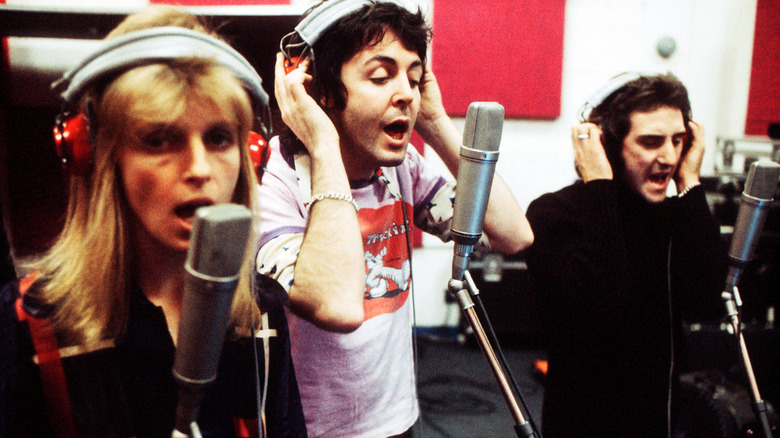
After the Beatles broke up in 1970, co-frontman Paul McCartney segued immediately into making new music on his own terms via several different permutations. Throughout the 1970s, McCartney released material under his own name, as part of a duo with wife Linda McCartney, and as the sometimes headlining and sometimes unnamed leader of a full-fledged band called Wings. That collective, which also included Linda McCartney and ex-Moody Blues guitarist Denny Laine, released studio albums only in the 1970s, and most sold pretty well, particularly the triple-platinum "Band on the Run."
However, Wings (or Paul McCartney and Wings) truly thrived on the singles chart. From 1972 until 1979, the band landed 22 releases on the Hot 100. More impressively, Wings soared into the Top 40 with every single one of those songs, and five of them made it all the way to No. 1. Among the Wings chart-toppers in the '70s: "Silly Love Songs," "Listen to What the Man Said," and "My Love."
Three Dog Night
Applying the vocal group model of the 1960s to a rock 'n' roll framework proved a very successful notion for Three Dog Night. The group outsourced its songs from prominent singer-songwriters of the early 1970s, counter to the common rock practice of recording compositions written by band members. A stable group of instrumentalists backed up the stars: three vocalists who split lead singer duties. All that flexibility meant Three Dog Night sounded wildly different from single to single. "Mama Told Me (Not to Come)," "Joy to the World," and "Black and White" each spent some time in the No. 1 spot in 1970, 1971, and 1972, respectively, and they don't much seem like they came from the same band.
All told, the broadly appealing Three Dog Night was one of the most frequently charting acts of the 1970. They generated 17 Hot 100 entries between 1970 and 1975, and all of them wound up in the Top 40. Apart from their chart-toppers, Three Dog Night also struck it big with songs like "Celebrate," "An Old Fashioned Love Song," and "Never Been to Spain."
Eagles
"Their Greatest Hits 1971–1975" is a vinyl every '70s diehard should already own, and it's likely most do. That first collection of smash hit singles by the Eagles is the top-selling album in U.S. history by a wide margin, the only LP to ever move 40 million copies across all media formats. That's a demonstration of the timeless appeal and enduring popularity of the Eagles, a group that dabbled in rock, country, country-rock, folk hard rock, and dance music from the time of their origin in 1971 as a backing group for Linda Ronstadt to an acrimonious split in 1980.
Across six studio albums, the Eagles provided a soundtrack for the '70s, and the hits just kept on coming. In 1972, the band's first single, "Take it Easy," reached the Top 20. That was the first of 17 Hot 100 tracks for the Eagles, a grouping that also included five No. 1s, such as "One of These Nights," "Best of My Love," and "Hotel California."
Grand Funk
In the 21st century, they're a '70s musicians we completely forgot about, but in their era, Grand Funk Railroad — later known by the truncated Grand Funk — were quantifiably and objectively one of the most commercially significant acts around. Millions of Americans couldn't get enough of the band's unique and rarely replicated blend of early heavy metal with danceable grooves, arena rock energy, and traces of soul and country. Grand Funk may not get played as much on classic rock radio as other instantly recognizable and loud '70s acts like the Who, but they lorded over both the album and singles charts.
Between 1969 and 1974, Grand Funk (Railroad) issued 10 albums, and every one of them was certified gold or platinum. And not just diehard rockers enjoyed the band. In 1973 and 1974, their singles "The Loco-Motion" and "We're An American Band" each reached No. 1 on the Hot 100. Altogether, and before the '70s came to a close, Grand Funk hitched onto the pop chart a grand total of 17 times.