

How Long Should Guitar Picks Last?

Whether you're a beginner guitarist learning some easy songs or a seasoned pro who can bust out some gnarly solos like the best of 'em, you have likely considered buying (or are perhaps already using) a guitar pick. And if you do, you can reasonably expect one to last from a few weeks to many months without needing to buy a replacement.
While using your bare fingers to strum and pluck strings might be preferable for some, using a pick offers quite a few benefits. Aside from helping you produce notes of consistent quality and allowing you to be more precise with which strings you strike, it also makes the playing experience considerably more comfortable (and generally callus-free). However, a guitar pick isn't a one-time investment. As with any other object that you repeatedly strike or handle, the pick will get worn down over time and will eventually need to be replaced.
There's no hard and fast rule as to when it's time to replace your guitar pick, as the rate at which it deteriorates depends on a few factors, including how frequently and heavily you use it. On the extreme end, it's not unheard of for professional guitarists to render a guitar pick unusable within just a day of constant use. In addition to your playing style, the material, tip shape, tip texture, and thickness of your guitar pick can determine how long it remains usable.
Factors affecting the lifespan of a guitar pick
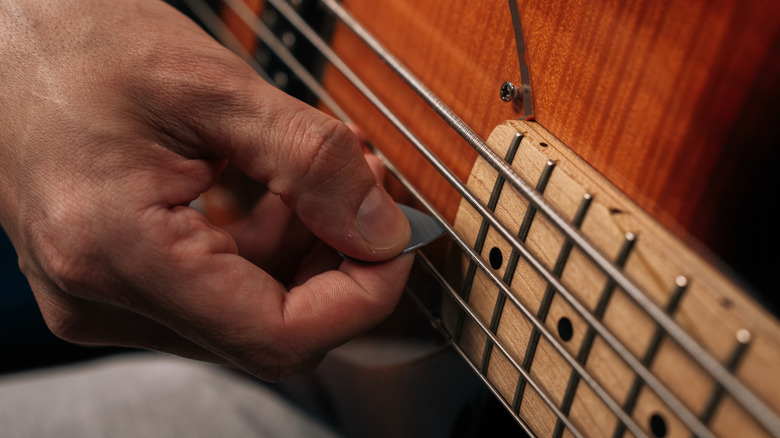
Generally, the tougher and thicker the material, the slower the pick's degradation will be. Guitar picks can be made of a surprisingly diverse variety of materials, from plastics such as acrylic and nylon to stone and metal, each with their own level of resistance to wear and tear. For plastic picks, celluloid sits on the lower end of durability, with nylon and acrylic offering longer lifespans, while more advanced materials such as carbon-reinforced nylon and Ultem thermoplastic can last even longer.
Furthermore, similar to how sudden temperature changes can damage your guitar, the temperature of the environment in which you are playing can affect your guitar picking experience, depending on the material your pick is made of. For some plastics, such as celluloid, low temperatures can cause stiffening, which in turn can lead to breakage. Then there's the shape, with the finer tips of pointier picks being more susceptible to wear, although this can be alleviated with polished tips, which have less friction.
So, how can you tell it's time to replace your pick? Signs include when the tip has essentially been worn away, when the tone sounds weak or dull, when there's visible damage on the pick, or when you start hearing string buzz (caused by the strings vibrating or hitting the frets incorrectly). One thing you absolutely shouldn't do, though, is to keep using your guitar pick until it simply breaks. Consider replacing your pick at the first sign of the aforementioned indicators to maintain the quality of your guitaring prowess.