

4 Songs You Didn't Know David Bowie Wrote For Other Famous Musicians
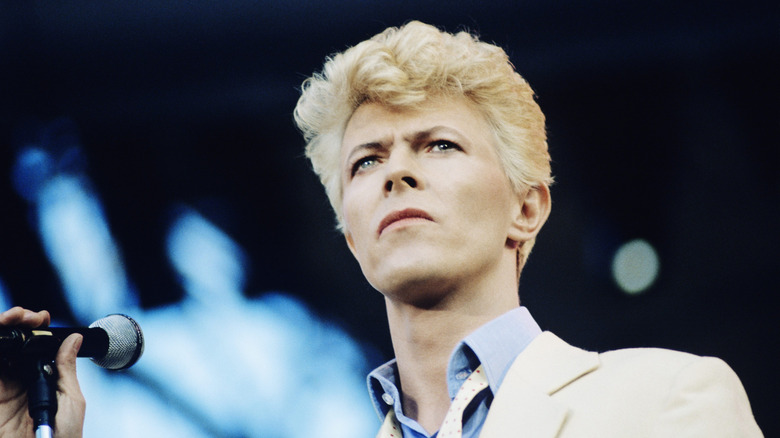
Over a stellar career that spanned five decades and straddled the turn of the century, David Bowie established himself as one of the icons of rock, both due to his incredible music and uncanny ability to reinvent himself as a performer. Yet Bowie didn't only conjure the Ziggy Stardust magic for himself; he also sprinkled it for other artists.
As a songwriter, Bowie penned tracks for other famous musicians that most people — apart from the absolute diehards — may not know came from his extraordinarily deep creative well. Remember Mott the Hoople's "All the Young Dudes"? Yep, that's Bowie. And Tina Turner's "Girls"? Also Bowie.
We have already covered the David Bowie songs that sound cooler today, so let's look at the music he wrote for other artists that slaps hard too. One thing remains certain here: There will never be another Bowie. He truly was one of one.
All the Young Dudes — Mott the Hoople
Have you ever heard a song where it feels like the guitar alone sings to you? That's Mott the Hoople's "All the Young Dudes." One doesn't even need to hear the lyrics to recognize the song, since the riff does a lot of the heavy lifting and deposits itself right into the memory bank. If that isn't enough, the chorus understands how to hook its poppy tentacles into listeners to create one of the most singalong-able anthems in music history.
"All the Young Dudes" is off Mott the Hoople's album of the same name, which was released in 1972. The track turned out to be the British rock band's biggest single on the Billboard Hot 100, peaking at No. 37 and staying on the charts for 11 glorious weeks. It also turned out to be the saving grace that prevented Mott the Hoople from calling it quits at the time, since they had been dejected by the overall reception to their music.
As the story goes, David Bowie offered them "All the Young Dudes" in an attempt to help them out, which it very much did. "It's a great song," Mott the Hoople vocalist Ian Hunter told Classic Rock. "God knows why he gave it to us. I've said that many times, but really, if I'd've had that song I wouldn't have given it to anybody. I think we caught him just right, because he had recorded it and wasn't happy with it."
Girls — Tina Turner
Tina Turner is one of a number of musicians who rescued their dying careers with one song. However, according to songwriter and producer Terry Britten, David Bowie played an important role in resuscitating Turner's stock in the music industry in the '80s. Speaking with International Musician and Recording World (via MusicRadar), Britten revealed how Bowie admitted he was a huge fan of Turner and wanted to work with her. This attracted the attention of the music label Capitol Records, which would go on to release Turner's albums in the '80s.
"David had this song 'Girls' for Tina, but he was too busy to produce it himself," Britten said. "So they asked me to do it." This kicked off a fruitful partnership between Britten and Turner. With songwriting credits attributed to Bowie and Erdal Kizilcay, "Girls" was included on Turner's 1986 album, "Break Every Rule" – the LP peaked at No. 4 on the Billboard 200.
There's an undeniable Bowie influence in the composition and cadence of "Girls," but this didn't help the song excel in the U.S. charts. On the other hand, it attracted some attention overseas, making the Top 20 in Holland. In 1987, Bowie released his own version of the track.
Over the Wall We Go — Oscar
British audiences know the name Paul Nicholas fairly well, since he's an actor, stage performer, and musician who achieved his fair share of success in the United Kingdom. Before using the name he's better known for, he experimented with various other aliases, including Oscar in the '60s. One of the pop songs he recorded as Oscar was "Over the Wall We Go," which was written by a young David Bowie.
The bouncy track that could double as a drinking song at a local bar is all about prison breaks — a topic that didn't exactly endear itself to the BBC's standards and resulted in a ban. Despite "Over the Wall We Go" not being anything remotely close to a hit song, it's tough to deny there's a cheeky charm to it that exuded dry British humor and showcased Bowie's talent to write about practically anything.
In an interview with The Guardian, Nicholas remembered working with the pre-famous Bowie. "He was very stylish, as you would imagine, even then," he said. "He was quite serious, I thought, for a young man. He told me about learning to be a mime artist and did a bit of mime for me, you know, putting the hands on the windows."
Oh You Pretty Thing — Peter Noone
Peter Noone is a musician who became mega-successful before he turned 21, achieving a period of superstardom as the singer of the pop outfit Herman's Hermits. During the peak of the band's success, they worked with renowned producer Mickie Most. One day, David Bowie met with Most and played some of his unrecorded demos, one of which would go on to be released by Noone as "Oh You Pretty Thing."
"David Bowie had played this song," Noone told Songfacts. "Mickie was really a big fan of Bowie, because he liked that Tony Visconti record 'Space Oddity.' He had a couple songs and Mickie said, 'I want both of these songs for Herman's Hermits.'" However, Herman's Hermits would break up before any further recording sessions, so Most decided that Bowie's radio-friendly "Oh You Pretty Thing" should be the pitch-perfect first single for Noone.
Bowie lent his piano-playing skills to the track, and the song was released in 1971. "Oh You Pretty Thing" turned out to be a U.K. Top 40 hit for Noone, peaking at a respectable No. 12 and spending nine weeks on the chart. Funnily enough, Bowie recorded his own version of the track titled "Oh! You Pretty Things" and released it on his 1971 album, "Hunky Dory," which debuted only a few short months after Noone's single.