

One Of Neil Peart's Most Beloved Drum Solos Was Made Up On The Spot
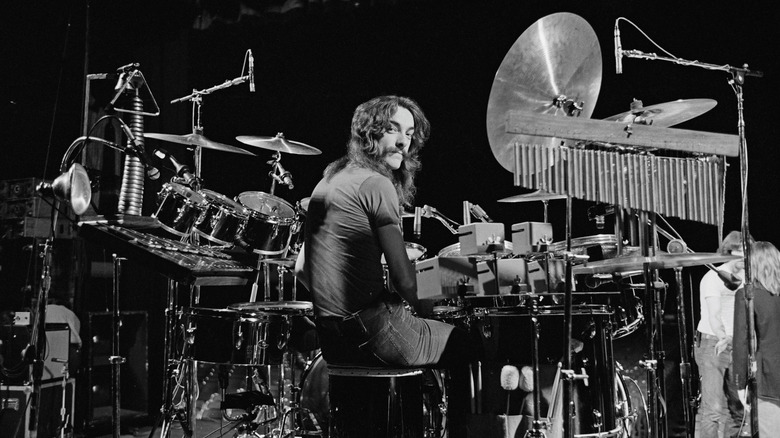
Every classic rock fan knows Rush's Neil Peart is a history-making drummer just as they know "Tom Sawyer," Rush's defining track. Peart, aka "The Professor," was a master craftsman on his drum kit, fashioning meticulously composed parts that drove, elevated, and interlocked with bandmates Geddy Lee and Alex Lifeson even as they stood out and illustrated his incomparable talent. Such is the case with the brief yet legendary 10-second-long drum solo in "Tom Sawyer," which Peart concocted on the spot.
Bear in mind, however, that "made it up on the spot" doesn't mean that Peart did one, unaltered take that he played forevermore from that point. Moments of musical inspiration can certainly happen this way, but it's more that Peart's initial idea for the "Tom Sawyer" solo came in the moment while the band was writing together. Then, he took that initial idea and sculpted it. In 1983, Peart wrote in Modern Drummer magazine (via Power Windows), "While we were making demos of the newly written songs, I got a little experimental (lost) in the end section, and fought my way out with a series of random punches. Listening back to this 'mistake,' I loved it, and had to learn how to do it so I could put more of them in."
Thus, Peart's drum solo for "Tom Sawyer" was born, beloved by air drummers as much as professionals, much like Peart's entire body of work. Right up until the Rush drummer's sad death in 2020 at the age of 67, he considered "Tom Sawyer" to be one of his favorite songs, as well as the most difficult — solo included.
Neil Peart's solo was built from a series of random punches
Don't take Neil Peart's use of the word "random" to mean that all of the cymbal crashes, tom fills, and double-kick drum hits in the solo of "Tom Sawyer" just sort of happened. The whole song is written in 7/8 time, rather than the bog-standard 4/4 time, but shifts time signatures leading into its drum solo. It moves from 7/8 to 7/16 to 3/8 before Peart's drum solo splits into three micro-sections characterized by descending toms, staggered double kicks, and an interplay between cymbals and kicks. Don't know what all that means? It means that Peart intentionally built a solo where his limbs are all doing independent things in perfect sequence, with perfect feeling, and in perfect unison with Geddy Lee and Alex Lifeson. And every member of an audience can still follow along by ear.
This is why, long after the initial, off-the-cuff moment that led Peart to develop the drum solo for "Tom Sawyer," the entire song still proved a challenge for him. He considered it incredibly challenging to play because not only was it mechanically difficult but also he was never sure he could nail the combined strength and fluidity needed to produce the song's feeling. And yet, you'd never know it listening to any of Peart's performances of "Tom Sawyer." You'd also never know the song's whole drum solo wasn't fashioned from the songwriting get-go.
This is why the drum solo for "Tom Sawyer" ranks among rock's greatest, classic or otherwise, much like Peart's "YYZ" solo from "Exit ... Stage Left," considered one of the best drum solos in rock history. Leave it to "The Professor" to not only play but also teach the rest of us how to play, too.