

The Brian Wilson Recording Trick That Revolutionized Rock Music Forever
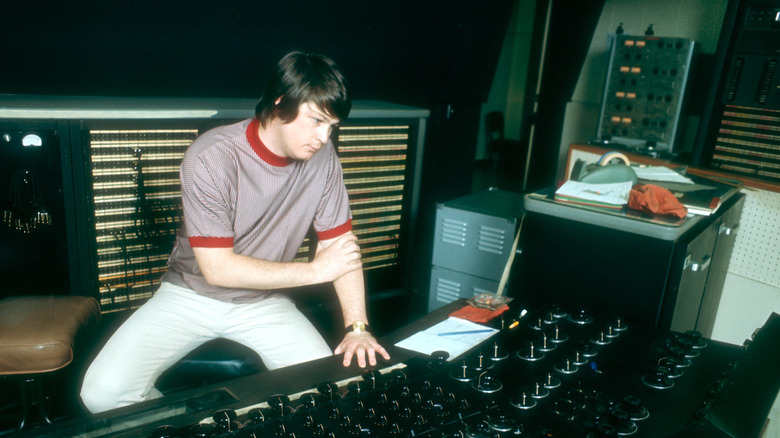
The 1960s was a transformative decade for rock music, a time when increasingly ambitious songwriting was matched by innovations in the studio that allowed artists to create recordings inconceivable back at the dawn of rock 'n' roll in the 1950s. And it was often individual artists who pushed forward what was possible in the studio, such as the Beach Boys' Brian Wilson, whose many contributions to recording included his pioneering use of modular recording in rock and pop.
Like their friendly rivals the Beatles and their producer George Martin, Wilson and the Beach Boys found themselves increasingly preoccupied with using the studio as an instrument unto itself as the 1960s rolled on. The bands were united in trying to develop new techniques to create bigger and brighter sounds, and amid this flurry of studio invention, Wilson came up with an altogether new method of recording that prefigured how a great deal of popular music is made today.
Brian Wilson was the inventor of modular recording
Brian Wilson had been a visionary artist since the Beach Boys first formed back in 1961. But it was in 1966, around the time of the sessions for "Pet Sounds" and "Smile," which was later abandoned, that he made his most decisive leaps forward in terms of studio composition. Throughout the history of popular music to that point, artists had typically entered a recording studio and delivered entire takes of songs, either with a whole band effectively performing live together, or with a relatively small amount of overdubbing in which different takes were then layered on top of each other.
Wilson's genius was to instead record each musician's performance in small "modules" that he would then piece together himself, like an aural collage. In this way he could order instrumentation freely and arrange the track to better serve the song, to a degree not previously used with a pop group. "Good Vibrations" was the first song to benefit from this treatment, and it is telling that little else recorded in 1966 sounds as lush and dynamic.
Today, musicians and music producers benefit from digital workstations that allow them to cut and paste musical fragments with ease. But back when Wilson first decided to abandon linear recording techniques in favor of modularity, it involved cutting by hand and piecing recordings together into spooled mosaics of tape. "Good Vibrations" is said to have been assembled from more than 90 hours of tape, which Wilson pored over until he had the raw materials to fulfill his musical vision. The approach required an incredible amount of patience as well as an obsessive eye for detail — both of which Wilson evidently had in spades.
Other innovations from the Beach Boys' Brian Wilson
Modular recording wasn't the only innovation Brian Wilson made in the recording studio. While the Beach Boys were a pop-rock group, Wilson was wildly imaginative in terms of the instrumentation he was willing to employ in their recordings — and went far beyond simply widening the sound with brass or strings. Where other bands stuck with guitar, bass, drums, and maybe some keys or harmonica, Wilson increasingly made eccentric and unexpected inclusions, including bicycle bells, tin cans, theremins, and water jugs to add unusual textures to the Beach Boys' sound.
Wilson was also a pioneer of blending and layering, combining multiple takes of vocals to spine-tingling effect on songs such as "God Only Knows." He also used classical elements, such as choral techniques to arrange vocal harmonies, which few had considered for use in pop music at the time. Despite stepping away from the music industry in the 1970s due to mental health issues, by the time of Wilson's death in 2025, he was roundly considered an icon and one of the most important figures in popular music.