

Commonly Misunderstood Folk Rock Lyrics You May Be Singing Wrong
Folk rock is known for its evocative lyricism, but the truth is that some of the biggest songs in the genre are often misheard by listeners. In this article, we revisit five classic tracks that you may be singing wrong — but don't worry, you're definitely not the only one.
The technical term for a misheard lyric or phrase is "mondegreen." It was coined by the journalist Sylvia Wright in the 1950s, after amusingly misunderstanding a line in the traditional Scottish song "The Bonny Earl of Morray." While she heard, "Oh, they have slain the Earl o' Morray and Lady Mondegreen," it actually went, "Oh, they have slain the Earl o' Morray and laid him on the green."
Chances are we all have countless mondegreens in our heads, which we have been singing wrong for years without anyone correcting us. But when we do find out what a misheard lyric to one of our favorite songs actually is, it can sometimes change the whole meaning of the track. Let's see if you have been correctly hearing these folk-rock classics from acts including the Mamas & the Papas, America, and Don McLean.
A Horse with No Name — America
"A Horse with No Name" was a huge hit for America, a three-piece made up of former school friends Dewey Bunnell, Dan Peek, and Gerry Beckley. The three were together in London, where their fathers were stationed in the U.S. Air Force. Released in 1972 stateside (it was released in the U.K. the previous year), just two years after the band formed, it took America to No. 1 on the Billboard Hot 100 and held the top spot for three weeks.
The evocative song summons the image of a lonely desert journey on horseback, with the narrator reflecting on their solitude and the landscape around them. Some listeners have suggested that the song is a metaphor for hard drug use, though songwriter Bunnell has consistently denied this is the case. Instead, he explained to journalist Mike Morsch of Vinyl Dialogues that the song is about "solitary thinking in a peaceful place." This is reflected in the chorus, which tells us, "In the desert you can remember your name / 'Cause there ain't no one for to give you no pain." However, some listeners mishear the line as "can't remember your name," chiming with the mirage-like atmosphere of the song.
American Pie — Don McLean
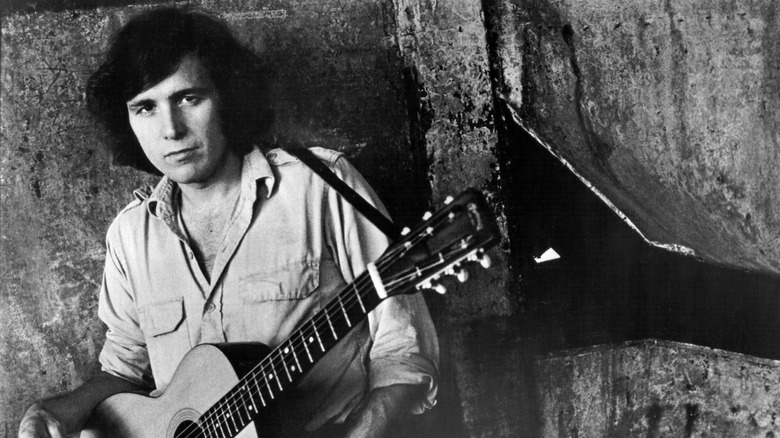
Don McLean's 1971 masterpiece "American Pie" is an eight-and-a-half-minute epic that centers on the tragic death of musicians Buddy Holly, the Big Bopper, and Ritchie Valens in a 1959 plane crash, aka "the Day the Music Died." Its verses are dense and winding, offering a vivid but cryptic panorama of the mid-20th-century American music scene and society in general. Meanwhile, the song's iconic chorus acts as an irresistibly singable counterpoint.
However, many listeners make a mistake when singing along on the radio, imagining that the lyrics go: "So, bye-bye, Miss American Pie / Drove my Chevy to the levee, but the levee was dry / And them good ol' boys were drinkin' whiskey and wine / Singin', 'This'll be the day that I die.'" Instead, the phrase in the third line is "whiskey and rye." The confusion is understandable: Rye is in fact a subcategory of whiskey, so the lyric doesn't quite make sense. Nevertheless, it works in the song, which spent four weeks atop the Billboard Hot 100 and remains a radio staple despite its length.
The Sound of Silence — Simon & Garfunkel
Simon & Garfunkel's "Sound of Silence" is one of the most moving songs in the duo's discography — a fact that has to some degree been obscured by its recent ironic use in online memes and a famous hard rock version that emerged 51 years later and won over a new generation. Written by Paul Simon when he was just 21 years old, the songwriter composed "The Sound of Silence" in the unlit bathroom of his parents' home, adding a literal meaning to the famous opening lines: "Hello, darkness, my old friend / I've come to talk with you again."
The opening is undoubtedly the best-known part of the song among casual listeners, who often get later lines completely wrong. One common misunderstanding comes in the fourth verse, when Simon and Garfunkel sing that "silence, like a cancer, grows." Listeners have reported a number of strange mondegreens related to this line. Most notably, some believed it said "silence, like a casserole."
Bad Moon Rising — Creedence Clearwater Revival
Creedence Clearwater Revival's (CCR) "Bad Moon Rising" is an uptempo swamp rock number. Though its partly acoustic instrumentation places it in the folk rock tradition, the song nevertheless confirmed John Fogerty and his group as one of America's most popular bands in the late 1960s. The track achieves the rare feat of combining a danceable, driving rhythm with foreboding lyricism that never detracts from the song's relentless catchiness.
The lyrics are characterized by the effective use of repetition, which seems to reinforce the solidity of the narrator's prophetic vision. However, despite many of us being familiar with the song, you've probably been getting it wrong even from the very first line — which doesn't replicate the title at all. Instead, according to the official lyric video on CCR's YouTube account, the opening lyric goes: "I see the bad moon arising," a subtle difference that you would barely detect by ear alone. Elsewhere, some have claimed to have misheard the later line "There's a bad moon on the rise" as "There's a bathroom on the right." It is purportedly such a common mondegreen that Fogerty himself occasionally sings the alternate lyric to entertain himself during live performances.
California Dreamin' – The Mamas & the Papas
The Mamas & the Papas' 1965 hit "California Dreamin'" is one of the defining folk rock songs of the 1960s (though it was successfully covered by The Beach Boys in the 1980s). The woozy vibe reflects the summer images summoned by the narrator of the song while surviving a particularly bleak winter in New York City. The tune was written by band members John Phillips and Michelle Phillips, whose lyrics feature a character entering a church and getting down on their knees.
But here's where things are not what they seem for many listeners. All these years, it has certainly sounded like the character in the song describes how they "get down on my knees and I begin to pray." The line gives the track a more overtly religious tone that suggests the narrator is asking for divine intervention to help them get to safe and warm Los Angeles. But actually, the lyric is "I pretend to pray," adding to the implication that the only reason the character has entered the church is to escape from the cold. The next lines double down on this angle, with the narrator commenting: "You know the preacher liked the cold / He knows I'm gonna stay." The story is complicated, however, by claims from within the group that vocalist Mama Cass actually misremembered the lyric during the recording and early live shows, singing "begin" instead of "pretend" until Michelle corrected her.