

5 Nearly Perfect David Bowie Songs That Should Be Required Listening For Younger Generations
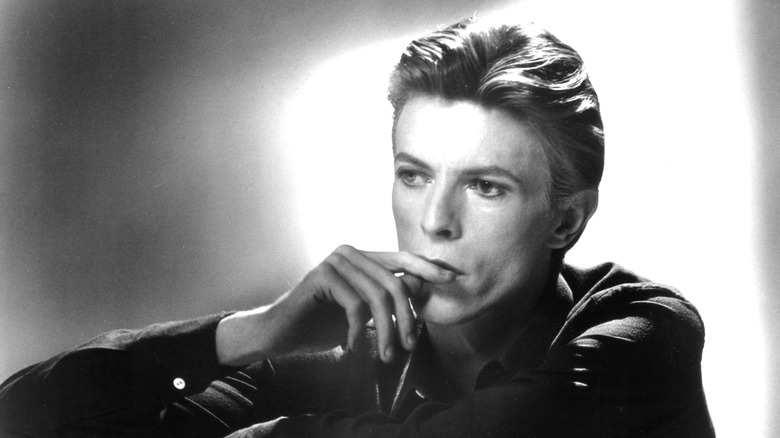
David Bowie's legacy as a rock visionary remains unquestioned. From his humble beginnings with his self-titled 1967 debut up until his final album, "Blackstar," he experimented with a variety of sounds and a bevy of collaborators, producing now-classic albums full of sheer creativity. But, in the decade since Bowie died of liver cancer, his star may have dimmed, which is a shame since he's made some music that is required listening for younger generations.
Whittling down the star's catalog to a handful of essential tracks is no easy task. There are plenty of underrated Bowie songs that deserve your attention, and he was the king of high school hits that summed up the thrill of being young. But these following songs are quintessential because they show his strength as a songwriter, a collaborator, and an artist. A musical chameleon until the day he died, Bowie was never shy about changing his appearance or his sound.
Ziggy Stardust
David Bowie first showed he contained multitudes by metamorphosizing from the psych-folk star of "Space Oddity" into a glam god. After first embracing a prog-adjacent sound on "The Man Who Sold the World" and an art-pop perspective on "Hunky Dory", his cocoon burst in n '72 to reveal a glam butterfly made of stardust and eyeshadow: "The Rise and Fall of Ziggy Stardust and the Spiders from Mars." The concept album, about an androgynous alien rockstar sent to save Earth from itself, peaks with the title track.
"Ziggy Stardust" finds Bowie and his band — guitarist Mick Ronson, bassist Trevor Bolder and drummer Mick Woodmansey — in perfect symbiosis, delivering a glam rock masterpiece. Ronson's opening electric riff snarls against Bowie's acoustic strumming, leading into a tragic tale about how Ziggy "made it too far" after he was too busy "making love with his ego." Bowie sings the final line with equal parts reverence and defiance: "Ziggy played guitar."
"Ziggy was in a rock & roll band and the kids no longer want rock & roll," Bowie explained in 1974 (via Rolling Stone). Eventually, Ziggy "starts to believe in all this himself and thinks himself a prophet of the future Starman" before his followers turn on him, yielding the titular "fall." But as the album shows, Bowie's star was on the rise.
Young Americans
By the mid-70s, David Bowie had shed his glam rock skin for a suit and combed hair. "I was through with theatrical clothes, and I would only wear Sears & Roebuck," he told Q magazine in 1999. "Which on me looked more outlandish than anything I had made by Japanese designers." With the new makeover came a new album, 1975's "Young Americans." Recorded at Philadelphia's Sigma Sound Studios, the LP aimed to capture the Philly soul sound of the early '70s through a Bowie-esque filer.
"It was seriously a 'plastic soul' album," Bowie told ZigZag in '78. "It was definitely me, portraying as a white Englishman, my view of American Black music, someone who watches more from outside than actually getting involved with it inside." To help this vision come to life, Bowie enlisted guitarist Carlos Alomar, who brought in his wife, Robin Clark, Ava Cherry, and a young Luther Vandross to sing backing vocals. After Bowie overheard one of Vandross' ideas ("What if there was a phrase that went, 'Young American, young American, he was the young American — all right!"), Bowie made Luther the album's vocal arranger (per Bowie's official website).
The title track is the best part of Bowie's "plastic soul," not just because of Alomar's excellent guitar work, David Sanborn's magnificent sax, or the unstoppable force of those backing vocals. It shows Bowie's willingness to yield his ego to produce the best song. He could have shot down Vandross's idea, but instead, he knew to encourage this talent and give it enough space to grow.
Heroes
It seems a bit obvious to dub one of David Bowie's most covered songs as one of his most essential. It's almost his most ubiquitous, being used in the finale of television programs like "Stranger Things" and "Regular Show" and films like "The Perks of Being a Wallflower" and "JoJo Rabbit." Yet, there is a reason why: It's arguably one of Bowie's most moving pieces of music, bolstered by phenomenal work by a band that featured Robert Fripp, George Murray, Dennis Davis, Carlos Alomar, and Brian Eno. With vivid imagery and Bowie's soaring vocals, "Heroes" is the perfect song to inspire anyone to overcome the impossible.
And it was born from a chance moment in July 1977. At the time, Bowie was in the midst of what has been dubbed his "Berlin Trilogy," a three-album run partially or entirely recorded at Hansa Studios in West Berlin. With contributions from Eno, these LPs —"Low," "Heroes," and "Lodger"—integrated ambient and electronic music, helping to shape post-punk and new wave. The middle entry took its name from a song written after Bowie watched from a window in Hansa as two lovers kissed by the Berlin Wall.
"Actually, it was [Bowie producer] Tony Visconti and his girlfriend [Atonia Maass]," Bowie told Classic Rock in 2015. Visconti was in a failing marriage at the time, but Bowie thought the kiss was moving. "[I] could see that Tony was very much in love with this girl," he said, "and it was that relationship which sort of motivated the song ['Heroes']."
Ashes to Ashes
After launching his career in '69 and rising to cosmic heights in the '70s, David Bowie brought it all crashing down in the '80s. After recording a new version of "Space Oddity" for British television at the end of '79, Bowie was repulsed by the nostalgia, so he turned on his beloved Major Tom. Set against one of George Murray's funkiest basslines, "Ashes to Ashes" recounts how Bowie's character experiences drug abuse issues: "Strung out in heaven's high / Hitting an all-time low."
"Ashes to Ashes" demonstrates one of Bowie's better qualities: An artistic detachment from personal preciousness — the belief that it's better to cannibalize the lore than preserve it when it doesn't serve a purpose anymore. Instead of leaving his breakthrough hit alone, Bowie used the good Major as a vehicle for his own struggles at the time. "There were elements of my really wanting to be clean of drugs," Bowie said to Mojo in 2002. "It probably came from my wanting to be healthy again."
The song also works as a bridge between Bowie's artistic and experimental beginnings and his mainstream, commercial success. "Ashes to Ashes" went to No. 1 in the U.K., his second chart-topper in England. It also served as a precursor to the follow-up album, "Let's Dance." It was his most commercially successful album (whose title track topped the charts in both the U.K. and USA).
Lazarus
David Bowie attempted to replicate the success of "Let's Dance" with two ill-received albums, ending the '80s on a down note. He refocused on 1993's "Black Tie White Noise," but at that time, he was over two decades into his career. While Bowie could have rested on his laurels, he didn't — he remained curious. On his "Earthling" album, he embraced the sound of the '90s U.K. jungle scene. Bowie also worked alongside Pet Shop Boys ("Hallo Spaceboy") and Trent Reznor ("I'm Afraid of Americans"). And in the 2000s, he used a series of albums to return to his art-rock roots. It is this era that produced arguably David Bowie's best album: 2016's "Blackstar."
It's hard to detach the album from the fact that it arrived mere days before Bowie's death. Such sentimentality might skew its evaluation, if not for the fact that it's a brilliant composition of experimental jazz rock, entwined with lyrical themes of mortality, legacy, and death. Though "Lazarus" was originally written for an off-Broadway jukebox musical of the same name, it ties into the album's theme and gives Bowie a worthy sendoff.
"This way or no way, you know I'll be free," he sings in the final verse, showing one can exit, stage left, with dignity and grace. "Just like that bluebird now, ain't that just like me? / Oh, I'll be free, just like that bluebird / Oh, I'll be free, ain't that just like me?"