

The 5 Best Covers Of Country Songs In Rock History
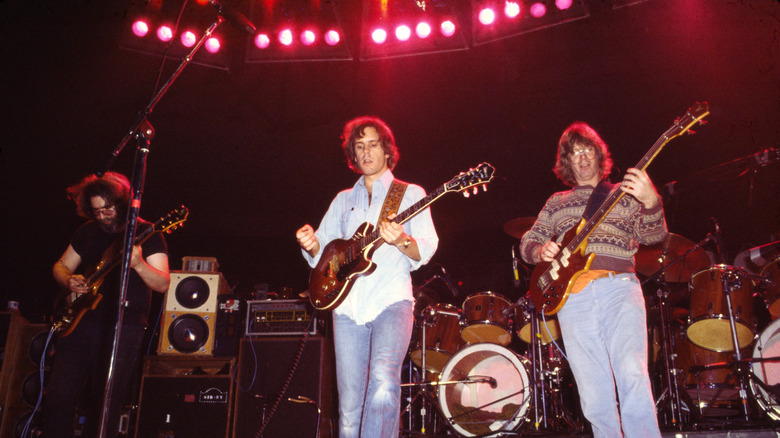
Given their shared roots of country and rock, covers the cross the line in either direction tend to have a special energy. (That is, of course, when you can find the line at all, with any number of acts defiantly straddling it.) Both genres have guitar-forward instrumentation and dive into topics like bad behavior and broken hearts, which can almost lead to a plug-and-play feel. With country, you can just dial down the accent, crank up the distortion, and bam: Your country jam is a rock song.
Plenty of rock acts have drawn from Nashville for their work, with the results ranging from near-satires to wild reimaginings to straightforward rerecordings of a proven winner. We've picked five of our favorites below, bringing together jam bands, thrash metal, and punk goddesses. It's a mini-celebration of the great things that can happen when a good old country song gets picked up by someone ready to plug in the amp and rock hard.
Jolene — The White Stripes
"Jolene" has attracted many covers because of its beauty, simplicity, and unusual take: There are a lot of songs confronting a lover or the other woman, but not many asking the Jezebel to do you a solid and back off. Dolly Parton's opus has been reimagined countless times, but one of the most chilling is the nigh-hysterical White Stripes version.
First of all, kudos for Jack White for not changing the name or the pronouns. He's a good enough musician to sing the part of a betrayed woman (or queer man in an unusual triangle), and his fidelity to the original saves the song from becoming absurd in the vein of Michael Buble's "cover" of "Santa Baby." White's vocal range veers between the frantic and unhinged and the gently mournful, making the familiar song fresh and unsettling. On your first listen, you really don't know where he'll go next. Love makes us do crazy things, and the Whites' unstinting reimagining of this country classic has all the arresting power of a true cry for mercy.
These Boots — Megadeth
One of the most nearly universal human experiences is making a complete ass of yourself over someone you like-like. And if you have any doubt about the uniting power of a cutie making a fool of you, consider the sweetly sassy Nancy Sinatra's classic breakup song "These Boots Are Made for Walkin.'" In the hands of Megadeth it became "These Boots," and they metaled up the music but kept nearly all the lyrics the same in its speedy, rip-roaring tribute.
Dave Mustaine, who like Nancy Sinatra had lovely long hair, sneers the lyrics out with the nasal contempt that animates the angriest punk and metal. The original's gentle pace is dramatically sped up: Sinatra casually walked out the door, but Megadeth took a few victory laps around the block, repeatedly looping around to give the faithless lover the finger. Thrash metal is some of the best exit music in the world, and this cover proves that it's as versatile as it is irreverent.
Where Did You Sleep Last Night — Nirvana
"In the Pines" is one of the creepiest songs in the American canon. Countless versions exist, filtered through country, bluegrass, Americana, blues, and any other genre Americans have performed in. The fragmented story and confusing lyrics vary through the iterations, but it's clear that something bad happened: A frightened woman flees into the pines, someone confronts her ... and a head is severed. The most famous two versions are probably those of Lead Belly and Nirvana, but the fight for the bronze would be an omnidirectional slugfest.
Though Kurt Cobain's mumbly delivery is great for Nirvana songs, you might not expect the fundamentally depressive vibe of most of the band's output to translate cleanly to other genres. Well, Cobain's famous version shows how disciplined (and brilliant) the ill-starred musician could be when he needed to be. He starts low and slow and grows higher, wilder, and more frantic as the song goes on, ultimately wailing and scratching his way to an ending that's nothing like a conclusion. This unusual entry is one of Nirvana's greatest cuts and gives fans the merest taste of what we missed from the frontman's early death.
Stand By Your Man — Motorhead feat. Wendy O. Williams
"Stand By Your Man" occupies a weird place in American culture. Country goddess Tammy Wynette recorded the anthem to feminine patience, but even she couldn't stand by the badly behaved George Jones indefinitely. And when Hillary Clinton swiped at the song, Wynette sniped back. Still, the sweet vocals and perceived "just put up with it, gals" message of the song have drawn feminist ire and a number of reinterpretations. One memorably feral iteration is by Motorhead, backed by terrifying punk siren Wendy O. Williams.
Wynette's singing voice was pretty. The Lemmy-Williams two-headed beast that caterwauls their version of "Stand By Your Man" is anything but. Spitting skepticism and heavy distortion in equal measure, the lyrics "He's just a man" take on a contemptuous new meaning as the two vocal greats scratch out their cover. Powerful, warbling guitars and no-respite percussion push the wonderfully weird track forward. We can only hope that if some mischievous guest had brought this LP to Wynette's home, she would've understood it as the compliment it is.
Mama Tried — The Grateful Dead
Merle Haggard's "Mama Tried" is such a cornerstone of outlaw country it's almost a cliche. If you have country fans in your life, you've probably seen one of them throw up their hands at a hopeless situation (or person) and say "Well, Mama tried," with or without some adjunct profanity. The song is an ode to a wasted life despite the best efforts of the people who love you, and it should be a heartbreaker. Yet it's delivered with a calm stoicism in the original Haggard version and something approaching cheer in the excellent cover by the good old Grateful Dead (who nevertheless never achieved mainstream success).
The shared roots of country and rock are especially visible in these two versions of the same song. The version by the Grateful Dead sounds exactly like "Mama Tried" but also like a Dead song, and the most surprising innovation is the California-clear delivery of the lyrics. Swapping out Haggard's excellent guitar work for the jam-band energy of the Dead is a break-even proposition (they're both great), with the cover version having the road-trip vim of the best of the Grateful Dead's catalogue.