

The 1969 Drum Solo That Changed Rock History Forever
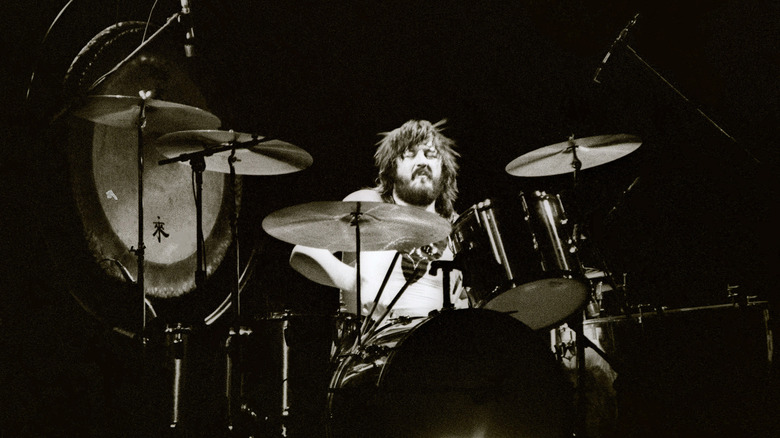
Some single performances are so exceptional and influential in their time that they become part of their craft's foundation going forward. And when it comes to drumming, one of those foundational performances is John Bonham's history-making drum solo on Led Zeppelin's "Moby Dick." Found at the end of "Led Zeppelin II," the original version — just over 4 minutes long, with only minimal padding from the blues grooves that bookend it — is a tour de force on its own. But its live counterparts expand it to a cosmic level, sometimes running over 30 minutes in length.
Bonham's incredibly dynamic work on "Moby Dick" employs a range of techniques from his signature alternating hand-foot triplets to even hand-drumming his set. Unsurprisingly, it has been praised extensively as one of the best drum solos in rock history. Likewise, Bonham's approach to drumming has been cited as an inspiration by one accomplished drummer after the next, from Dave Grohl to Lars Ulrich to Queen's Roger Taylor.. There's little doubt that "Moby Dick" helped change rock drumming forever, and here, we'll explore how it came to be and why it had such an impact — without going over 30 minutes.
The Moby Dick solo stitched together multiple takes
Firstly, to dispel a bit of the song's mystique, the recorded version of "Moby Dick" off of "Led Zeppelin II" is a combination of different takes stitched together to appear like one continuous solo. Now to recast the spell: Although the four-minute version was a studio Frankenstein, live versions like the 15-minute performance filmed live at the Royal Albert Hall in 1970 — one of the best concerts that year — clearly demonstrate that the editing was merely a stylistic choice. John Bonham can deliver, and that is further evidenced by the fact that Bonzo improvised the takes that comprised the album version of "Moby Dick."
The song was originally known as "Pat's Delight," but given that the drum licks were improvised anew every time, the only real throughline between "Moby Dick" and its earliest origins is the general idea to give Bonham a dedicated drum solo. It was Jimmy Page in his role as band producer who helped pick and choose which bits of which of Bonham's improvisations fit together best. He evidently chose well, as the stitching of the various takes was so good as to be virtually seamless on the final recording. As it was tracked recorded one little moment after another, "Moby Dick" in its final form is a bit like a sampling of Bonham himself — not at any one point, but overall.
Bonham's showmanship brought the solo to new heights live
Although the album version of "Moby Dick" still gives us chills whenever we listen, it's the live versions that showcase the song in its full, almost primal glory. Though relatively few recordings exist for a band of Zepp's stature, the aforementioned Royal Albert Hall performance is ample indication of the heights Bonham could reach when given enough runway. In a piece for Louder, Chris Welch, who watched a rendition of "Moby Dick" stage-side, wrote about the solo's evolution into ever-grander forms: "John flew around the drums with astounding dexterity and brute strength ... Then it was bare hands, beaters, gongs and cymbals for the tumultuous climax. John realised not everybody liked drum solos, and to keep their attention, he worked out a whole series of permutations."
That showmanship is a big part of the reason for the solo's acclaim. Bonham showcased his talent in a way that made it earn the center stage. Whether it was instinctual or the result of active planning, Bonham structured his "Moby Dick" solos into something varied but coherent, with the crests and troughs and tension and release of a story. After a flurry of those constantly-iterating triplets, Bonham might quiet things down by tossing his sticks and drumming his kit like it was all bongos, only to slam back into the closing blues riff with the full band. Bonham's work on "Moby Dick" helped make drum solos not just an accessory but also a center point to rock recordings and concerts, and in that way, changed rock history.