

The 1964 Van Morrison Song Patti Smith Turned Into A Punk Rock Classic
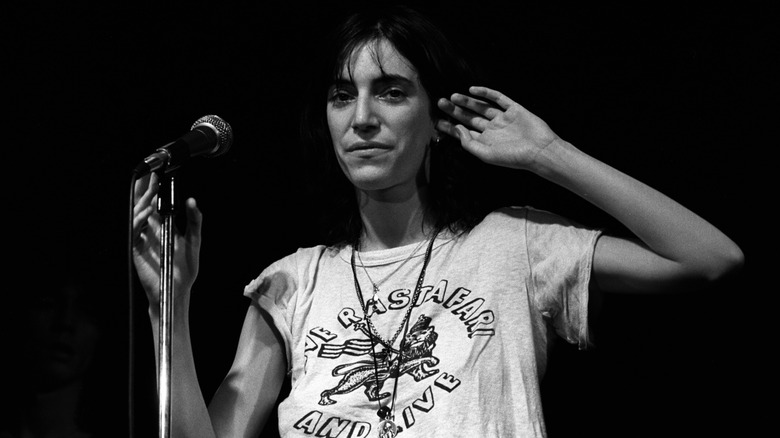
Before punk was a uniform — before the leather jackets, liberty spikes, chains, and safety pins — it was subversive street art and literature. It was Patti Smith moaning "Jesus died for somebody's sins but not mine" on "Gloria," the first song off her 1975 debut album "Horses." But that song's bones, including its three-chord riff and chorus, come from Van Morrison. His gritty, bluesier version, released with his band Them in 1964, represented the rock 'n' roll rebellion of a different era. Still, the danger and abandon of his original made it appealing to Smith and her bandmates, and it became the perfect vessel for the Patti Smith Group's emerging sound.
Over the years, other groups, the Doors among them, performed the song, but there's never been anything like Smith's take on it. Her reimagining of Morrison's classic tune remains by far the most gut-wrenching, inventive, and impactful; one of those '70s songs that sound even cooler today than they did in their time. "By the improvised end of 'Gloria,'" she writes of an early performance in her memoir "Just Kids," "we had unfurled ourselves." As she mapped her poetry onto the classic material, Smith recast it in her image and made it her own. And her band, always inventive, ensured that their opening salvo became iconic and unforgettable.
All that glitters is Gloria
Them's "Gloria" predates the Ramones, the CBGB nightclub, and the punk scene that produced Patti Smith by over a decade, yet you can hear some of the genre's DNA in it. That's mainly thanks to Van Morrison's gritty vocals: The way he rasps and snarls through his lyrics about desire and the excitement of seeing a lover at midnight makes the song almost menacing. Add a little distortion and speed up its repeating chord structure, and you'd get a decent facsimile of a Ramones or Stooges tune.
"Gloria" was originally released as a B-side to Them's cover of Big Joe Williams' "Baby Please Don't Go," which peaked at No. 10 on the U.K. Singles charts in 1965. In the U.S., a somewhat more restrained version by the Shadows of Knight— basically Chicago's answer to the British Invasion — climbed to No. 10 on the Billboard Hot 100. The Doors also breathed life into the song, and "Gloria" became a part of their live set; in 1983 — 12 years after front man Jim Morrison's death— a live recording reached No. 18 on Billboard's Hot Mainstream Tracks charts.
Each artist freely took liberties with the lyrics of "Gloria." Van Morrison's "And then she comes to my room" turns into the less suggestive "Then she call out my name" in the Shadows of Knight rendition. However, the brilliance of Smith's version is that, as she incorporated her lyrics and his, she introduced new layers of meaning, dressing up its bluesy garage rock roots in artsy rags, urban bohemia, and a fistfight with Jesus to create one of the songs from 1975 that defined rock history.
Punk's new oath
For Patti Smith and her band, "Gloria" was an entry point. In "Just Kids," she recalls how the song's simple structure became a kind of cradle for their artistic vision. Strumming the first chord of the song inspired her to recite lines from "Oath," a poem she'd written about losing her childhood faith in God. "[T]he marriage of the chords with this poem excited me," she writes, "Three chords merged with the power of the word." The iconic opening line, Smith noted, was written "as a declaration of existence, as a vow to take responsibility for my own actions."
From there, she turned a song about desire into one about longing and memory. In her fourth verse (the original only has three), the narrator is pining for Gloria while lost in a crowd of thousands, alienated: "I let my eyes rise to the big tower clock / And I heard those bells chiming in my heart / ... / Calling the time when you came to my room." In the original, the narrator is excited about seeing his love again, declaring his emotions; in Smith's retelling, we've got nothing left but memories.
Smith's "Gloria" is iconic in part because it's formative to punk rock — and a product of the legendary CBGBs scene — without fully sounding like it. Released before the Ramones and Sex Pistols made simple, fast, and loud guitar rock the genre's primary vehicle, the song is driven by piano, building to its furious crescendo rather than erupting after a quick "1-2-3-4." But precisely because it sounded like nothing else coming out in its time, because it's rock 'n' roll as art and poetry, and because it shakes a fist at the sky, "Gloria" is pure punk.