

Commonly Misunderstood Bee Gees' Lyrics You May Be Singing Wrong
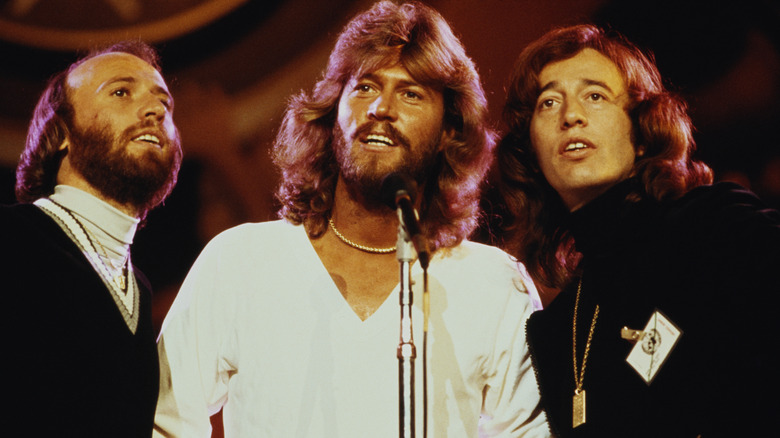
The Bee Gees are among the most misinterpreted bands in rock 'n' roll history; their lyrics have historically and continue to baffle even fans. Founded by brothers Barry, Robin, and Maurice Gibb, the Bee Gees scored the most No. 1 hits of the '70s, but it would seem that at the time, when those songs came on the radio or over the speakers at the discotheque, many of the people who sang along didn't get a lot of the lyrics anywhere near correct. It's hard to find fault with those individuals, as the Bee Gees' vocals can be hard to make out. The "Saturday Night Fever" disco hits and beyond featured upper-register harmonies and garbled falsetto, and its pre-dance music folk-inspired rock employed walls of voice-obscuring sound.
Some Bee Gees songs, spanning across all eras of the long-standing band, are even harder to understand than others. Here then are the Bee Gees lyrics you might not be correct about, which rank among the most commonly misunderstood lyrics of all time.
Lonely Days
By 1971, the Bee Gees were just a few years into their status as an international hit-making collective, and that year, the harmony-powered folk-pop lament "Lonely Days" soared to No. 3 on the U.S. pop chart. The blunt title should've made it pretty clear what the Bee Gees were going for in "Lonely Days," as the song is a self-loathing musical mope from a guy missing his one true love. The common lyrical misreads come across as inappropriate and absurd. "Lonely Days" opens with a hello to the world: "Good morning, Mr. Sunshine, you brighten up my day." A few Bee Gees fans thought the Gibbs were attacking the sun, as in "you blighted up my day."
A few lines later, the sad lyrics state, "I see you every morning / outside the restaurants / the music plays so nonchalant." Listeners thought the Bee Gees sang "outside the rest of lawns" and that the music plays "so long, shalom" or "so none shall want." A persistent refrain in "Lonely Days" is the rhetorical question, "Where would I be without my woman?" It would be a much stranger song if listeners' wrong reads were right. Some thought the Bee Gees wondered where they'd be without "a Roman," "an omen," "my moment," "my moron," my Lola," "my wombat," or "my robot."
Jive Talkin'
Their ultimately successful rebrand as a disco act began in earnest when the Bee Gees issued the chugging and quite funky "Jive Talkin'," which ascended to No. 1 for two weeks in the summer of 1975. Ironically, to talk jive means to spout nonsense, and that's exactly what "Jive Talkin'" listeners have admitted to hearing. Perhaps "jive" was such a new or unfamiliar slang term to such wide swaths of the population that their brains just didn't recognize it, and they filled in the cognitive holes with better-known words, even if they didn't make much sense.
Some silly stand-ins for "jive talkin'" include "dry donkey," "giant doggie," "time doggie," "crash diet," "gyrating," "trash talkin'," and "child talkin'." Even if listeners did get the "jive talkin'" part of the song correct, many didn't altogether understand the next part of the line. As written, it's "jive talkin' / you're telling me lies." The resolution isn't "strawberry pie," "shake to the right," "it's all very fine," or "'til 10 in the night."
How Deep Is Your Love
The Bee Gees' first single from the "Saturday Night Fever" soundtrack, the dreamy and romantic "How Deep Is Your Love" spent three weeks at No. 1 in late 1977 and early 1978. But maybe "How Deep Is Your Love" is just too captivating, transcendent, and floaty because numerous listeners got so caught up in the song's vibes that they didn't hear the lyrics correctly and have been muttering the wrong words to themselves whenever they hear it for nearly 50 years.
So many plaintive and heartfelt statements from the Gibb brothers get lost upon execution. Just before the chorus kicks in, they evocatively sing of a lover: "And you come to be on a summer breeze." The nature of the vehicle was subject to widespread speculation, with Bee Gees fans hearing "submarine," "summary," "your Vaseline," "a stump of cheese," or "sulfur brisket." The chorus kicks off with the band imploring the subject, "And it's me you need to show / how deep is your love." The delivery is so high-pitched and breathy that it's not enunciated well enough, and so it's been misheard as "it's me you need to shave" or "shove." In the chorus, the Bee Gees argue to choose love "'cause we're livin' in a world of fools." Or, as a few Bee Gees fans assumed, it's actually a world of "ghouls," "prunes," "booze," "poo," "worms," "drool," "goose," or "domes."
More Than a Woman
The Gibb brothers collectively wrote "More Than a Woman" and included their recording on the "Saturday Night Fever" soundtrack. But the Bee Gees' version wasn't the hit; the take by R&B family group Tavares on the same album reached the Top 40. Perhaps the cover was more accessible or lyrically coherent to the average late 1970s radio listener because the Bee Gees' track created a lot of confusion and bafflement.
The main line of the chorus reflects the title: "more than a woman to me." Performed in tight harmony in high notes with a lot of strings in the mix, the lyric got muddled up to the point where numerous listeners thought the Bee Gees had paid tribute to a "bald-headed woman." Other reads of that lyric run from the serious and sensical to the utterly ridiculous. But the Bee Gees simply didn't record a disco classic about a "blonde-headed woman," "hard-hatted woman," "boneheaded woman," "bow-legged woman," "leather woman," "banana woman," "four-letter woman," "four-handed woman," or "one-handed woman." Nor is the song about a "four-legged," "Montana," "nomadic," "strawberry," "mulberry," or "poor little" woman.
Alone
Among the best Bee Gees songs that aren't "Stayin' Alive" or "How Deep Is Your Love" is "Alone," an unlikely comeback hit for the trio in 1997 that arrived about 20 years after "Saturday Night Fever" made the group disco standard-bearers. A clearly earnest mid-tempo ballad, enough people bought and listened to "Alone" to send it to No. 28 on the pop chart, but a great many listeners still didn't know the real words.
The emotional crux of "Alone" comes on the titular line upon which the chorus is built: "And I don't want to be alone." Lead vocalist Barry Gibb does slightly slur his phrasing there, resulting in people hearing the line as "And I don't want to be a gnome." In discussing feelings of vulnerability and best-laid plans going awry in the verses, Gibb declares, "I was a midnight rider on a cloud of smoke." Some thought Gibb was boasting, "I stored s***loads of saliva" or that he was "a big-time writer," "a minicab driver," or "in 'Knight Rider.'" Just after, the singer states, "I was an iron man / I had a master plan." Plenty thought he was referring to "a man named Dan" or "a mighty man" who had that plan.