

The No. 1 Song On August 16, 1992 Sounds Even More Nostalgic Today
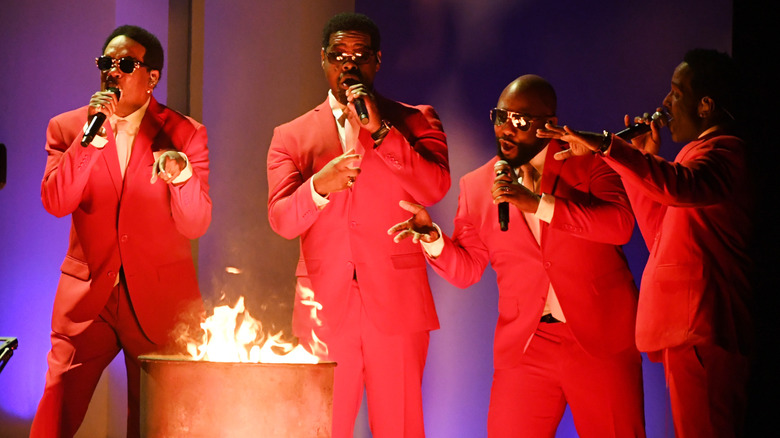
Though the early '90s are often associated with grunge rock and gangsta rap — music that channels rage and anger — this era also saw an explosion of smooth and soulful R&B. With gorgeous doo-wop harmonies and slick hip-hop production, Boys II Men led the charge, carrying the torch of classic soul artists from their hometown of Philadelphia into a new era. That blend of old school and new helped make the quartet's "End of the Road" the No. 1 hit song on August 16, 1992 and a timeless, nostalgic classic.
If you went to middle or high school dances, listened to the radio, or watched MTV in this time, you simply couldn't escape "End of the Road." Few can resist this breakup ballad, and for Gen Xers and older millennials, it's among the songs that take them back to their first crush. By the time Nathan Morris, Wanya Morris, Shawn Stockman, and Michael McCary hit their shimmering four-part harmonies in the chorus — "Although we've come to the end of the road / Still, I can't let go" — you can't help but be carried away.
Thanks to its mix of classic soul, R&B, and gospel, "End of the Road" already sounded a little nostalgic in 1992. But over 30 years on, it's even more so. With every listen, fans go back to a time when love was everything and a breakup was the end of a universe. Sounding cooler with every listen, it's bound to make you think of the one that broke your heart.
Boys II Men and the Philadelphia sound
Within around four years of forming in Philadelphia's High School for Creative and Performing Arts in 1987, Boys II Men crashed the charts with their debut single "Motownphilly," which reached No. 3 on the Billboard Hot 100. That new jack swing-era song announces their arrival, blasting into the spotlight "[l]ive and direct from Philly town." The quartet was putting their city back on the map.
"End of the Road" channels Boys II Men's home in a different way. In the late '60s and early '70s, the City of Brotherly Love fostered its own brand of R&B: Philly soul. Vocal groups like the O'Jays and the Delfonics produced songs with sweeping string or horn arrangements, infectious grooves, and passionate singing. "We were fortunate to have that type of music and that type of history at our disposal while we were growing up," Shawn Stockman told The Gainesville Sun. "If that music wasn't on the radio, then our parents were playing it at home."
Put on Harold Melvin & the Blue Notes' 1972 classic "If You Don't Know Me By Now," and you can hear Philly soul's imprint on Boys II Men. Its mellow grooves and luscious harmonies become the bedrock for emotions to swell, soar, and explode, anticipating the arc of "End of the Road." "Girl, each time I try, I just break down and cry / Pain in my head, oh, I'd rather be dead," Wanya Morris sings in the pre-chorus, turning love into a matter of life and death. Building on their Philly roots, Boys II Men produced a breakup song that hurts so good it will never leave our playlist.
Breaking Records and briefly beating the King

When singer and songwriter Babyface (aka Kenneth Brian Edmonds) was working on "End of the Road" with producers L.A. Reid and Daryl Simons, he wasn't sure he had a hit. "As it was being written, I kept thinking, 'This is a bad song,'" he recalled in the "Billboard Book of Number 1 Hits." But then he had the epiphany to hand it to Boys II Men. Wanya Morris had no doubts, recalling in a Billboard interview, "[A]ll we knew was, if they give us this record, we're gonna' sing it like Boyz II Men sings it."
With vocals recorded in a quick, three-hour session between concerts, "End of a Road" was featured on the soundtrack of the Eddie Murphy-starring comedy "Boomerang." After that album climbed to No. 4 on the Billboard charts, Boys II Men's label Motown realized what they had on their hands. The rereleased version of their debut album "Cooleyhighharmony," with the song as a bonus track, sold over 9 million copies.
The single of "End of the Road" sat at the top of the Billboard Hot 100 charts for 13 weeks, breaking a 36-year-old record for longest-running No. 1 set by Elvis. Though Whitney Houston's "I Will Always Love You" bested that total when it hit No. 1 two weeks after that run ended, Boys II Men had become a behemoth. If you remember "End of the Road" from 1992, you'll probably spin it at your 50-year high school reunion. No matter when you were born, it stirs up emotions as if designed in a lab to make you cry.