

5 Rock Songs You Didn't Know Were Based On Books
Rock fans often get a bum rap for being illiterate. Well, we may not earn many grammar points for lamenting that we "can't get no satisfaction" or "we don't need no education," but there's a treasure trove of rock songs and albums inspired by great works of literature. The rock poets of every generation have a rich history of drawing on classic novels, often finding a new spark of passion or theatrical urgency that's not readily apparent just from a standard reading.
Whether its British heavy metal pioneers Iron Maiden conquering the arid deserts of Arrakis in a song inspired by "Dune," or prog legends Rush drawing inspiration from Ayn Rand for a track about standing tall against the overwhelming demands of the collective, we wanted to take a look at some of the classic rock anthems that pay homage to the printed word. Here's to the backbeat poets who make all that stunning prose jump off the page.
To Tame a Land — Iron Maiden
For all of their headbanging, fist-pumping fury, Iron Maiden is a band of readers. The challenge lies not in finding one example of a Maiden song inspired by literature but in choosing from the vast library of titles that come to mind, from "The Rime of the Ancient Mariner" to the Tennyson-inspired "The Trooper." But "To Tame a Land" is of particular interest. Based on Frank Herbert's 1965 masterpiece "Dune," the song dives into a modern literary classic with Iron Maiden's signature anthemic gusto. The story of Paul Atreides, a young noble whose family travels to the titular desert planet to take over production of a mysterious resource, unfolds against a background of eastern-sounding guitar riffs. In only a few short verses, the band succeeds in giving Paul's ascension to planetary messiah the kind of depth and gravitas that the source material slow-burns over hundreds of pages.
Frank Herbert himself famously refused to grant the band permission to call the track "Dune," with lead singer Bruce Dickinson going so far as to claim the author threatened legal action against them. Undeterred, Iron Maiden soldiered on with a new song title, and another entry in the vast library of their hard-rocking intellectualism.
2112 — Rush
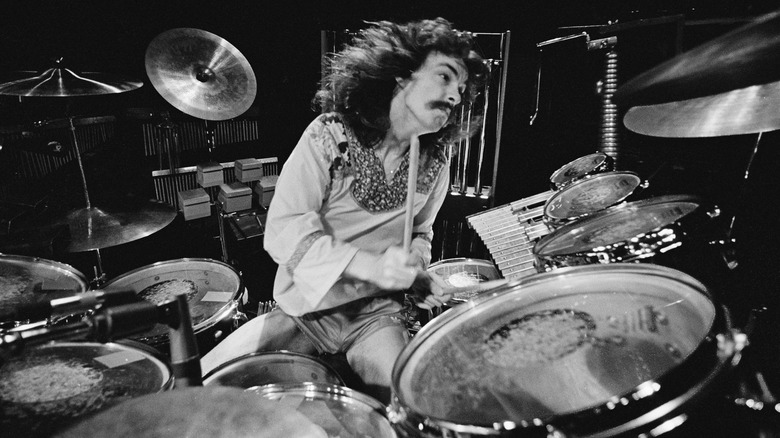
Rush's first three albums increasingly fused their passions for heavy metal and progressive rock but did not yield the sales figures envisioned by their music industry overlords. Anticipating that their fourth album would be their last, the band decided to go out defiantly and with heads held high rather than bow to label pressure to turn in radio-friendly fare. To that end, they released "2112," a dense, multilayered progressive rock concept album that opened with the titular 20-minute epic, in 1976.
For inspiration, drummer and lyricist Neil Peart turned to the ultimate individualist, Ayn Rand. A survivor of Communist Russia, Rand's ongoing theme of the noble outsider standing strong against the collective permeated her novels and her philosophy of Objectivism. Peart found particular inspiration in "Anthem," Rand's 1937 novella that describes a future world so consumed by collectivism that singular pronouns have been eliminated. Both Rand's original and Peart's adaptation tell of brave souls who present technological innovations to an ominous high council, only to face severe punishment. The parallels were so overt that Peart acknowledged Rand in the album's liner notes.
That said, there are differences: Rand's hero invents an electric light bulb, while the protagonist of "2112" discovers a long-lost electric guitar, and Rand's story has a far more optimistic ending. The album was a massive success for Rush, propelling the band to bona fide rock stardom even as association with the controversial author led them to face down accusations of political extremism.
Rocket Man — Elton John
At first glance, Elton John's "Rocket Man" occupies the same conceptual headspace as John Denver's "Leaving on a Jet Plane" or Wyclef Jean's "Gone 'til November": songs about long-distance travel and the melancholy of prolonged detachment from loved ones. But where Jean and Denver remain bound to their home world, Sir Elton is reaching for the stars, and there's darker implications to that than a mere metaphor. Lyricist Bernie Taupin drew the song's inspiration from the Ray Bradbury short story "The Rocket Man," a part of his 1951 collection "The Illustrated Man."
Bradbury's original short story tells a somber tale of an intergalactic laborer who grows increasingly morose during his long absences, torn between his work in outer space and his family on Earth. The central crux of the narrative is not simply a family man who misses the comforts of home but a soul torn in two directions, wondering whether the domestic dad or the interplanetary adventurer is his true self. Seen in that light, lyrics like "I'm not the man they think I am at home" take on a whole new dimension.
Scentless Apprentice — Nirvana
"Scentless Apprentice," the second track off Nirvana's 1993 album "In Utero," is based on Kurt Cobain's favorite novel, "Perfume" by Patrick Süskind. A historical fantasy set in the 1700s, the novel follows the life of a brilliant young perfumer who has no body odor of his own (hence the song title). It is a sinister tale of obsession and inner turmoil, one that Cobain captures viscerally in the song's unrestrained noise rock.
By that point, Cobain's identity as the slacker poet king of the grunge generation was firmly enshrined. He had already collaborated with beatnik legend William S. Burroughs, providing guitar instrumental backing for the spoken-word recording "The 'Priest' They Called Him." Cobain's own lyrics painted dark portraits of conflicted characters, such as the coldly detached protagonist of "Polly," showing real literary merit beneath the flannel shirt and chronically unkempt hair.
Released in late September 1993, less than two months before the filming of the group's iconic "MTV Unplugged" episode, "In Utero" was a rough, noisy, sonically obtuse affair that saw the trio deliberately disowning their pop sensibilities for something closer to the brutal sonic experimentation of their underground roots. As such, "Scentless Apprentice" fits nicely into the album's concept both lyrically and musically. It is a story of the inner turmoil of a destructive personality, a common undercurrent for "In Utero" and Nirvana at large.
I Robot — The Alan Parsons Project
It's a real shame that Isaac Asimov's science fiction milestone "I, Robot" seems to mainly exist in the public consciousness as a boneheaded Will Smith action movie with little connection to its rich, thought-provoking source material. But modern cultural stumbling blocks aside, Asimov's original short story collection has captured the imaginations of countless science fiction enthusiasts, prog rock mastermind Alan Parsons outstanding among them.
Fresh off his titular band's debut album "Tales of Mystery and Imagination" (which was itself an homage to the works of Edgar Allan Poe), Parsons uses the source material not as a literal narrative but rather as a reference point for songs that examine the ominous nature of evolving technology and the implications for our humanity. In an era filled with speculation about how AI could destroy the world, such ruminations seem all the more relevant in the almost 50 years since the album's release.
But even beyond that fearful, dystopian vision, "I Robot" — Parsons dropped the comma from the title because of rights issues — is a sonic world of synthesizers in dialogue with electric guitars, with unrelenting funk and R&B grooves holding it all together. The title track is a stone groove instrumental with hip futurist overtones, and it only goes deeper from there. The exploratory but always infectiously melodic journey of "I Robot" goes a long way to prove that Parsons was more than just the composer of one of those rock songs you've definitely heard but probably couldn't name.