

5 Folk Rock Hits That Prove Acoustic Guitars Can Still Rock A Stadium
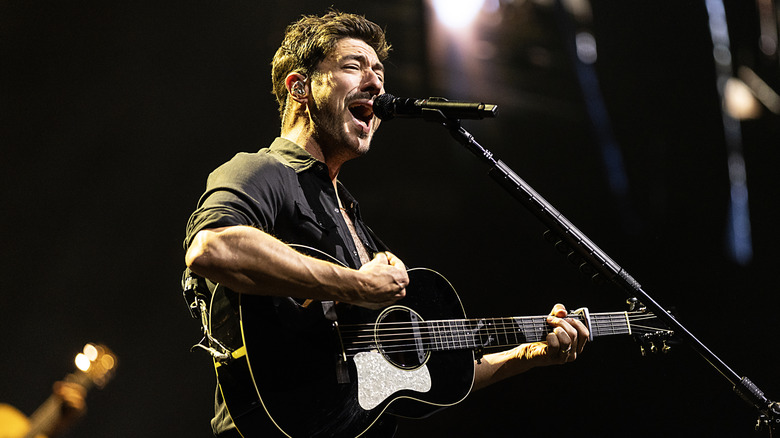
Despite folk rock reaching its peak in the mid-'60s, there are plenty of contemporary folk rock bands still shaking stadium shows with their acoustic guitars. The idea that this feedback-free instrument is only good for staid classical passages and easygoing campfire tunes has long been blown away, following decades of pioneering players who pushed the limits of what six strings and a sound hole can achieve. It turns out that when you apply enough gumption and play with as much passion as the electric guitar players do, you can cause as much of a ruckus as any plugged-in rock band.
Certain folk rock songs became hits by showing off just how much power you can put behind acoustic guitar and other instruments, creating songs that balance a tender heart with a swinging fist. Artists like Indigo Girls and Tracy Chapman helped get the party started, opening doors for 21st-century folksters to expand the melodic clamor. And there's always room in the arena for a classic Simon and Garfunkel track, those folk rock granddaddies who set the tone and showed how the genre can climb from a whisper to a scream without abandoning their acoustic ambitions.
Closer to Fine — Indigo Girls
A high-energy contemplation about loosening your grip on life, "Closer to Fine" is a joyous celebration of life's okay-ness that introduced the folk stylings of Indigo Girls to the mainstream music world. Amy Ray and Emily Saliers updated the concept of the folk singer, infusing their music with a keen literary sensibility and unplugged arrangements that rocked and bounced without the need for crackling feedback.
The song rose to No. 52 on the Billboard Hot 100 when it showed up in 1989 — a solid chart debut for a folk act at the time — and as one of the tracks on their self-titled LP from that year, helped the Indigo Girls snag a Grammy for best contemporary folk album. The tune also reached well beyond its era, becoming a sing-along favorite in films like the John Krasinski-directed family movie "The Hollars" and the Oscar-winning blockbuster "Barbie" as a contemplative jangler that gives melody to characters' watershed moments.
The Indigo Girls have pushed through the changing musical tides, adding new textures and colors but holding steady to the folk music idiom they started with. "Closer to Fine" has remained a linchpin in their musical sets, reminding old and new fans alike that an acoustic guitar can send rocking strains of rapturous sound soaring through the rafters.
The Boxer — Simon & Garfunkel
The quiet passages in the Top 10 folk rock classic "The Boxer" are a feint that lets the ultimate '60s duo Simon & Garfunkel lull listeners into a false sense of safety. Simon's lyrics paint a sepia-toned portrait of a loner making his way in the big city. The slow unraveling of the main character is mirrored in the gentle instrumentation, which gets more and more raucous as the emotional stakes ramp up. It reaches a pinnacle that puts acoustic guitars and chamber instruments in the center of a maelstrom that rocks hard enough to blow your hair back.
The song has the lyrical soul of a short story, with verses that describe a humble rural worker attempting to keep his head above water. "Asking only workman's wages / I come lookin' for a job but I get no offers." It's all gentle jangle behind the words until the vocalized "Lie la lie" chorus comes crashing like an emotional cave-in. The drums thunder, the guitars strum harder, and the tension simmering under the surface comes barreling out.
The extended repeat of this rocking combination becomes mesmerizing, whipping the emotional landscape into a frenzy again and again like a pugilist delivering a barrage of punches, until it settles back down to where it began. The combination was a game-changer for folk rock and opened the doors for all sorts of sonic experiments that let the ordinarily subdued acoustic guitar out of its cage.
Fast Car — Tracy Chapman
Tracy Chapman showed up on the circuit when folk music was having a late-'80s resurgence, led by her searing portrait of inner-city struggles, "Fast Car." The song was pop enough to resonate with radio listeners, but folk enough to remind fans of the genre just how powerful an acoustic guitar and a strong voice could be. Add to those essentials a sober, lyrical tale of the working-class desire for a better life inspired by Chapman's Cleveland upbringing, and she conjured up a familiar recipe from the folk cookbook, with seasoning distinctive enough to signal that a new chef was in the kitchen. The fact that she could rock with the best of the old guard was a tasty bonus.
In 2023, Luke Combs released a highly successful remake that leaned into the more country-sounding layers and became a No. 1 country hit and a No. 2 sparkler for 19 weeks on the Billboard Hot 100. It bested the original's No. 6 placement back in 1988 and reminded the world of how powerful a songwriter and performer Chapman is. A shared performance between Chapman and Combs on the 2024 Grammy Awards broadcast brought the room to its feet while giving rocking acoustic guitar strains a much-deserved spotlight.
Home — Edward Sharpe and the Magnetic Zeros
When the stomp-and-clap motif started taking over folk-rock in the early 2000s, Edward Sharpe and the Magnetic Zeros showed up to add gritty authenticity, and this new folk collective recalled the great tradition that set the table for their down-home sound. Even the lyrics are a call-out to the Southern spirit of this musical mode: "Alabama, Arkansas, I do love my Ma and Pa / Not the way that I do love you." You can practically smell the hay and the bonfire smoke from the barn dance scene that the song inspires.
"Home" hit No. 25 on the Billboard Alternative chart in 2010 and helped secure a spot for the band at the 2013 Governor's Ball in New York. It also led to some social media silliness 15 years later, when an X user called it the worst song ever. Regardless, the song had set the stage for the band's future success, which included placing their 2012 follow-up album at No. 1 on the Independent Music Chart, as well as landing at No. 5 on the Billboard Hot 200. It's also one of those insidious folk rock howlers that get stuck in your head like nobody's business.
Little Lion Man — Mumford & Sons
Mumford & Sons bravely stepped into the folk rock ring in 2010 with their debut single "Little Lion Man" and proved that acoustic guitars, banjos, and a standing bass could rock as hard as any electrified combo. All it took was a quicker pace and a stronger strum to get the party started. Marcus Mumford singing about false strength and dropping the ultimate in swear words in the chorus showed off the swagger of a self-assured rock star with a decidedly bluegrass character. The final refrain steps up the pace like a frenzied barn dance, inviting hand claps and head bobs from anyone lucky enough to be within earshot. Then it all comes to an acapella close out with roughhewn harmonies that feel like a whiskey shot warming you from the inside.
"Little Lion Man" made a searing impression; it topped Billboard's Alternative Airplay chart and turned out to be the start of a five-single run, in which the lead song from each of the band's albums reached No. 1. A few years later, Mumford & Sons would achieve a status only the Beatles had pulled off prior: Six singles from their album "Babel" were on the Hot 100 simultaneously, all with similarly fiery instrumentation. Not bad for a group that started as somebody else's backing band. It turns out "Little Lion Man" had the right spark to set off a folk rock inferno, with rocking acoustic guitar tones feeding the flames.