

5 John Bonham Drum Solos That Deserve A Place In Rock History
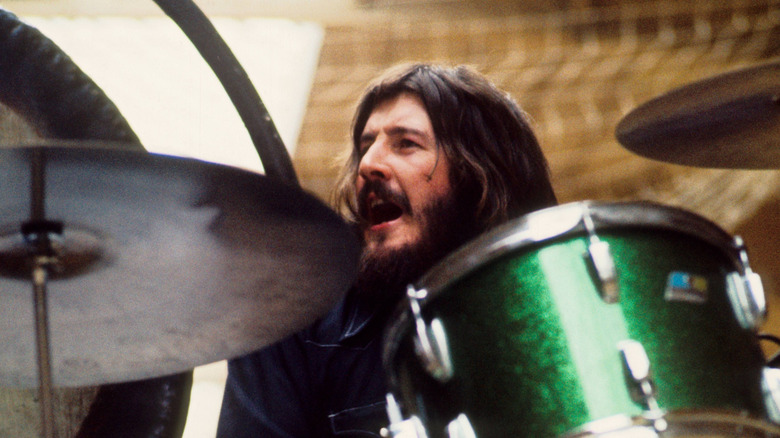
Picking five John Bonham drum solos is trickier than it sounds because it is largely the same piece ("Moby Dick") performed time and time again, running anywhere from six minutes to a staggering 30 minutes. Whether he was changing up the pacing, adding a little razzle dazzle (like kettledrums or an "Out on the Tiles" intro swap), or extending the entire thing by 20 minutes, John Bonham knew how to build and stack new sounds and techniques onto his already established style.
As recorded in the first book-length account of Bonham's life, John Bonham: A Thunder of Drums written by Chris Welch and Geoff Nicholls, he taught himself to play the drums at the age of five on pots, pans, and coffee tins before his parents finally bought him a real kit 10 years later. He later spent his teens playing in various local bands, teaching himself to drum by ear and imitating his favorite jazz artists like Gene Krupa and Buddy Rich. By 1968, Bonham had crossed paths with Robert Plant, and was brought into Led Zeppelin. Over the band's 12-year run, Bonham earned the reputation as one of the most technically advanced and hardest-hitting drummers in rock 'n' roll. Bonham's tragic death in 1980 also resulted in the end of Led Zeppelin, but his legacy lives on, influencing nearly every future rock drummer that came after him.
In 2016, Rolling Stone named Bonham No.1 on their "100 Greatest Drummers of All Time" list, ranking him ahead of Ginger Baker, Keith Moon, and Neil Peart.
The Studio Original
Before it became an eight — then 10 —and then 20-minute live showcase, "Moby Dick" was a tight, four-and-a-half-minute track built around a much longer improvised drum session that was pieced together with Jimmy Page and John Paul Jones. The track evolved out of an earlier demo Bonham did that he called "Pat's Delight," named after his wife.
Bonham's craft is beautifully captured in this recording, but what most people are missing is the pure showmanship of his drumming style. On stage, he looks like he genuinely enjoys what he does and watching him switch from using sticks on his snares and tom-tom to hand-played conga drums is something the studio album cannot demonstrate in its full glory.
Royal Albert Hall, London 1970
The show at Royal Albert Hall is the version of Bonham's stage performance people normally picture, largely because it is one that has an official release on the 2003 Led Zeppelin DVD. Bonham's solo opens with a nod to his early jazz influences and Ginger Baker's influence can also be heard throughout, as well. It is later in the solo that Bonham's signature move is put on display: a rolling triplet pattern later coined by other musicians as the "Bonham triplet."
There is one point during the solo that Bonham splits his playing between his drumsticks and his hands, until he drops his sticks completely and finishes his fill with just his bare hands. Reportedly, there were nights when Bonham came off stage with his hands covered in various cuts and blisters from his intense playing.
Madison Square Garden, New York City 1973
Aside from being performed in an iconic location, this particular show was also featured on the silver screen. Filmed across three nights for "The Song Remains the Same," this solo runs more than 10 minutes long in the final cut. This particular version of Bonham's solo is another great example of how he continued to build his stagecraft, changing his setup to include two kettledrums.
This show capped off one of the biggest tours of the band's career at that point. The official Led Zeppelin website cites an AP news article, claiming the band spent the summer of 1973 breaking ticket sale records across the U.S. with one Tampa Stadium show topping a crowd attendance record previously held by the Beatles.
Earls Court, London 1975
There were some nights Led Zeppelin performed where Bonham's solo stretched well past 20 minutes. His bombastic snare bursts and lively high-hat claps were not enough to save him from fans using his drum solo segments as a bathroom break. Many critics were not impressed with the sheer scale of Bonham's solo and thought it was a result of the band's excess and indulgence rather than a showcase of Bonham's talent. Even Keith Richards in an interview with Rolling Stone described Bonham's playing as him "thundering down the highway in an uncontrolled 18-wheeler."
Despite the drum solo stretching to unheard of lengths, one could argue it was simply John Bonham rising to the occasion for such a grand return to the U.K. after not having performed in London since 1973.
North American Tour 1977
This 17-minute-long stretch of "Moby Dick" was dedicated to Bonham's son who was reportedly watching, along with Jimmy Page, Robert Plant, and John Paul Jones, from the side of the stage (per Far Out Magazine). What sets this particular performance apart is the portion of his solo where his traditional drum kit turns into a full on electrical synthesizer. At this point in their career, it was normal for Bonham to add all sorts of different percussion instruments to his kit, and in this case, he added electronic drum synths that he pulled out 20 minutes into his solo.
This ethereal, almost hypnotic sound builds up to a final outro where Jimmy Page rejoins him on stage to ease right back into the groove and close out the song. Bonham's heavy right-footed technique drew on the greats like Ginger Baker while still establishing his own unique and heavy style. It was both iconic and so wildly innovative that this solo, alone, secures John Bonham's place in rock history as one of the greatest drummers of all time.