

Quote Of The Day By PJ Harvey: 'I've Always Felt That I'm Affected By ...'
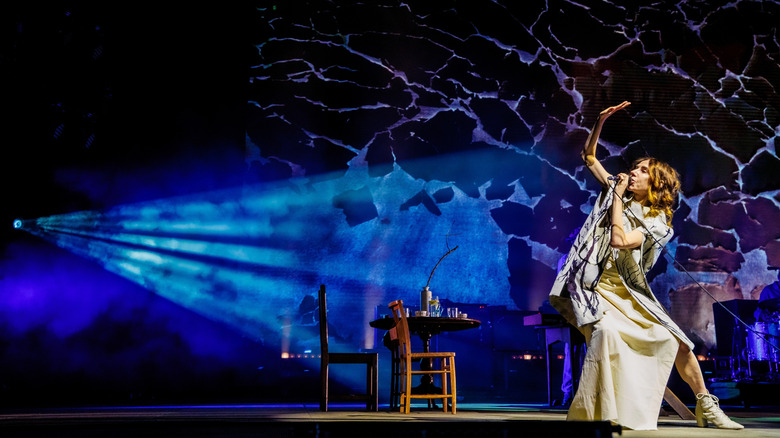
With albums that span post-punk to piano ballads and electronic downtempo, Polly Jean "PJ" Harvey has always defied simple categorization. She's never had a Billboard Hot 100 hit, though her highest-charting album, 2004's "Uh Huh Her," hit No. 29 on the Billboard 200, 11 years after her song "Rid of Me" from the album of the same name helped prove 1993 was the decade's best year for women in rock. She's also spawned a loyal, adoring fanbase. But to Harvey, she just tells the stories that she sees in response to the world.
Very much a multidisciplinary performance artist who's dipped her toes in poetry, oral recitations, and illustration, Harvey comes from a household with one foot in music and another in stone quarrying. She was raised in the village of Corscombe, England (current population: 450), took to the saxophone and guitar from a young age, and attended art school before releasing her first album in 1992, "Dry," in her early 20's. She reached more commercial visibility shortly thereafter with 1993's "Rid of Me," her rock-leaning sophomore outing, and then wandered into whatever chameleonic musical domain she wanted with each subsequent album.
This kind of artistic flexibility is always a bit difficult for some folks to wrap their heads around, even when it comes to an artist like David Bowie and his most famous looks. But Harvey is not only actively disinterested in public perception of her work; she considers each song a unique, malleable story that depends on how the listener inhabits and digests it. This insight is why she gets our quote of the day.
Quote of the Day by PJ Harvey: 'I've always felt that I'm affected by ...'
"I've always felt that I'm affected by the world, by the way we treat each other, by the way different countries treat each other," PJ Harvey told Mother Jones in 2011. More pointedly, Harvey continued, "I've always been very affected by politics, society, but I never got to a place as a writer where I felt like I could begin to deal with such things and do it well."
Context is everything with this quote, as it comes on the heels of 2011's "Let England Shake." With that album, Harvey turned her storytelling sensibilities towards what we might loosely call a "political" angle, but should more accurately call a focus on the English countryside viewed through the impact of conflict between nation states. Harvey really hadn't really addressed such a topic before in her work, and typically dealt in realms of emotional interiority.
As Harvey told Mother Jones, she took inspiration from an exhibition by war photographer Seamus Murphy, titled "A Darkness Visible," who photographed the daily lives of survivors of Afghanistan's post-9/11, protracted conflict. Harvey took this lens and turned it towards everyday people in England. Thus "Let England Shake" was born, and songs like "The Words That Maketh Murder" with lines like, "I've seen soldiers fall like lumps of meat / Blown and shot out beyond belief."
Taking Harvey's entire songwriting approach into account, one where she invites people into a world that can provide something they need to learn or understand, both her quote and "Let England Shake" make perfect sense. It all depends on the receiver of the art.
Deeper Meaning of PJ Harvey's Quote — Receptivity
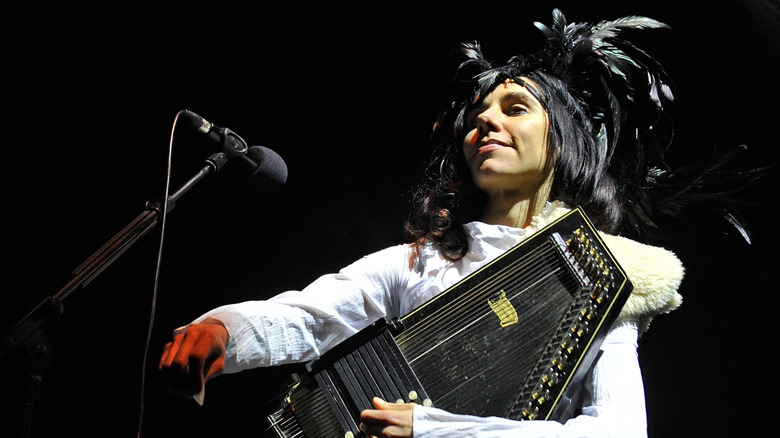
By itself, PJ Harvey's quote about being "affected by the world" is self-evident. We're all affected by the tenor of the times, the politics of the age, and conflicts between nation-states in some way, even if we're not running from explosives in active war zones. It's really the second part of her quote about getting to a place where she could address such things via art, and articulate her feelings about them, that bears closer scrutiny.
Artists have always used their work to portray feelings about historical events, especially war. That was one of the pillars of the countercultural movement of the '60s through and beyond the wild Summer of Love, including obvious examples like Creedence Clearwater Revival's "Fortunate Son" or Joni Mitchell's "Fiddle and the Drum." Cynics could dismiss all such work as idealistic nonsense, or foolish reductionism that amounts to "War is bad." Others could applaud each and every attempt to call out those in authority making decisions that put the lives of others at risk. It all depends on the listener.
More to the point, Harvey's quote points to art's person-to-person impact. She attended a gallery of Seamus Murphy's, who inspired her to make "Let England Shake," which she in turn passed along to fans. Harvey was receptive to Murphy's message, used it to come to her own conclusions, and articulated those conclusions to others in her own way. "Let England Shake" might not have brought about world peace at the snap of a finger, but it did ripple onwards. Arguably, that's the most that a piece of art could do and the most an artist could hope for.
More Quotes from PJ Harvey
- "I firmly disbelieve that one has to be a tortured soul to write good music."
- "I don't really concern myself too much with what other people make of my work."
- " ... I feel like the actual, the most beautiful thing about a song is that it is something that goes out there in the universe and people use it in the way that they need it in their lives."
- "I'm not an autobiographical writer, but I am a writer who deals with human emotion on all levels."
- "Two people can say exactly the same words, saying the same story, and it would mean something entirely different."
- " ... You shouldn't separate the piece from the way it's intended. I always feel like words shouldn't be unraveled from the music."
- "What song is not about love?"