

Rockers Who Faced Major Medical Setbacks — And Kept Rocking
As much as rock stars are entertainers first and paragons of virtue a distant second, there are some who step up and truly inspire us. Not the least among them are those who persevere in the face of major medical setbacks, proving the transformative, healing power of music and the spirit that moves those who make it. It is a sobering reality that no person — however accomplished or applauded they may be — is exempt from the effects of illness and injury. But it is also a deeply humanizing one: That the gods of our rock pantheon are as prone to medical trials and tribulations as the rest of us brings us closer to them and, in so doing, allows them to inspire us all the more.
With that in mind, we wanted to celebrate famous musicians that have had life-threatening illnesses and kept rocking hard. From an early celebrity death from AIDS to a young guitar prodigy facing the ultimate setback for a budding virtuoso, here's to the rockers who faced the ultimate in ill health and took it in stride.
Jason Becker
Sometimes illness sidelines a promising career that's only just begun. When Jason Becker was diagnosed with amyotrophic lateral sclerosis — more commonly known as Lou Gehrig's disease — he had recorded 1991's "A Little Ain't Enough" with David Lee Roth, following the departure of Steve Vai. Beforehand, he'd made a name for himself as a boy-genius guitar virtuoso, both as a solo artist and as part of Cacophony with future Megadeth guitarist Marty Friedman. The wunderkind that seemed destined to conquer the guitar world was given three to five years to live.
The condition eventually left Becker paralyzed save for the ability to move his eyes. With that in mind, his father developed a communication system built around eye movements that allowed Becker to continue composing by dictating each note to a human assistant. The laborious process yielded extraordinary results with 1996's "Perspective." Written in part while Becker was still able to compose on a computer, the album features his rock, classical, and world music brought to life by a wealth of session players, including Matt and Gregg Bissonette (bassist and drummer for David Lee Roth, respectively) and Journey's Steve Perry.
Becker would go on to continue as a composer, with his works performed by classical orchestras and rock musicians alike. As of 2026, he is alive with the help of caregivers and released another album, the critically acclaimed "Triumphant Hearts" in 2018. Expanding on his already accomplished compositional range, the album features classical, metal, and world music alongside funk, R&B, and swing jazz styles.
Freddie Mercury
Rockers the world over remember what it was like the day Freddie Mercury died. The iconic Queen front man was one of those transcendent figures; a rock god whose extraordinary vocal capacity, compositional prowess, and magnetic personality made him come off less like a lead singer so much as an emissary from another — and infinitely more fabulous — dimension. As such, the world was shocked to learn that Mercury had been living with HIV, which had progressed to AIDS, at the time of his death on November 24, 1991.
While the last 12 months of Freddie Mercury's life were removed from the public eye, he'd been living with HIV since 1987, and during that time had been determined to keep making music for as long as possible. That unconquerable resolve yielded three final albums, 1989's "The Miracle," 1991's "Innuendo," and 1995's posthumous "Made in Heaven." Though public speculation had reigned about the front man's increasingly frail physique, justification for those concerns cannot be heard in Mercury's scorching vocal performances.
Of particular note is "The Show Must Go On," a stunning testament to that iron will off "Innuendo." As guitarist Brian May told Rolling Stone, he expressed concern that Mercury's ill health would prevent him from delivering the song's ruthlessly challenging vocal parts. Undaunted, Mercury reportedly responded, "I'll f***ing do it, darling," had a vodka, and proceeded to deliver a career-defining performance full of the kind of fire and fury that only he could muster.
Melissa Etheridge
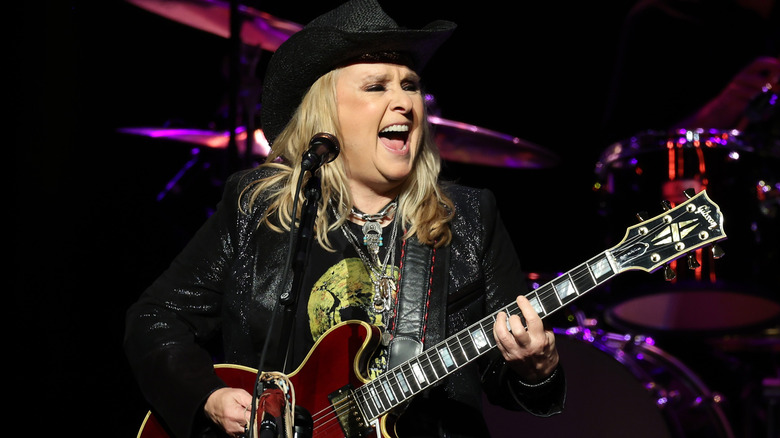
When Melissa Etheridge, rock's leading purveyor of female-fronted rootsy Americana, was diagnosed with breast cancer in 2004, it became a testament to her own unshakable spirit and to the inspirational power of her music. Already known for her LGBT advocacy, Etheridge became an outspoken supporter of women facing the condition as well as a spokesperson for healthy living practices in general.
Like so many women who deal with breast cancer, the once prolific singer/songwriter was forced to put touring life on hold so that she could focus on an intense battery of treatments and their considerable side effects. For Etheridge, the necessary vacation was an opportunity to reevaluate her life and perspective. "I got to know myself," she explained to AXS TV. "And I got to understand spirit and body and health. And I came out of that a whole new person and excited about life and about my art and dedicated to 'I'm only going to do what I love from now on.'"
That indomitable spirit soon emerged in song. Once cancer-free, Etheridge wrote the song "I Run for Life," which centers on the healing power of running after her treatments and the resiliency of the human spirit. "I run for hope / I run to feel," she enthuses in the song's euphoric chorus. "I run for the truth / For all that is real / I run for your mother your sister your wife / I run for you and me my friend / I run for life."
Rick Allen
From hardcore fans to passing listeners, most people familiar with the band know about how Def Leppard's drummer lost his arm: Rick Allen crashed his car into a wall while speeding on New Year's Eve, 1984, severing his arm when he was thrown from the vehicle. The loss was an understandable setback for the drummer after the recent success of his band's latest album, 1983's "Pyromania." With the sudden change of fortune, he was left despondent in a hospital bed, dubious about his future.
The young rockstar was coming to terms with his career being over just as it had reached its highest point yet, when a visit from friend and Def Leppard producer "Mutt" Lange brought him back around. In speaking with Allen, Lange was able to shift his focus away from the current setback and onto future possibilities. For Allen, that meant incorporating electronic drums into his kit and arranging them in a way so that parts that would require the missing limb could be played with his feet and right arm. Thus, devastation became innovation.
The reward of Allen's perseverance would be 1987's "Hysteria," the band's chart-topping, career-defining masterpiece and the fulfillment of Lange's vision for the band to produce the hard rock equivalent of Michael Jackson's "Thriller." Where the King of Pop's magnum opus had yielded seven hits, "Hysteria" produced six bona fide smashes of its own, including the band's signature classic, "Pour Some Sugar on Me."
Lemmy Kilmister
In retrospect, it only seems right that Lemmy Kilmister, bassist and front man for speed metal pioneers Motörhead, would want to die with his boots on. By the time of his diagnosis with prostate cancer in December of 2015 (just two days before his death), the mustachioed metal maven had spent decades as the seemingly indestructible face of the hard-living, full-speed-ahead rock and roll ethos.
Behind the scenes, Kilmister had been forced to reevaluate his lifestyle in the preceding year, with mounting health concerns following the release of the band's 2013 album "Aftershock." Issues with his heart and diabetes had begun to take their toll, leading to the band being forced to conclude their set at that year's Wacken Open Air Festival early. Refusing retirement even in advanced age, Lemmy adopted a new health regimen and rallied to complete what would be his band's final studio album, 2015's "Bad Magic."
Despite the strong resurgence, Kilmister experienced symptoms of what would ultimately be determined to be cancer. Undaunted, he completed the band's world tour in support of their final album, with the last date, December 11, at the Max-Schmeling-Halle in Berlin, Germany, happening only 17 days before his death on December 28, 2015.