

5 Rock Songs That Capture The Spirit Of Autumn
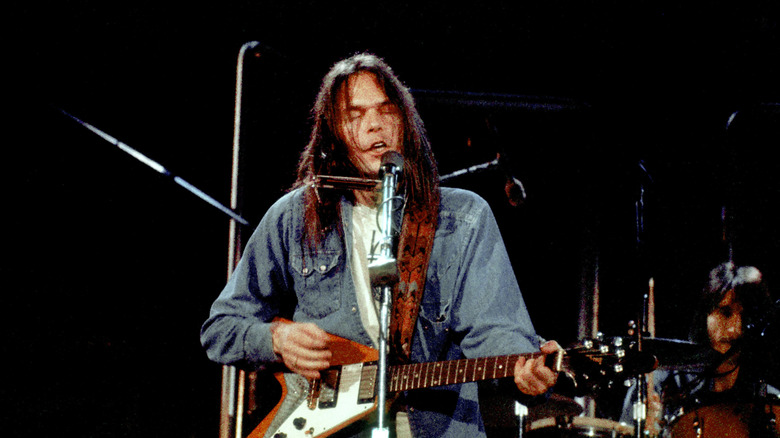
Despite temperatures dropping and nights growing shorter, for many people, autumn is a much-loved season. It's when the rich colors of the changing leaves mean it's time for warmer clothes, hot soups, pumpkin-spiced coffee, and a return to cosier activities. Autumn has also been a source of inspiration for many musicians — it signifies the passage of time and aging and contains a calm but acute feeling of melancholy. With that in mind, we've selected five of our favorite rock songs that we think summon the spirit of autumn best.
Typically, these tracks — by artists including Small Faces, Neil Young, and others — have a sense of wistful nostalgia in keeping with the end of summer and the dying off of the foliage following the last summer harvest. But others, such as a deep cut from classic rock legends the Kinks, take on a different tone, focusing on playfulness and levity. In both cases, you're bound to find some great new additions to your autumn playlist.
The Autumn Stone — Small Faces
Small Faces' "The Autumn Stone" came to serve something of a biographical role in the story of the British band, becoming part of the soundtrack to their breakup in 1969. Following the announcement that the group was dissolving, its record label, Immediate Records, quickly got to the task of issuing two compilation albums to cash in on the sad news. The first was 1969's "In Memoriam," on which "The Autumn Stone" features as the final track.
The acoustic guitar-led song was penned by the Small Faces frontman Steve Marriott and features a typically emotive lead vocal from its writer, which reminds you that the band began performing R&B and soul. It has a laid-back, reflective tone, with tasteful instrumentation that suits the song's transcendent theme of love and connection set against the inevitable passage of time. "The Autumn Stone" was rejected as a single when Small Faces was still a unit, and it's undoubtedly a hidden gem in their discography.
Harvest Moon — Neil Young
A relatively late classic in Neil Young's sprawling discography and a vinyl every diehard should own, 1992's "Harvest Moon" album is a callback to the beloved, autumnal 1972 record "Harvest." As well as revisiting the same themes, Young recruited several of the same personnel who worked on the former album, such as James Taylor and Linda Ronstadt, to play on the latter. The highlight is the title track, which became a U.K. Top 40 hit for the veteran singer-songwriter.
A beautiful song written for Young's wife at the time, Pegi, "Harvest Moon" recalls Van Morrison's "Moondance" in that it's an invitation to a lover to dance together on a romantic evening. The delicate acoustic instrumental is made especially memorable by Ben Keith's haunting recurring riff played on a lap steel guitar, as well as a beautifully melodic harmonica solo toward the end of the track that contrasts mournfully with the comparatively uplifting chorus that follows. It's a beautiful, relaxing folk rock classic that nevertheless manages to summon the deepest feelings.
The Boys of Summer — Don Henley
Despite the title of the song, it's clear from the lyrics of Don Henley's 1984 "The Boys of Summer" that the narrator is looking back over the warmer months from autumn, evoking a sense of nostalgia for days gone by — a common theme of autumnal songs. Inspired by a Dylan Thomas poem that begins "I see the boys of summer in their ruin," the track was written by Tom Petty & the Heartbreakers guitarist Mike Campbell. The end result is a reflection on the passing of youth.
Campbell initially brought the song to Petty, but the rocker turned the song down, allowing Campbell to show it to Henley. Henley was struggling in his career after the break-up of the Eagles, and with "The Boys of Summer," he had a surefire hit on his hands. The song is based around very of-the-time electronic instrumentation, including drums and synth lines, both of which still sound excellent today, despite, or perhaps because of, their immediate evocation of the 1980s. "The Boys of Summer" also features a stunning set of lyrics that sees the narrator chronicling empty streets, beaches, and lakes, noting the absence of the young people who would be there during the summer months. Yet he promises that even with the passing of time, his love will stay strong. It's an uplifting but poignant track that serves as a reminder of Henley's vocal prowess.
Autumn Sweater — Yo La Tengo
For many alternative rock fans, Yo La Tengo is one of the defining American bands of the 1990s, and "Autumn Sweater," their most popular song, gives several indications why. The decade that spawned the grunge movement was famously characterized by harsh rock performances and angry vocals. But the work of the cult New York trio typically leaned toward quieter, more nuanced performances that complement the delicate vocals of singer Ira Kaplan.
"Autumn Sweater" begins with warm, pleasing percussion that is then joined by a beautiful chord progression on the organ, performed by Kaplan, who also uses the instrument to provide the song's bassline. The beautifully straightforward track is about a couple that wants to "slip away" together soundlessly, with the partner to whom it is addressed wearing the titular garment. "Autumn Sweater" is snug and comfy as a warm pullover, and it has real nostalgic power. It's the highlight of Yo La Tengo's classic album, "I Can Hear the Heart Beating as One," and it has received a significant amount of critical acclaim since its release.
Autumn Almanac — The Kinks
"Autumn Almanac" is one of Ray Davies' masterpieces, a genre-defying pop classic that some of his contemporaries, such as XTC's Andy Partridge, considered among the greatest songs ever written. The track was released in 1967, months prior to the arrival of the classic 1968 Kinks album "The Kinks Are the Village Green Preservation Society." On that record, Davies offers deeply nostalgic work that sees him recalling childhood memories and yearning for the Britain of the past. "Autumn Almanac" certainly shares a similar space in his songbook.
The track fits the album's theme perfectly. Images of a person with a rheumatic back viewing the signs of the season and clearing away fallen leaves are balanced with descriptions of a cozy life spent enjoying everyday, working-class pastimes. However, while the choruses sound upbeat and celebratory, there is an element of regret, perhaps, in the deployment of minor chords and the narrator describing how they can never leave home: "And I can't get away / Because it's calling me, come home." The arrangement provides constant surprises, revealing Davies' genius for multi-faceted songs that are emotionally rich and insightful.